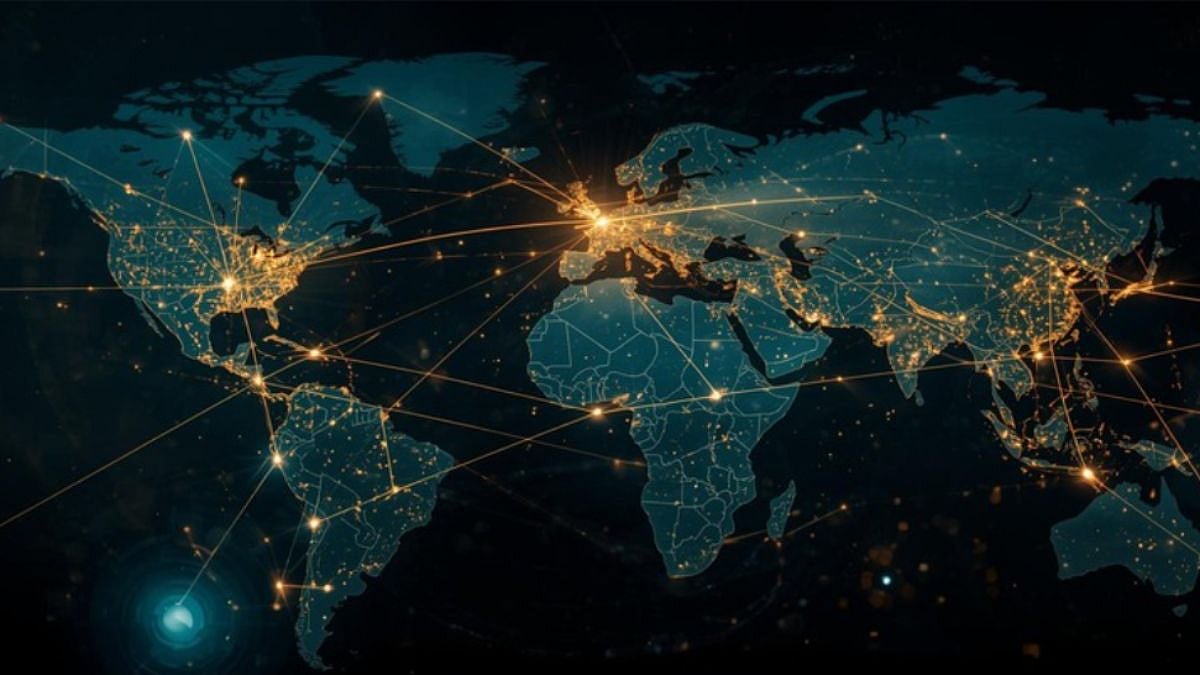
World politics is facing a new defining moment. Are we still in Cold War 2.0, or are we in the phase of what diplomat and former president of the Council on Foreign Relations Richard N. Haass calls “post-post-Cold War”? As he argued, 9/11 ended America’s innocence, and “we entered the post-post-Cold War world”, a period when increasingly potent transnational challenges intersect with still important traditional concerns.
In today’s globalised world, wars between states are not so common, the Israel-Hamas war notwithstanding, but conflict is endemic. British political scientist Mark Leonard describes it as the Age of Unpeace. The forces which were meant to bring the world together are pushing it towards conflict. The world is trapped somehow between war and peace.
Ivan Krastev and Stephen Holmes, in their book, The Light That Failed, offer a fascinating analysis of the post-Cold War period. Much of the unpredictability about the shape of the world was the assumption in the Western political and ideological quarters that the world was going to change but the Western world would remain the same.
As Krastev and Holmes argue, Eastern Europe’s former Communist states’ movement “in space became movement in time”. They turned increasingly right and authoritarian, even xenophobic. Liberalism became a victim instead of the victor. Liberal democracy, touted as the victor in the ideological war, was replaced by the oppressive influence of Moscow.
Francis Fukuyama’s supposed end of history marked the beginning of what Krastev and Holmes call an “Age of Imitation”. The irony is too stark to be missed. The Trump revolution hoped the nations exiting the communist rule would come to resemble the US. Instead, Trump has elevated Putin’s Russia and Orban’s Hungary into models for the US.
The Washington Consensus has failed. Nationalism is challenging multilateralism. The role of states is rising and is no longer seen as secondary to the markets. The Bretton Woods institutions are no longer the only game in town. China’s influence and clout have grown beyond imagination. The Global South, BRICS in particular, is staking a claim to play a larger role in global governance. The European Union is walking a strategic autonomy tightrope in the China-US tug of war.
And now the Washington Consensus is sought to be challenged by the “London Consensus”. Over 50 of the world’s leading economists and policy experts at the London School of Economics and Political Science have come out with The London Consensus: Economic Principles for the 21st Century. This volume contains the best available evidence and ideas which seek to address the urgent political, social, and economic tasks ahead.
Trump’s election and his mercurial behaviour on tariffs and migration have turned US-Europe on its head. That has pushed countries towards an à la carte world in the age of multiple great powers. The unipolar world has been buried forever. China’s rise is phenomenal. But Russia, India, and Brazil will not be pushovers.
Global politics is at a crossroads. The trends in world politics are worrisome. We are moving towards what Robert Kaplan calls a “global Weimar” of perennial chaos and conflict. The world is armed to the teeth and internally divided to the bone.
Rising polarisation, harder solutions to regional and global problems, institutional inertia, and institutional fragmentation are becoming intractable. Problems are compounding, and solutions are increasingly elusive.
Reaching agreement in international negotiations has been made more complicated by the rise of new powers like India, China, and Brazil, because a more diverse array of interests have to be hammered into the agreement for any global deal to be made.
Multipolarity coincides with complexity, making negotiations tougher and harder. The core multilateral institutions created 70 years ago, for example, the UN Security Council, have proven difficult to change as established interests cling to outmoded decision-making rules that fail to reflect current conditions. In many areas, international institutions have proliferated with overlapping mandates.
Imperial tendencies are resurfacing around the world. Trump has revived the “Manifest Destiny” phase of the American foreign policy by laying claims over Greenland, the Panama Canal, and Canada. Now he has decided to boycott the G20 Summit being held in South Africa. Trump is both a symptom and a cause of the new world disorder. The Russia-Ukraine war has become a never-ending war.
Sovereigntist mercantilism is another worrying trend. “My-country-first” and “don’t tread on me” have become new mantras. Aleksandr Dugin, who has shaped Putin’s view of Russia, believes civilisations, not individuals, are the main actors of history. A majority of countries are wrestling with disjunctive constellations in world affairs.
The world is slowly moving towards a “one world, many systems” model. China’s rise has challenged America’s sole superpower dominance. The world has come to a stage where the countries don’t have to choose from a prix fixe menu of alliances. We are witnessing today the advent of an “à la carte” world.
Timothy Garton Ash, Ivan Krastev, and Mark Leonard define the contemporary world as an à la carte world. A major opinion poll conducted in 2021 in 21 countries for the European Council on Foreign Relations and Oxford University’s Europe in a Changing World research project suggested that countries preferred to mix and match their partners on different issues rather than signing up to a set menu of allegiance to one side or the other. Some call it selective alignment.
Leonard argues that geopolitics has become “a loveless marriage in which the partners can’t stand each other but are unable to get divorced.” In the à la carte world, countries may choose the US in one area of policy, China in another, and Russia, Europe, and India in yet other policy domains.
We are now living in a post-NATO world where black is white, up is down, friends are foes (and vice versa), and once-unthinkable impossibilities have become our new reality. German foreign minister Annalena Baerbock calls it “a new era of wickedness”.
Is à la carte world a new alignment or what External Affairs Minister S Jaishankar calls “multi-alignment” to describe India’s relationship with the world? He has also used another term, “multi-vector”, to explain countries going in different directions in foreign policy at the same time. Whether the à la carte world becomes a new geopolitical order, time alone will tell. One thing is clear: the US and China will vie for dominance in an à la carte world order.
The author comments on global affairs.

