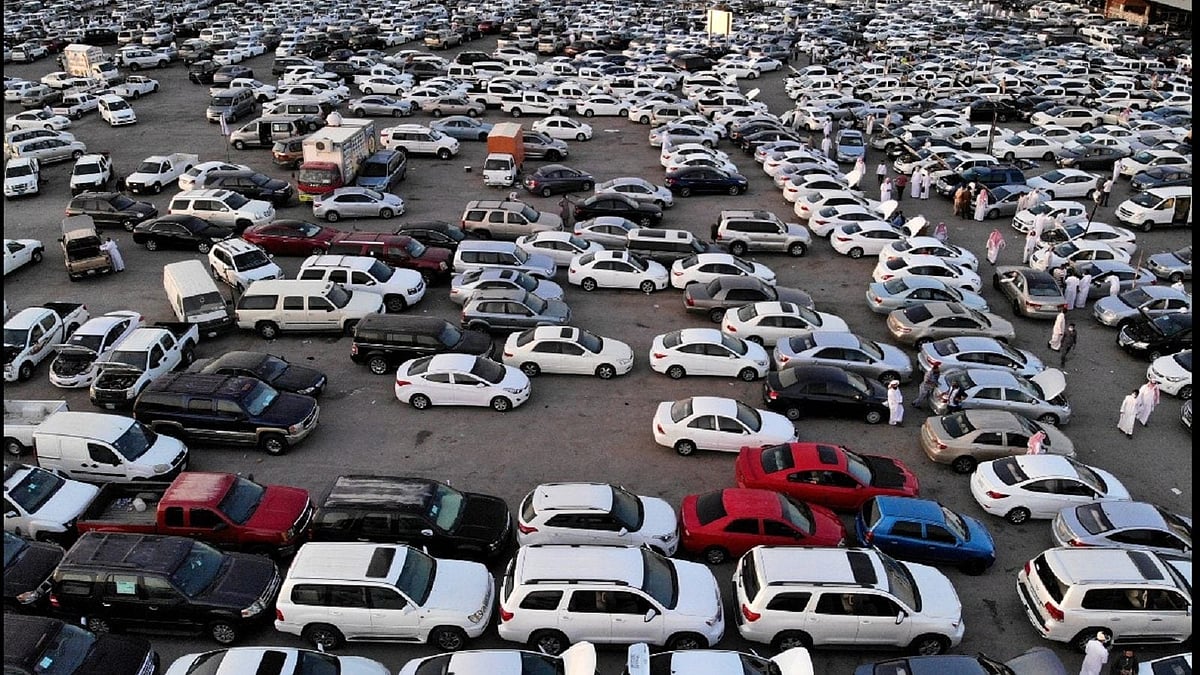
It was an unpleasant New Year's 'gift' for owners of diesel-engine-powered vehicles in Delhi from the State Transport Department. The Delhi government has finally decided to implement a 2015 order by the National Green Tribunal (NGT) to de-register diesel vehicles which are more than 10 years old. This means that such vehicles will no longer be legally able to ply in the national capital from January 1, 2022. In a bid to soften the blow, the Transport Department will give an 'NOC' (No Objection Certificate) to the vehicle being registered elsewhere outside the National Capital Territory of Delhi, where such a ban does not apply. This means that owners of such vehicles, who were faced with the prospect of disposing of their vehicles for scrap value, may be able to recover something from what they had shelled out to buy such vehicles. The order after a plea against an order by the National Green Tribunal was rejected by the Supreme Court. The NGT further rejected an appeal filed by an association of schools in Haryana – which occupies a chunk of the National Capital Region – to modify the order to at least exclude the Covid period, which would have bought an additional two years' time. While dismissing the modification plea, the NGT observed that a report of the pollution monitoring body had found that one new diesel car was equal to 24 petrol and 84 new CNG cars on road. The NGT also said that the government had failed to prove that allowing 10-year-old diesel vehicles to continue plying would not be harmful to the health of the public.
While this brings to an end a protracted legal battle which culminated in an order issued on April 7, 2015, to de-register all diesel vehicles older than 10 years, which was amended a year later to de-register 15 to 10 year-old diesel vehicles, starting with the oldest, in a phased manner. It is a significant development, since the environmental regulatory actions taken in Delhi set a precedent for other cities to follow. In fact, a PIL filed in 1985 led to the eventual setting of emission standards for vehicles in the country in 1990. A subsequent Supreme Court order mandating that all public vehicles, including buses, taxis and auto-rickshaws, switch to the relatively cleaner Compressed Natural Gas (CNG) as a fuel has also been widely followed by many city transit authorities in the country. It is no one's case that polluted air in our cities does not need drastic action. After all, 13 of the 15 most polluted cities in the world in 2020 are in India. Delhi, Mumbai and Kolkata figure in the list of the world's top ten mega cities with the worst air quality. Drastic action, was therefore, called for. With the executive dragging its feet over action, the Courts have stepped in to force the pace.
While action is welcome, the Delhi order is problematic on a number of fronts. The first is that vehicular age has been used as a criterion for determining whether it should be allowed to ply or not. While in general, older vehicles would be perhaps lacking in more advanced emission control technology found in newer vehicles, the real issue is whether the vehicle meets the emission standards of the day or not. A well-maintained older vehicle may in fact be less polluting than a much newer, but badly maintained and badly used newer vehicle. The second is the so-called NIMBY – 'Not in My Backyard' – phenomenon at play here. While Delhi is indeed badly polluted, so are large parts of the surrounding NCR region, which form part of the same weather system. This is why stubble burning in Punjab and Haryana and even Pakistan impacts air quality in Delhi. Banning old vehicles in Delhi and allowing them to ply elsewhere simply transfers the problem, not solve it. There is also the continuing demonisation of one fuel vis-à-vis the others, whereas all internal combustion engines using any type of fuel emit pollutants to a greater or lesser degree. Admittedly, the explosion of diesel cars in India was caused by a faulty fuel subsidy regime, which made diesel considerably cheaper than petrol. That is no longer true, and most vehicle makers are already increasing the share of petrol vehicles in their output. And finally, there is the issue of encroachment into executive space by the judiciary.
The issue of bad air quality in our cities is a complex one, calling for a multi-faceted response. This includes tighter vehicle and vehicle emission standards, judicious use of fiscal incentives to encourage cleaner vehicles, a massive improvement in public transport systems and a radical rethink of urban planning to limit unplanned expansion of urban agglomerations. While the end of cleaner air is desirable, it should not be confused with the means. As Delhi's CNG experience has shown, piecemeal tinkering achieves at best temporary palliatives.


