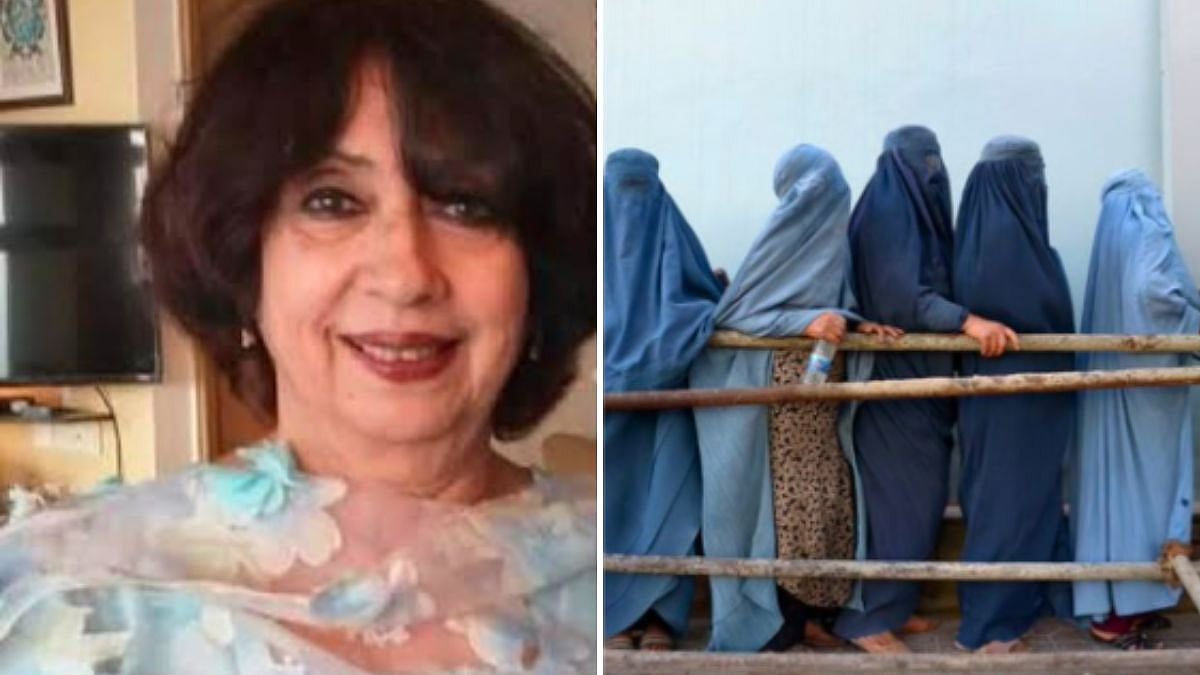
At the inception, it must be stated that the Taliban regime's new outrageous, fiendish law tyrannising, indignifying, and abusing women—legalising physical assault, institutionalising discrimination, and permitting domestic violence—violates every norm of a modern civilized society and needs to be condemned at every level.
Inflicting gender apartheid, it exposes an unacceptable misogynistic, patriarchal mindset in contradiction to Gender Justice in Islam.
With relation to gender, like other gender-related verses of the Quran, the exegetical understandings of 4:34 have been widely discussed and periodically examined by modern scholars contextually, methodologically, and historically, overcoming androcentric readings of the pre-Islamic period.
In the worldview of Islam, there is no context where wife-beating is held permissible.
The root of the word "Wadribuhunna" (4:34) is "DaRaBa". Arabic dictionaries give a long list of meanings to the word:
To travel, to get out: 3:156; 4:101; 38:44; 73:20; 2:273
To strike: 2:60, 73; 7:160; 8:12; 20:77; 24:31; 26:63; 37:93; 47:4
To beat: 8:50; 47:27
To set up: 43:58; 57:13
To give (examples): 14:24, 45; 16:75, 76, 112; 18:32, 45; 24:35; 30:28, 58; 36:78; 39:27, 29; 43:17; 59:21; 66:10, 11
To take away, to ignore: 43:5
To condemn: 2:61
To seal, to draw over: 18:11
To cover: 24:31
To explain or pay heed to: 13:17, 4:34
As seen, the word has multiple meanings. Why, then, is the word "beat" selectively used in relation to women?
There is no indication in the Prophet’s Tradition (Sunnah) that beating a woman is permissible, and the Prophet (pbuh) was never reported to have beaten one of his wives. Even in situations of conflict, he used to quit home for a certain amount of time in order to allow his wives to ponder upon the issue and perhaps review their behaviour or attitude.
The Taliban have seized every opportunity to use their power to control women. Their "Virtue" laws, enforced by the Ministry for the Propagation of Virtue and the Prevention of Vice, include regulations mandating severe restrictions on women's mobility, education, employment, segregation, and social controls limiting their public life and access to healthcare. And now, they are targeting them with another law permitting physical abuse.

It is time for Muslims world over to challenge the atrocities of the Taliban, which are drawing women into the medievalism of the Dark Ages. Their trampling and distortion of the rights of Muslim women granted to them by the Quran and the Prophet (pbuh) must be brought to its logical end.
Such actions draw away from Islam's focus on a woman's self-worth, her right to determine choices, her access to opportunities and resources, her power to control her life, and her ability to influence social change for a more just world—encompassing economic, social, political, and educational dimensions for holistic development. These are Islamic norms and values.
Islam overcame the pre-Islamic patriarchal, misogynistic attitude of the dominance and subjugation of women; this is no longer either applicable or accepted by Muslim women.
(Dr Zeenat Shaukat Ali , is an Islamic scholar and director-general of the Wisdom Foundation)
