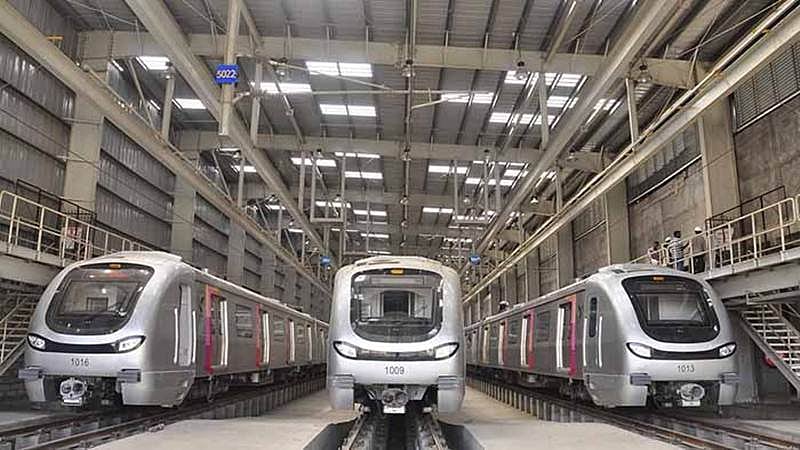
The most controversial project Metro 3, referred also as Colaba-Bandra-Seepz Metro, has been in state government’s pipeline for many years. But this year finally the project has started. The city’s first underground metro corridor that would connect Colaba with SEEPZ via Bandra will have trains with eight coaches and not six because the Mumbai Metro Rail Corporation (MMRC) has estimated a surge in the number of passengers if the project is completed by 2020.
Things you need to know about Metro 3:
Metro 3 also referred as Colaba-Bandra-Seepz Metro, is a part of the metro system for the city of Mumbai. When completed, the 33.5-km long line will be the first underground metro line in Mumbai. The metro line will connect Cuffe Parade business district in the extreme south of the city to SEEPZ in the north-central with 26 underground and one at-grade station. The cost of this corridor is estimated at Rs 23,136 crore.
Also Read: High court wants video conferencing in all courts across Maharashtra by March 2017
The project is being implemented by the Mumbai Metro Rail Corporation Limited (MMRCL). The line starts at Cuffe Parade, will run through Nariman Point, Churchgate, CST, Girgaum, Worli, Dadar, Mahim, Bandra, Bandra-Kurla Complex, Kalina University, Santacruz East and past the domestic and international terminals of Mumbai Airport, through Andheri MIDC and terminates at SEEPZ.
A 20 km metro line from Colaba to Bandra was announced in January 2004, as part of a master plan unveiled by the Mumbai Metropolitan Region Development Authority (MMRDA). On 27 February 2012, the Central Government led by Congress gave principal approval plan for Metro 3.
Thereafter, Metro 3 was approved by the state cabinet on 26 February 2014. The foundation stone for the project was laid by Chief Minister Prithviraj Chavan in a bhoomi pujan ceremony at Andheri on 26 August 2014, in the presence of Union Urban Development minister Venkaiah Naidu.
Stations:
MML-3 is a 33.5 Km long underground corridor running along Colaba-Bandra-SEEPZ. Length of the corridor is marked with 27 key stations out of which 26 will be underground. Stations that will be covered under Metro are:
Passenger interchange facilities will be provided at Chhatrapati Shivaji Terminus (Central Line); Churchgate, Mumbai Central and Mahalaxmi (Western Line), Marol Naka (Metro Line 1), Bandra-Kurla Complex (Metro Line 2) and Mahalaxmi (Mumbai Monorail).
Also Read: Mumbai-Konkan water transport likely to start from March 2017
Car Shed:
The car yard will be constructed at Aarey Colony opposite to Seepz. All the metro coaches will be parked in this car yard.
The first is the construction of a Metro car shed first proposed near Aarey Colony in Goregaon where the city’s western Sanjay Gandhi National Park. Environmentalists and citizens opposed this plan since the green patch in Aarey Colony is one the very few such open spaces in Mumbai and the car shed plan over 30 hectares involved cutting nearly 2,300 trees.
Chief minister Devendra Fadnavis formed a six-member committee under Mumbai metropolitan commissioner U.P.S. Madan with representatives from the Nagpur-based National Environmental Engineering Research Institute (NEERI) and IIT Mumbai as members to propose alternative sites.
Drawbacks:
By constructing Metro 3 underground, Government of Maharashtra is attempting to replicate the Underground Delhi Metro Transit system, hoping it would somehow make Mumbai a ‘World Class’ City.
But it must be noted that Delhi is an inland City located 300m above mean sea level whereas Mumbai is an Island City located barely 3-5m above mean sea level. The Underground Metro Line 3 is planned to be constructed 15-30 metres underground which would leave the underground Metro vulnerable to flooding during Monsoon season, whenever High tide and Heavy rains coincide, due to high ground water table in Mumbai City, potentially risking commuter lives.
Also Read: Bombay High Court’s directive to babus over malnutrition
In order to avoid similar subway flooding, Mumbai Metro Rail Ltd would have to install multiple Rain water evacuation pumps along the 33.5km underground route. But this pumped out rain water will, most likely, overwhelm the BMC Storm water drains causing flooding in the surrounding neighborhoods. In order to avoid this, MMRCL would have to construct its own Storm water drains as well as Special Rainwater storage tanks similar to Tokyo’s Metropolitan Area Outer Underground Discharge Channel facility to hold excess rain water during heavy rain- high tide situations. Both are very expensive yet critical engineering bottlenecks, considering the narrow width of the Roads and expensive Real estate cost along the route.
The great barrier:
As a mark of protest against the construction of the Metro Rail 3 project, residents of Kalbadevi and Girgaum areas night blackened the barriers at the construction site. After the defacement was noticed by Mumbai Metro Rail Corporation (MMRC) authorities the barriers, placed four days back, were freshly painted. But work at the site was temporarily stopped. The protest came amid local residents seeking clarity on the issue of rehabilitation from the MMRC.
Shopkeepers in the area are also troubled by the upcoming displacement. The Colaba-Seepz corridor has been the resettlement of 1,780 hutments and 709 families which will be affected by the project along the 33.5km track.
