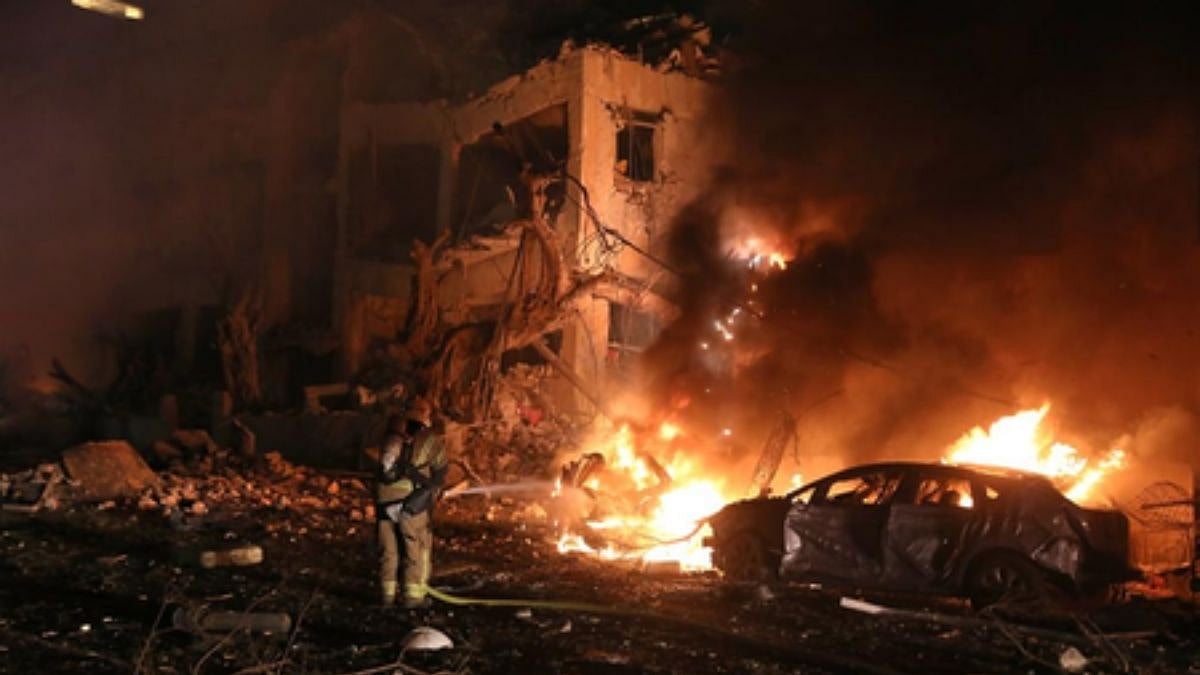
The escalating conflict between the United States and Iran has created a paradoxical "win-win" environment for both Russia and Ukraine in the Eastern European theatre. While Ukraine and Russia remain locked in an existential struggle, the Middle Eastern conflagration has provided each with unique strategic and fiscal lifelines.
According to independent analyst Shanaka Anslem Perera, the Iran-US conflict has effectively merged with the Russia-Ukraine war through the shared technology of the Shahed drone. This convergence allows Ukraine to trade battle-hardened expertise for critical Western hardware, while enabling Russia to bypass sanctions and replenish its war chest through soaring energy markets.
Ukraine’s drone tech leverage
Ukraine has successfully transitioned from a passive recipient of Western aid to a vital security provider for the Middle East. President Volodymyr Zelensky announced on Tuesday that Ukrainian military teams, specialised in "Shahed-killing," have been deployed to Qatar, UAE and Saudi Arabia. These teams utilise low-cost interceptor drones—often 3D-printed and costing between $1,000 and $2,000—to down Iranian loitering munitions that cost up to $50,000. According to Perera, this is a "quid pro quo nobody saw coming."
By protecting Gulf oil infrastructure with indigenous technology that is a thousandth of the cost of a Patriot missile, Kyiv has gained extraordinary leverage. This deployment, which includes a separate team in Jordan for US base protection, allows Ukraine to demand the one thing it needs for its own survival, which is, sophisticated American air defence batteries that Washington was previously hesitant to ship in bulk.
The necessity of Ukrainian intervention highlights what US officials, speaking to Axios, have termed a major tactical miscalculation. Nearly seven months ago, Ukraine presented the Trump administration "drone combat hubs" in the Persian Gulf, which was then dismissed. However, the lethality of Iranian drone strikes, which have claimed the lives of seven US service members, forced a total reversal. This has strengthened Ukraine’s position as a global leader in unmanned aerial combat, proving that the country that cannot yet fully defend its own power grid is now the primary guardian of the world’s energy heartland.
Russia’s energy-triggered economic windfall
While Ukraine gains tactical hardware, Russia is reaping a massive financial harvest from the regional instability. According to CNBC, Russia has emerged as a primary beneficiary of the US-Iran war as oil prices surged past $100 per barrel. The conflict has rattled global energy markets, particularly due to fears regarding the Strait of Hormuz.
Analysts at MST Marquee noted that the US has been forced to relax restrictions on Russian crude to ensure global supply stability. This "sanctions easing" has allowed Russia to clear a massive "flotilla" of idling tankers. Bloomberg reports that Moscow’s seaborne exports averaged 3.26 million barrels a day in the period leading to March 8. Even as Ukrainian drone strikes occasionally hamper Russian terminals like Novorossiysk, the overall increase in global benchmarks has dramatically boosted the value of the Kremlin’s exports, funnelling billions back into its war machine.
Synergy of war
The most striking aspect of this geopolitical shift is how the two wars have become a single, unified conflict. Iran designed the drone, Russia scaled its production for the invasion of Ukraine and Ukraine learned to kill it. Now, Ukraine is selling that lethality to the countries Iran is attacking, funded indirectly by the very nation Russia is fighting.
Bloomberg data shows that India has purchased roughly 30 million barrels of Russian oil since the US provided a "green light" for purchases to offset Middle Eastern losses. This creates a cycle where the US-Iran war provides the high oil prices Russia needs to survive sanctions, while simultaneously providing the high-stakes theatre Ukraine needs to prove its technological indispensability to the West. Both nations have found a way to utilise the Middle Eastern chaos to bolster their respective positions in their own primary conflict.
Fuelling a longer and deadlier escalation
The ultimate consequence of this "win-win" scenario is a terrifying elongation of the war in Eastern Europe. As Bloomberg notes, the "windfall" flowing into the Kremlin’s war chest from $100-plus oil allows Russia to re-arm and sustain its offensive operations indefinitely, effectively blunting the edge of Western economic pressure.
Simultaneously, if Ukraine successfully leverages its Middle Eastern deployment to secure the advanced Patriot batteries and offensive weapons it seeks from Washington, the technical parity between the two sides will reach a fever pitch.
Rather than leading to a stalemate or peace, this influx of resources—swelled cash for Russia and advanced American hardware for Ukraine—ensures that both combatants are better equipped than ever to continue the slaughter. The Middle Eastern drone war has not provided an exit ramp, instead, it has provided the fuel and the firepower for a conflict that promises to become significantly more protracted and lethal as both sides find the means to double down.

