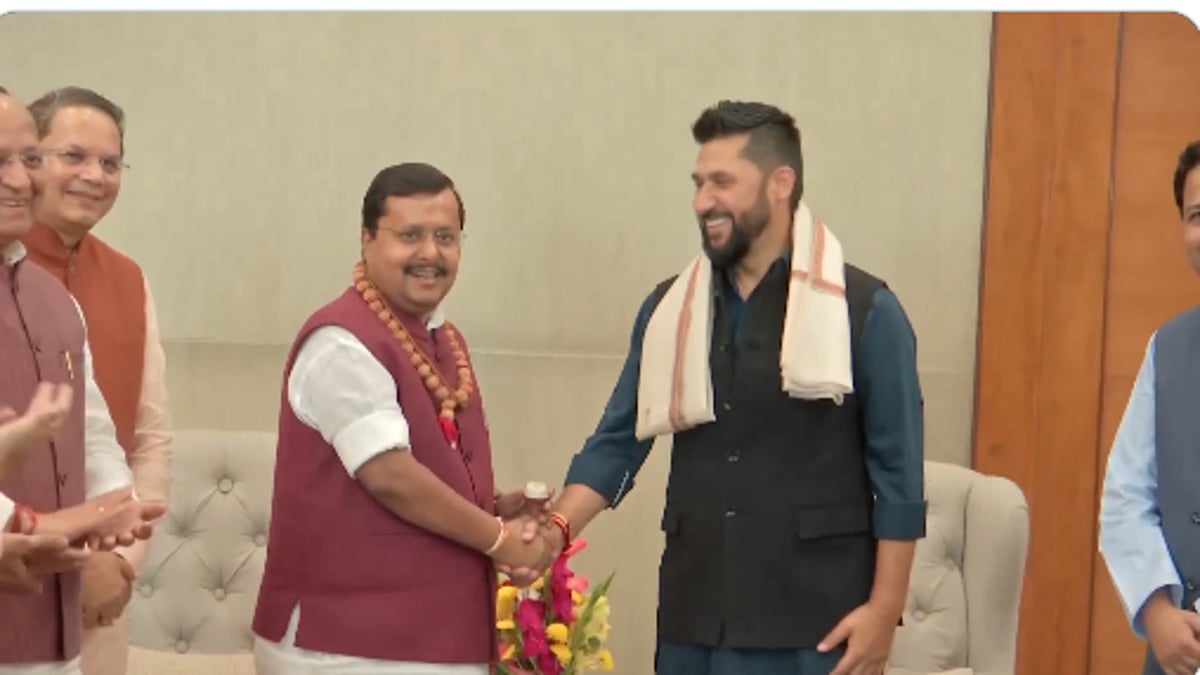
The historically tight yet frequently volatile relationship between India and Nepal is undergoing a quiet, pragmatic shift punctuated by major political milestones unfolding right now. On Tuesday, Rabi Lamichhane, president of Nepal’s ruling Rastriya Swatantra Party (RSP), arrived at the BJP headquarters in New Delhi to meet with national president Nitin Nabin under the 'Know BJP' initiative.
This unprecedented party-to-party engagement follows a historic address to parliament by Nepal’s newly elected, 35-year-old Prime Minister Balendra "Balen" Shah, who broke long-standing diplomatic taboos by acknowledging that border encroachment along their shared boundary is a mutual, technical issue rather than a one-sided Indian violation.
These developments signal that a new political reality in Nepal is fundamentally changing the conversation. Leaders in Kathmandu are increasingly recognising that sustained combative ties with India offer little practical return and that turning toward friendly, result-oriented diplomacy is the key to unlocking Nepal’s economic future. Driven by a younger generation of leaders who want to move past old grievances, both nations stand on the cusp of replacing "ultra-nationalist rhetoric" with high-impact economic collaboration.
What triggered recent friction between the neighbours
The underlying tension between New Delhi and Kathmandu centres on a long-standing border dispute over the Kalapani-Limpiyadhura-Lipulekh region. This strategically vital territory sits at the trijunction of India, Nepal and Tibet. India maintains the area is part of Uttarakhand, a stance New Delhi reiterated via Ministry of External Affairs (MEA) spokesperson Randhir Jaiswal, who stated that Nepal's claims lack historical evidence. Conversely, Nepal claims the territory based on its interpretation of the 1816 Sugauli Treaty signed with British India.
The dispute intensified in 2019 when India issued a new political map including the area and escalated dramatically in May 2020 when Defence Minister Rajnath Singh inaugurated a road through the Lipulekh Pass to aid Hindu pilgrims traveling to Kailash Mansarovar.
In response, Nepal’s Parliament took the unprecedented step of amending its Constitution in June 2020 to legally incorporate the disputed lands into its own national map. The diplomatic chill deepened further in last month when a proposed visit to Kathmandu by Foreign Secretary Vikram Misri was abruptly postponed.
According to reporting by The Kathmandu Post, the friction arose because Prime Minister Balen Shah refused to grant Misri an appointment, strictly adhering to protocol dictates that a visiting foreign secretary should only negotiate with his direct counterpart rather than a head of government.
Who is leading Nepal's new pragmatic approach?
The shift away from hostile rhetoric is being spearheaded by a fresh crop of political actors who have disrupted Nepal's traditionally stagnant political environment following massive youth-led protests. Chief among them is Prime Minister Balen Shah, an engineer and former rapper who rose to power on a wave of public desire for structural change. Alongside him is the RSP, a young, inclusive political force that secured an unprecedented mandate by enrolling the younger generation into delivery-based politics.
Unlike the older political guard, the RSP explicitly positions itself as a modern entity aimed at delivery-based politics. Writing an opinion piece for the Hindustan Times,, RSP chair Lamichhane expressed a clear desire to shift the entire vocabulary of India-Nepal relations away from geopolitical friction and place it firmly on development diplomacy. Rather than using India as a political punching bag to rally nationalist votes, these new leaders are viewing New Delhi as an essential economic partner.
How Kathmandu is rewriting the border narrative
In a striking departure from past political theatre, Prime Minister Balen Shah delivered his first parliamentary address on Sunday, offering a highly nuanced take on the border issue. Instead of launching a one-sided attack on New Delhi, Shah acknowledged that territorial encroachment is a complex, mutual issue. He revealed that technical assessments indicate some lands utilised by Nepali citizens technically sit on the Indian side of the border, while areas used by Indians fall within Nepal.
To fix this, Shah announced that India and Nepal have agreed to move the dispute from public shouting matches to a quiet, expert-led forum. The two governments are establishing joint technical teams comprising historians, surveyors and territorial experts to resolve cross-border occupations through table talks.
While Nepal's Ministry of Foreign Affairs quickly issued a clarification stating that this technical reality does not abandon its sovereign claim over the Lipulekh region, Shah’s public admission that both sides share responsibility marks a massive diplomatic olive branch.
When and where are these new diplomatic ties being tested
The transition toward friendly partnership is happening right now through direct, high-level political engagement in the Indian capital when Lamichhane arrived at the BJP headquarters in New Delhi.
This visit represents a deliberate effort by Nepal's ruling coalition to build a direct rapport with India’s political leadership, pitching high-impact projects like the 150-kilometre Raxaul-Kathmandu railway line and an integrated energy market. It also coincides with a warm public exchange between the heads of government.
Following Shah’s swearing-in, Prime Minister Narendra Modi extended public congratulations on X, noting that Shah's leadership carries the trust of the Nepali people. Shah's office responded with public gratitude, explicitly stating an eagerness to work closely with Modi to advance multifaceted relations for the common prosperity of both nations.
Why a friendly partnership is the only real option for Nepal's future
Nepal’s leadership is gradually realizing that maintaining combative ties with India is a losing strategy that actively harms its own citizens. As a landlocked Himalayan nation, Nepal relies overwhelmingly on India for transit, trade routes, consumer goods and energy cooperation. Constant diplomatic warfare yields zero territory while choking off the economic oxygen Nepal needs to develop and expand its economy.
By replacing the old language of geopolitical friction with development diplomacy, Nepal aims to transform its foreign missions into engines of investment and economic partnership. A friendly relationship allows both nations to focus on shared prosperity, such as cross-border electricity sales, improved transit infrastructure and a proposed Kathmandu-Bengaluru digital corridor.
Ultimately, Nepal’s new political forces are betting that a relationship delivering measurable results to the daily lives of ordinary citizens is far more valuable than scoring points over a map.
