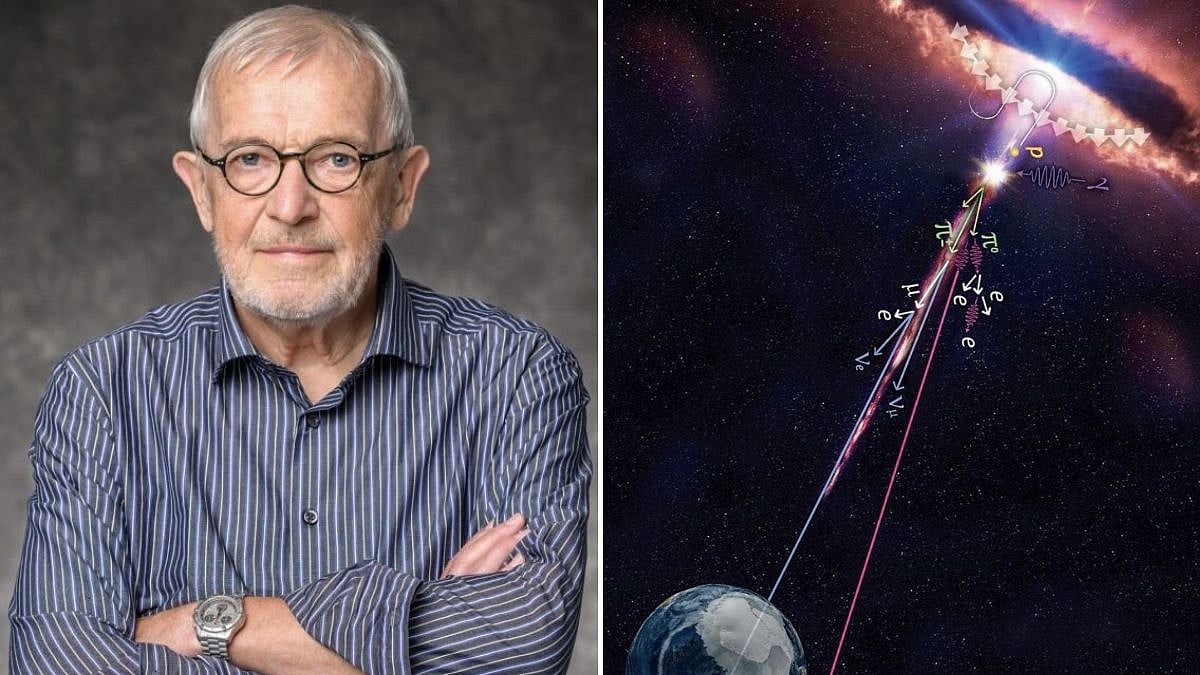
Belgian-born particle physicist Francis Halzen spent decades pursuing some of the universe’s most elusive particles, eventually helping transform Antarctic ice into a massive observatory capable of detecting them.
The 82-year-old scientist, who is affiliated with the University of Wisconsin-Madison in the US, has devoted much of his career to studying neutrinos, tiny particles that rarely interact with matter and can pass through the Earth and human bodies virtually without a trace. Their elusive nature has earned them the nickname “ghost particles”.
Halzen’s pioneering work on high-energy neutrinos and the IceCube Neutrino Observatory earned him the 2026 Nobel Prize in Physics.
From Belgium to the South Pole
Born in Belgium, Halzen began exploring the possibility of detecting neutrinos at the South Pole in the 1980s.
He realised that the vast quantities of ice there could be used to track the particles. That idea eventually became central to the IceCube Neutrino Observatory, a research facility at the South Pole in Antarctica.
The University of Wisconsin-Madison is the observatory’s lead institution.
Halzen led an international team of researchers and engineers behind the facility, which collects evidence of neutrino interactions deep within Antarctic ice.
“Francis Halzen has led an international team of researchers and engineers who have provided us with a fantastic instrument. His tenacity and scientific vision has paved the way for a new kind of astronomy,” Mark Pearce, chair of the Nobel Committee for Physics, said.
Why are neutrinos called ‘ghost particles’?
Neutrinos are extremely small cosmic particles with very little mass. They are produced by sources including stars, and trillions pass through human bodies every second.
Because neutrinos interact with matter extremely rarely, scientists cannot simply observe them as they travel through space. Instead, researchers look for what happens on the rare occasions when neutrinos collide with other particles, producing flashes of light or charged particles.
Halzen focused on high-energy neutrinos that originate beyond Earth and can carry information about distant cosmic events.
"The messengers bring information from the cosmos," Eva Olsson of the Royal Swedish Academy of Sciences said. "They open the door to distant galaxies and tell us about the processes of exploding stars."
The neutrino interactions detected by IceCube can help scientists understand how high-energy neutrinos are produced and could potentially reveal previously unknown cosmic phenomena.
‘Neutrino Man’
Halzen’s pursuit of the particles had attracted recognition well before the Nobel Prize.
In 2014, US-based Smithsonian magazine dubbed him “Neutrino Man” when recognising him with one of its Ingenuity Awards. It described his work as an “amazing experiment (that) heralds the beginning of a new era in astronomy”.
The magazine also published a comic about his life titled How One Physicist’s Pursuit of the Cosmos Took Off in Antarctica.

Nobel call came as a surprise
Halzen was in Italy when the Nobel Committee contacted him by phone on Tuesday.
“It was a great surprise and I obviously didn't expect it,” he said.
Halzen said there had previously been predictions that he could win the Nobel Prize, but receiving the news still made him feel “strange."
His decades-long effort to capture signals from particles that are almost impossible to detect ultimately provided scientists with a new way of studying some of the most distant and energetic phenomena in the universe.

