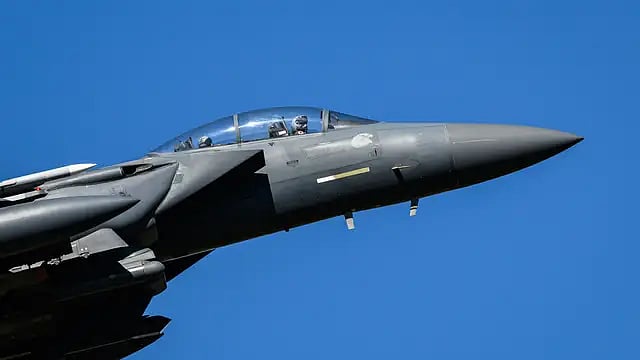
Washington: Who is “Dude 44 Bravo”? The call sign has become synonymous with one of the most dramatic survival stories to emerge from the US military’s conflict with Iran in 2026.
“Bravo” was the weapons systems officer (WSO), or backseater, aboard a two-seat US Air Force F-15E Strike Eagle that was shot down during a strike mission in Iran. His real name has not been publicly released for security reasons. He and the pilot, identified by the call sign “Alpha”, were part of a mission designated Dude 44.
Their aircraft was struck by an Iranian shoulder-fired, heat-seeking missile during a strike mission against industrial facilities linked to Iran’s drone and missile programmes in a mountainous region south of Isfahan.
F-15E Shot Down, Two Crew Members Eject
After the missile hit their aircraft, both Alpha and Bravo were forced to eject roughly 100 miles inside southern Iran.
While Alpha was recovered within hours, Bravo landed several miles away and was left alone behind enemy lines. Seriously injured, he would spend nearly two days attempting to evade Iranian forces that were searching the area.
The episode later became one of the most closely watched US military rescue operations of the conflict.
‘No Parachute’: Bravo’s Terrifying Fall
Bravo's ordeal began even before he reached the ground.
The missile strike damaged his parachute, leaving him in a high-speed free fall. He later recalled looking up and seeing what appeared to be “no parachute”, describing it as one of the most frightening moments of his life.
As he fell, he prayed for help and prepared for the possibility that he would not survive.
The impact left him with severe injuries, including a broken back, a broken arm and shoulder injuries. He also suffered a sprained ankle along with facial and head injuries.
Yet despite his condition, Bravo knew that remaining near the crash or landing site could expose him to Iranian forces.
How Bravo Survived Behind Enemy Lines
His survival depended heavily on the SERE Survival, Evasion, Resistance and Escape training he had received as a US military aircrew member.
Despite his injuries, Bravo moved away from his landing location and made his way towards a roughly 7,000-foot ridgeline. He eventually found a mountain crevice or concealed position where he could remain hidden.
Iranian forces, including members of the Islamic Revolutionary Guard Corps and Basij, were searching for him.
At times, they reportedly came within only a few hundred metres of his hiding place.
Bravo had very limited supplies and was unable to use his locator beacon freely because doing so could reveal his position. For much of his ordeal, he also had no food.
Massive US Rescue Operation
As Bravo remained trapped behind enemy lines, the US military launched a large-scale combat search-and-rescue operation.
The mission involved more than 150 aircraft and hundreds of personnel, along with special operations forces and A-10 “Sandy” aircraft tasked with providing protection.
The operation also involved intelligence and deception efforts, including support from the CIA, as American forces attempted to prevent Iranian troops from locating Bravo before the rescue team could reach him.
The search continued for almost two days as the US forces raced against time.
Rescued As Iranian Forces Closed In
Bravo was eventually located and recovered on Easter Sunday morning, just as Iranian forces were closing in on the mountain where he had been hiding.
His rescue brought an end to nearly 48–50 hours spent alone and seriously injured in hostile territory.
The operation has since been described as one of the most complex US combat search-and-rescue missions in recent military history.
‘Modern-Day Miracle’
Bravo has described his survival as a “modern-day miracle.”

In his first public account of the ordeal, during an interview with Norah O’Donnell on 60 Minutes, he spoke about the terrifying moments after the aircraft was hit, his injuries, his efforts to remain hidden and the eventual rescue.
He also credited Alpha, his pilot, for helping save their lives during the ejection and praised the military personnel involved in bringing him home.
The story of “Dude 44 Bravo” has since emerged as a striking example of the US military's long-standing “leave no one behind” commitment — a mission that continued even after Bravo had spent almost two days isolated, injured and hunted deep inside enemy territory.

