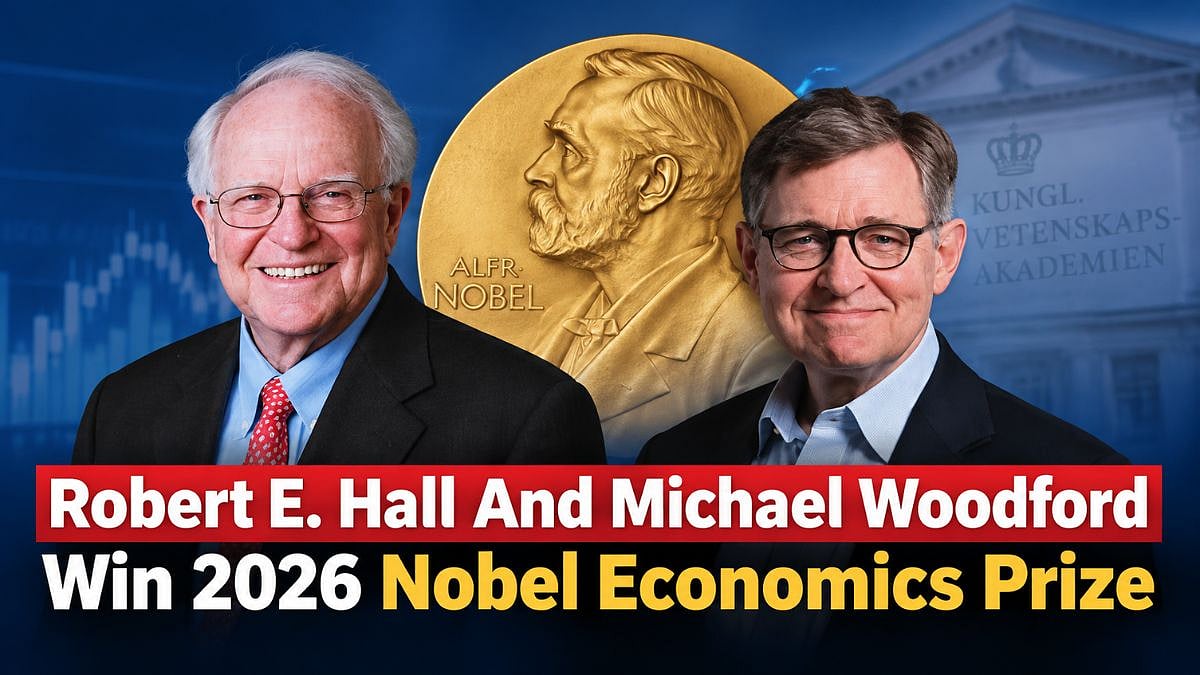
American-born economists Robert E. Hall and Michael Woodford have won the 2026 Nobel Memorial Prize in Economics for developing models that help governments and central banks respond to economic shocks and stabilise economies. The Royal Swedish Academy of Sciences announced the winners in Stockholm on Monday, recognising their contributions “for microeconomic foundations of macroeconomic stabilisation”.
Who are Hall and Woodford?
Robert E. Hall is affiliated with Stanford University in California, while Michael Woodford is associated with Columbia University in New York.
The two economists have contributed to developing the theoretical foundations of models used by central banks and governments worldwide to understand economic fluctuations and formulate responses to financial disruptions.
Their research has helped policymakers better understand how economies react to shocks, including energy crises and sudden changes in household consumption.
Woodford, who spoke to the Nobel committee over the phone from New York on Monday, expressed surprise at receiving the prestigious recognition.
“It's a tremendous honour, it's a surprise.”
Why were Hall and Woodford awarded the economics prize?
The Royal Swedish Academy of Sciences recognised the economists for their work on the microeconomic foundations of macroeconomic stabilisation, which has helped improve the models used to manage economic instability.
“The laureates have helped us smooth out the economy's peaks and troughs,” the academy said in a statement.
John Hassler, chair of the Committee for the Prize in Economic Sciences, highlighted the importance of their contributions to modern economic policymaking.
“The laureates' work has provided us with a stable theoretical foundation for the models that are now used by central banks and governments around the world,” Hassler said in a news release.
“With them, we are better equipped to deal with shocks in the economy, such as energy crises or sudden changes in how much households consume.”
What is the Nobel Memorial Prize in Economics?
The economics award is formally known as the Bank of Sweden Prize in Economic Sciences in Memory of Alfred Nobel.
Sweden's central bank established the prize in 1968 in memory of Alfred Nobel, the 19th-century Swedish businessman and chemist who invented dynamite and founded the five original Nobel Prizes.
Although Nobel purists emphasise that the economics award is technically not one of the original Nobel Prizes, it is presented alongside the other honours on December 10, the anniversary of Nobel's death in 1896.
Last year's economics prize went to three researchers who studied business innovation and explained how new products and inventions contribute to economic growth and human welfare, even as they displace older businesses.
Also Watch:

Prize money and Nobel announcements
The prize money for this year stands at 12 million Swedish kronor, equivalent to approximately $1.2 million. The amount remains the same whether the award goes to an individual, a small group of laureates or an organisation.
The announcement of the economics prize follows last week's Nobel honours in medicine, physics, chemistry, literature and peace.
To get details on exclusive and budget-friendly property deals in Mumbai & surrounding regions, do visit: https://budgetproperties.in/

