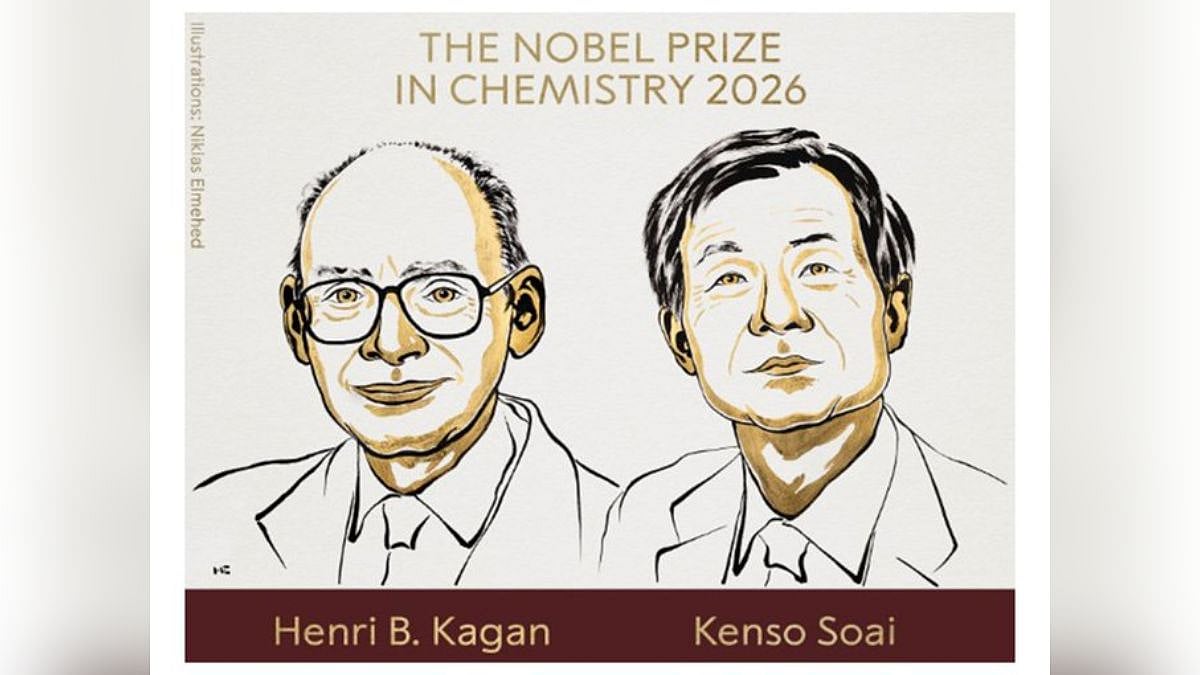
Scientists Henri B Kagan and Kenso Soai have won the 2026 Nobel Prize in Chemistry for helping solve a mystery that has puzzled chemists for more than a century: why molecules that are mirror images of each other can behave differently and how one specific version can be produced selectively.
Their work on asymmetric reactions has provided chemists with powerful ways to create the desired “left-handed” or “right-handed” form of a molecule, an advance with major implications for pharmaceutical manufacturing.
“Henri Kagan and Kenso Soai have provided a solution to a chemical mystery that is over a century old: how homochirality can emerge spontaneously,” Heiner Linke, chair of the Nobel Committee for Chemistry, said in a news release.
Who Is Henri Kagan?
Kagan, 95, is a French scientist affiliated with Université Paris-Sud in Orsay, France. His research helped chemists overcome a fundamental problem in chemistry: how to produce an excess of one form of a molecule when two mirror-image versions are possible.
Kagan and Soai developed asymmetric reactions that allowed chemists to selectively produce particular mirror-image forms of molecules. Their research built on discoveries made by 19th-century French chemist Louis Pasteur.
Pasteur, while studying tartaric acid, which is important in wine production, observed that bacteria fermented only one of its two forms, the one naturally found in grapes. The other form did not undergo fermentation. His findings demonstrated that some substances can occur in two mirror-image forms with different properties.
The challenge of selectively creating the required form, however, remained unresolved until work by Kagan and Soai provided ways of producing an excess of one form through asymmetric reactions.
Who Is Kenso Soai?
Soai, 76, is a Japanese scientist affiliated with the Tokyo University of Science. His research, like Kagan’s, centred on the chemistry of asymmetric molecules and helped explain how reactions could favour one molecular mirror image over another.
Soai was shopping near his home when the Nobel committee reached him with news of the award.
“This is the most exciting day in my life, I am very glad to share this prize with professor Henri Kagan,” Soai said, speaking by phone to the Nobel Prize press conference, adding that he had been shopping when he received the news.
At the time, the Nobel committee was still trying to contact Kagan to inform him that he had won the prize.
Why Their Work Matters
Many molecules essential to life exist in two forms that mirror each other, much like left and right hands. Yet living organisms almost exclusively use only one version, a phenomenon known as “homochirality”, derived from the Greek word for hand.
The phenomenon has puzzled chemists for more than a century. Kagan and Soai’s discoveries showed how chemical reactions could be made to favour a single molecular mirror image, giving chemists important tools for designing reactions used in pharmaceutical manufacturing.
“The left-handed version of the drug can have one effect, and the right-handed version can have another effect, and then we need methods for selectively preparing them,” Peter Somfai, a member of the Nobel Committee for Chemistry, said.
“In developing such methods the findings of this year's laureates are important. They provided powerful tools for that,” he said.
The significance of distinguishing between molecular mirror images was starkly illustrated by the thalidomide scandal of the early 1960s. Thousands of children were affected by birth defects linked to the sedative thalidomide. Researchers later found that the mirror-image form of the drug’s active substance had caused the harm.
From Pasteur’s Discovery To The Nobel Prize
Kagan and Soai’s Nobel-winning research traces its scientific roots to Pasteur’s work, but their advances helped address the practical challenge of creating the desired form of a chiral substance.
Their ability to produce asymmetric reactions and generate an excess of one molecular form became particularly important for chemists developing pharmaceuticals, where different mirror-image forms can have dramatically different effects.
Kagan and Soai will receive their Nobel medals from Sweden’s King Carl XVI Gustaf at a ceremony in Stockholm on December 10, the anniversary of Alfred Nobel’s death. The awards ceremony will be followed by a banquet at Stockholm City Hall. The laureates will also share 12 million Swedish crowns ($1.2 million).

