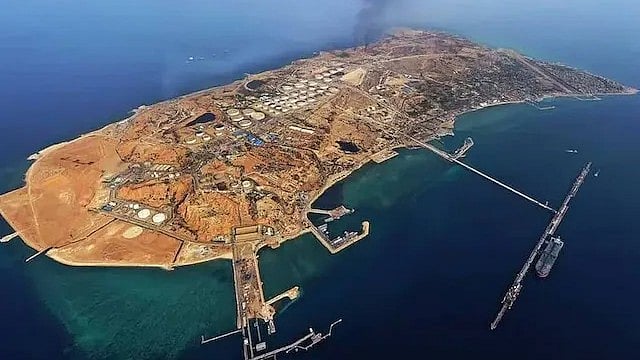
On Saturday, the geopolitical scenario of West Asia shifted as US President Donald Trump announced that the United States Air Force launched a series of targeted strikes against military facilities on Iran’s Kharg Island. This 22-square-kilometre coral outcrop in the northern Persian Gulf is often referred to as the "Forbidden Island" due to its extreme security, but its real value lies in its status as the economic heart of Iran.
The operation marks a significant "up the ante" move by the Trump administration. While the president claimed that US forces "obliterated" their targets, the strike was notably surgical, focussing on defence infrastructure rather than the island’s massive oil terminal. This strategic choice serves as both a physical blow to Iran’s military presence and a psychological warning regarding the vulnerability of its most prized asset.
Why Kharg Island matters
To understand why this specific target is so critical, one must look at the Iranian economy. Kharg Island is the undisputed backbone of the country’s financial life, processing approximately 90 per cent of Iran’s vital crude oil exports—totalling nearly 950 million barrels annually. According to energy experts like Steven Wills of the Center for Maritime Strategy, the island was specifically developed because much of Iran’s coastline is too shallow for the supertankers that carry oil to global markets like China.
According to a report in the Hindustan Times, Petras Katinas, a researcher at the Royal United Services Institute, notes that while Kharg is not a nuclear site, it is the primary engine for financing the Iranian government and military. Losing control of this "crown jewel" would essentially paralyse Iran's ability to operate as a modern state.
What was hit and what was spared?
Reports from the semi-official Fars news agency as quoted by Al Jazeera confirm that more than 15 explosions rocked the island during the raid. The confirmed targets included an army defence facility, a maritime base, a helicopter control tower and a helicopter carrier. Despite the intensity of the attack, which sent thick plumes of smoke rising over the Gulf, the oil infrastructure itself remains intact.
However, the definition of "intact" is a matter of debate. Ed Hirs, an energy economist at the University of Houston, told Al Jazeera that because the island is so small, it is difficult to imagine that the oil exporting apparatus hasn't faced some level of disruption. For now, Iranian forces claim to have reactivated their defences within an hour of the strike, attempting to invalidate US claims that their military presence was "decimated."
Strategic Strait of Hormuz leverage
The primary motivation behind the strike appears to be a battle for control over the world’s energy lanes. Iran’s most potent weapon in this conflict has been its influence over the Strait of Hormuz. By threatening to block this narrow passage, Iran can effectively hold the global energy market hostage.
President Trump’s message following the strike was a direct ultimatum. The oil infrastructure was spared this time, but that decision will be "immediately reconsidered" if Iran continues to interfere with the free passage of ships. This move is an attempt by the US to regain the initiative, telling Tehran that if they do not free up the Strait, the US is prepared to destroy the very industry that keeps the Iranian government afloat.
Risk of a catastrophic retaliation
The reaction from Tehran has been swift and stern. The Iranian Army Headquarters command centre has warned that any hit to oil facilities on Kharg Island would trigger a massive offensive against any American-linked oil installations in the region. This "tit-for-tat" strategy could expand the conflict to neighbouring states like Saudi Arabia and Qatar, where minor strikes have already been reported.
JPMorgan’s global commodity research team warned that a direct strike on the island’s oil capacity would likely trigger "severe retaliation," potentially leading to a regional energy war. Such a scenario would not only be catastrophic for the Middle East but would also cripple Asian economies that rely heavily on imported crude oil.
What happens next?
The world is now watching to see if this move leads to de-escalation or a full-scale regional war. If the US has indeed degraded the military defenxes on Kharg, it could perhaps pave the way for an expeditionary force to occupy the island, giving the US a permanent "chokehold" on Iranian exports. Conversely, if Iran feels its economic survival is at stake, it may use its remaining "cards"—including the total closure of the Strait of Hormuz—to force an international crisis.

