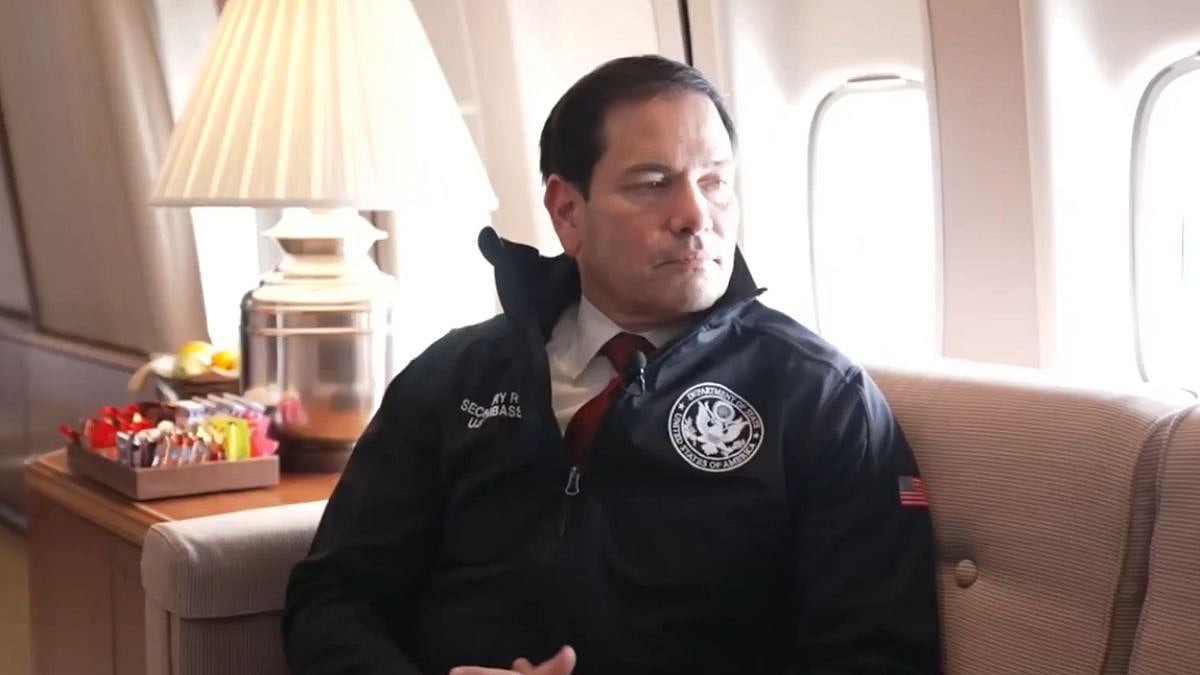
Beijing: US Secretary of State Marco Rubio has said Washington hopes to convince Beijing during the talks between President Donald Trump and his Chinese counterpart to play a “more active role” in resolving the Iran war crisis.
Trump arrived in Beijing last night for a three-day visit during which he is scheduled to have several rounds of talks with Xi. Trump was welcomed by Chinese Vice President Han Zheng at the airport, a rare honour that broke with usual diplomatic protocol.
Speaking to Fox News aboard Air Force One on the way to Beijing, Rubio said the Iran war was a “huge source of instability” and “threatens to destabilise Asia more than any other part of the world because it’s heavily reliant on the straits for energy”.
"It's in (China’s) interest to resolve this. We hope to convince them to play a more active role in getting Iran to walk away from what they’re doing now and trying to do now in the Persian Gulf,” he said, the Hong Kong-based South China Morning Post reported on Thursday.
When departing for Beijing on Tuesday, Trump told reporters that he planned to have a “long talk” with the Chinese leader about Iran.
But Trump also said he did not think he needed Xi’s help with Iran and that the US would “win it one way or the other, peacefully or otherwise." In the Fox News interview, Rubio described Beijing as Washington's "top political challenge" but added that "it’s also the most important relationship for us to manage".
“(China is) a big, powerful country... We’re going to have interests of ours that are going to conflict with interests of theirs, and to avoid wars and maintain peace and stability in the world, we’re going to have to manage those,” he said.
"There are clearly areas where they’re so important for the United States that we’re going to have to raise those issues. And we’ll continue to do so...There might be some areas of cooperation, too, and we want to make sure we don’t walk away from those,” he said.
Rubio also said the US was “not trying to constrain China, but their rise cannot come at our expense”.
“Their rise cannot come at our fall,” he said.
“When (China's) plan conflicts with the national interest of the United States, we need to do what’s right for the United States. And that’ll come up on this trip, but more importantly, that’ll be a feature of this relationship for a long time,” he said.
(Except for the headline, this article has not been edited by FPJ's editorial team and is auto-generated from an agency feed.)

