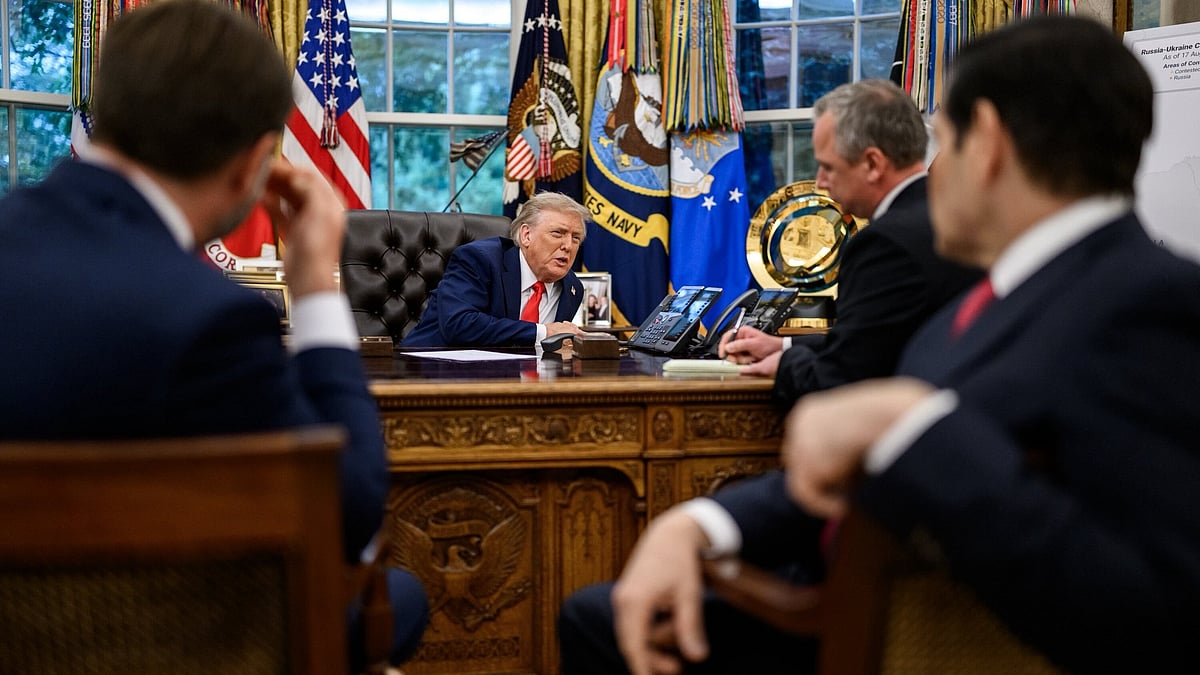
New Delhi: US President Donald Trump on Saturday abruptly terminated a scheduled press interaction in the Oval Office, ordered reporters to leave, and used dismissive hand gestures to silence questions regarding shooting of naval vessels, at least one of them Indian.
The atmosphere shifted sharply when Olivia Rinaldi, a White House reporter for CBS News, attempted to steer a conversation toward the escalating conflict in the Strait of Hormuz “Mr President, a question on Iran,” Rinaldi began, according to video of the exchange.
“Iranian gunboats fired upon two vessels today. President Macron said that….” Trump did not allow her to finish the inquiry. As she spoke, he intervened with a series of physical signals. He first made a quick, circular motion with his pointer finger, an apparent signal to his aides to wrap up the event.
When the questioning persisted, he transitioned to a sharp, sideways thumb gesture— reminiscent of a baseball umpire’s signal for an out—and repeatedly commanded, “Out! Get out. The dismissal comes at a precarious moment for the administration.
Only hours earlier, Trump had used social media to announce that the US Navy had intercepted and disabled an Iranian cargo ship, the MV Touska, after it breached a US-led naval blockade. Trump claimed that US forces “blew a hole” in the vessel’s engine room to take custody of it .
In Delhi, the exchange was interpreted as Trump appearing reluctant to address the attack on Indian ships. Indian-flagged tankers Sanmar Herald and Jag Arnav were fired upon by Iran’s Islamic Revolutionary Guard Corps while transiting the Strait, forcing them to retreat.
The incident raised immediate concerns about the safety of Indian crew members and the security of a critical global shipping route. The April 18 firing by IRGC units has triggered outrage in India, with an audio clip—purportedly of a ship’s captain reacting as his vessel was hit— circulating widely on social media.
New Delhi summoned the Iranian ambassador to lodge a formal protest, and the Ministry of External Affairs issued a strong statement. India was not alone in facing such aggression. French authorities reported that the CMA CGM Everglade, sailing under the French flag, along with a British freight vessel, was also targeted the same day.
Notably, Trump later referenced the French and British ships in a post on Truth Social, but made no mention of the Indian vessels. “Iran decided to fire bullets yesterday in the Strait of Hormuz—a total violation of our ceasefire agreement! Many were aimed at a French ship, and a freighter from the United Kingdom. That wasn’t nice, was it?” Trump wrote.
Diplomatic observers in New Delhi view both Trump’s public remarks and his refusal to engage on India as significant. Former ambassador and West Asia expert Talmiz Ahmad argued that the Iranian action must be seen in a broader regional context.
“Iran had kept the Strait open on the understanding that there would be peace in Lebanon and that the U.S. blockade would be lifted,” Ahmad said. “This did not happen.
Instead, U.S. officials indicated the blockade would remain. The resulting escalation led to a closure posture by Tehran, and Indian and other ships got caught in the middle.
This is about ground realities, not bilateral ties.” Another diplomat pointed to internal dynamics within Iran. While Foreign Minister Abbas Araghchi suggested the Strait would remain open, his remarks were criticized domestically.
Soon after, Speaker Mohammad Bagher Ghalibaf warned that continued blockades would mean the Strait “will not remain open,” underscoring that decisions would be shaped “by the field, not by social media.”
Also Watch:
Diplomats noted that New Delhi’s response was measured and expected, but emphasized that Washington’s reaction warrants closer attention. As one senior diplomat put it, Trump’s lack of response to the attack on Indian ships was “very telling,” suggesting that India’s concerns may not be a top priority for the U.S. at this moment.

