The Federal Aviation Administration (FAA) has lifted the nationwide ground stop imposed across airports in the United States following a telecommunications outage that disrupted air traffic control operations, triggering thousands of flight delays and cancellations.
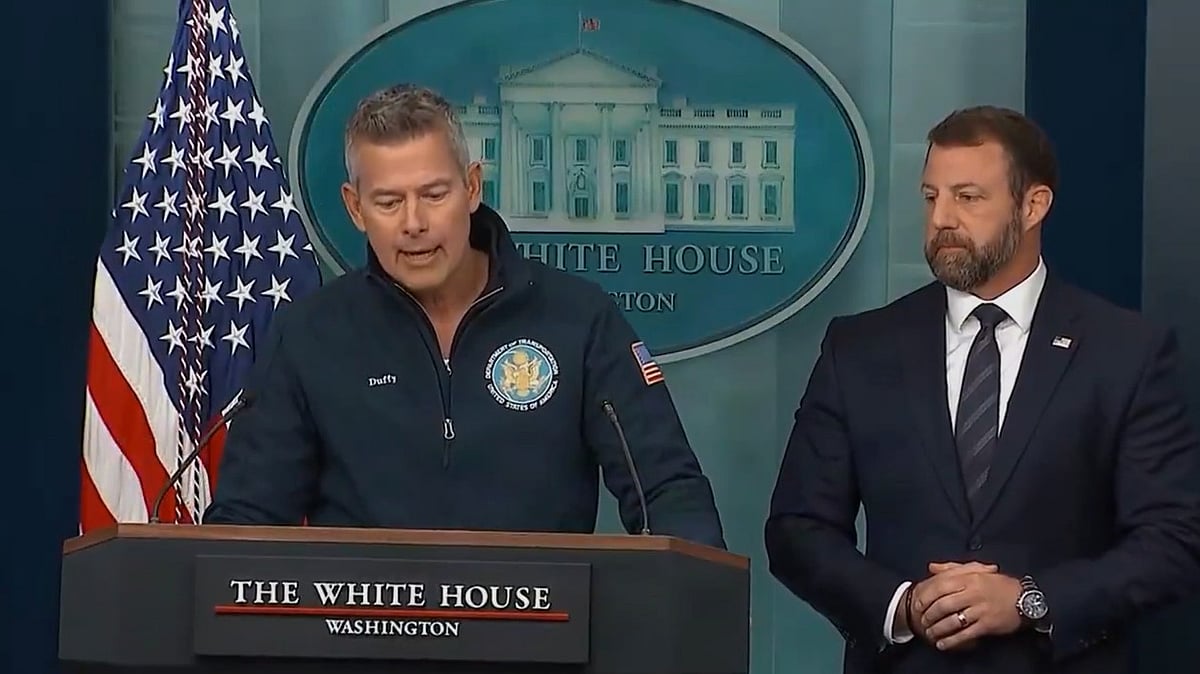
US Transportation Secretary Sean Duffy, addressing reporters during a press briefing, attributed the technical failure to ageing telecommunications infrastructure and called on Congress to provide funds for a comprehensive overhaul of the country's air traffic control system.
What Caused The Nationwide Ground Stop?
Duffy said the disruption began at approximately 3:36 pm (local time), when radar and communication systems at air traffic control centres and Terminal Radar Approach Control (TRACON) facilities across the country experienced instability, prompting authorities to ground flights as a precautionary measure.
"At 3:36 p.m., we experienced instability for our radar and our communications in our centres and our TRACONs across the country," Duffy said.
Explaining the decision to impose the nationwide ground stop, he said air traffic controllers began receiving inconsistent radar data and communication signals from aircraft, prompting authorities to activate established safety procedures.
"The TRACONs and the centres, we started to have inconsistency in the data from the radars and our communication with airplanes. And we have procedures for this. Our pilots are well trained, our air traffic controllers are well trained, and at that point we issued a ground stop," he said.
Over 3,500 Aircraft Were Airborne When Ground Stop Was Issued
Duffy said more than 3,500 aircraft were airborne when the ground stop was issued, adding that authorities coordinated their safe landing. At the time of his briefing, fewer than 400 aircraft remained in the airspace.
He clarified that critical aviation operations, including medical evacuation flights, cargo movements carrying life-saving medicines and law enforcement operations, were allowed to continue despite the restrictions.
"We didn't lose all telecom, we didn't lose all radar, but that instability because of an abundance of caution and making sure we keep the American flyer safe we did the ground stop, but we were going to allow those life-saving movements to still occur," Duffy said.
Sean Duffy Blames Ageing Telecom Infrastructure
Attributing the disruption to outdated infrastructure, the Transportation Secretary explained that the country's legacy telecommunications equipment, which operates on an analogue system, had become overloaded with data, resulting in inconsistencies in the information transmitted through its routers and switches.
"We have TDM telecom. So, this is analog telecom. Our switches, our routers actually got overloaded with data, and they went down. And—I shouldn't say they went down they started to give us inconsistency in the data from those routers, and because of that we shut the system down," he said.
Duffy added that newer Internet Protocol (IP) switches installed under the Trump administration continued functioning during the incident, while older hardware experienced technical instability.
He also renewed the administration's appeal to Congress to provide bipartisan funding for a comprehensive modernisation of the US air traffic control system, arguing that incremental repairs would not adequately address the infrastructure challenges.
"The president for the last year has been asking Congress to fully fund a full build of a brand new air traffic control system," Duffy said.
"Let's not do a patchwork fix to a system that's critical for every single family. It's not red, it's not blue, it's not Democrat, it's not Republican. It's American. Give us the money to fix it," he added.
Level up your brain the fun way. Play daily games and quizzes on FPJ Smart!
US Rules Out Cyberattack, Microsoft Link
Meanwhile, US Homeland Security Secretary Markwayne Mullin assured passengers that there was no indication that the telecommunications outage was linked to a national security threat or cyberattack.
"I want to make sure everybody understands that there is no connection between this and Microsoft. I know a lot of people are making that jump. So far, what we've seen, there is actually no cyberattack. We're still working through that process. Our teams are working," Mullin said, dismissing speculation linking the incident to a separate Microsoft disruption.
Mullin said the Trump administration had mobilised resources across government agencies to respond to the situation and ensure passenger safety.
He also said the Federal Emergency Management Agency (FEMA) had activated its centres to assist passengers who might require essential medication or other support due to the disruption.
"We are working with the airports, with the communities, with the cities, the states, to make sure those passengers that may find themselves in need—FEMA has activated their centres to make sure that there's no medication that is being missed," he said.
Around 7,000 Flights Delayed Or Cancelled, Air India Issues Advisory
The FAA had earlier issued the nationwide ground stop after a temporary telecommunications outage affected air route traffic control operations across the United States. The agency confirmed that all flights had been accounted for, while international arrivals were being handled on a case-by-case basis.
According to flight-tracking platform FlightAware, approximately 7,000 flights were delayed or cancelled following the disruption. Flightradar24 data had also indicated that thousands of aircraft were airborne and heading towards US airports when the ground stop was announced.
The disruption prompted airlines to issue travel advisories, with Air India warning of possible consequential disruptions to its flights to and from the United States.
In a post on X, the airline said, "A nationwide ground stop is currently in effect across the US due to communication outages affecting air traffic operations. As a result, departures from airports across US are impacted, with possible consequential disruptions to Air India flights to and from the U.S."
The airline advised passengers to check their flight status before proceeding to airports, adding that its teams were closely monitoring the situation.
(Except for the headline, this article has not been edited by FPJ's editorial team and is auto-generated from an agency feed.)

