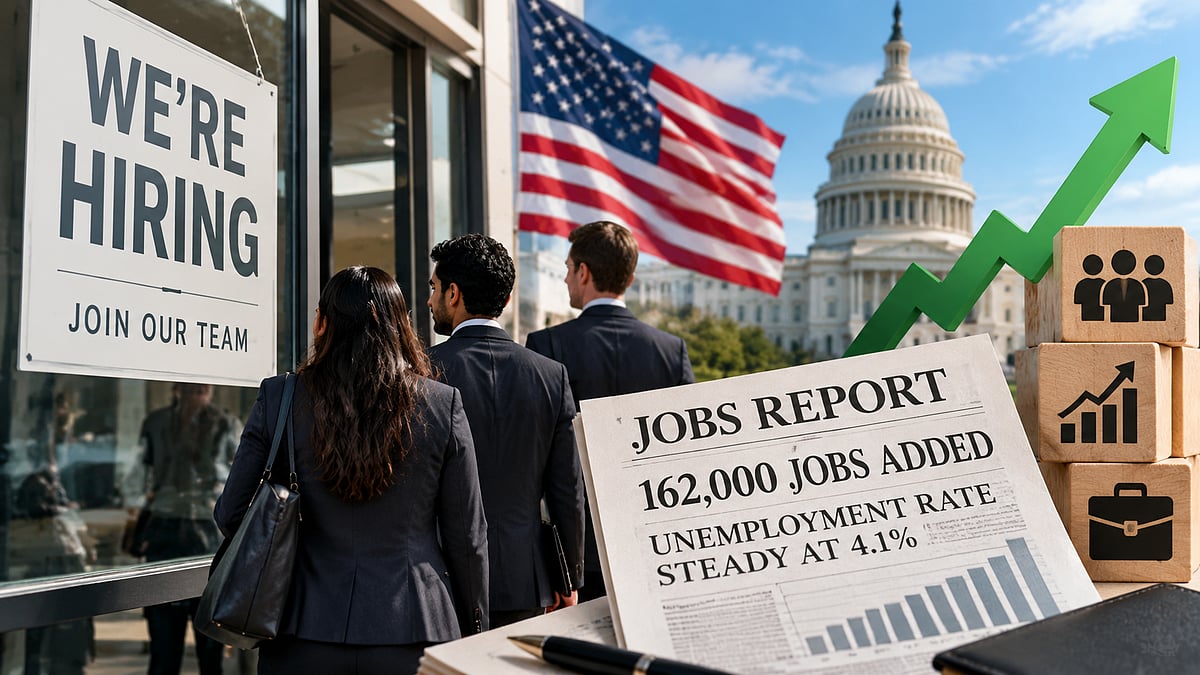
The US job market rebounded in August, with employers adding a stronger-than-expected 162,000 jobs while the unemployment rate remained at a low 4.1%.
The Labour Department's jobs report, released on Friday, could provide a boost to President Donald Trump two months before the midterm elections, with the state of the economy weighing on voters' minds.
Hiring beats forecasts
Hiring substantially exceeded the 65,000 jobs that forecasters had expected, according to a FactSet poll. Labour Department revisions also added 55,000 jobs to previously reported June and July payroll figures.
Employers created 21,000 jobs in July, compared with the department's earlier estimate that they had cut 23,000 jobs.
The US labour force, comprising people working or looking for work, also increased by 683,000 in August after declining in June and July.
Worker shortage reshapes labour market
Companies have been grappling with a shortage of workers amid Trump's immigration crackdown and the retirement of baby boomers. Some employers are responding by turning to technology for tasks previously performed by people.
At the same time, companies have been reluctant to lay off existing employees, providing most American workers with unusual job security and helping keep unemployment low.
“It's a very strange labour market,'' David Kelly, chief global strategist at JP Morgan Asset Management, wrote in a commentary on Monday.
The central puzzle is that hiring remains weak even as layoffs are rare.
The Labour Department reported on Tuesday that gross hiring, before accounting for people who lost or left their jobs, fell 5% to fewer than 5.1 million new jobs.
Fewer workers competing for jobs
The US no longer needs to create as many jobs as it did until recently to prevent the national unemployment rate from rising. Trump's immigration crackdown and baby boomer retirements have reduced the number of people competing for work.
More than 1.3 million people have left the US labour force over the past year.
As a result, the monthly "break-even" hiring rate, which stood at 155,000 in 2023-2024, may have fallen to nearly zero, according to a Federal Reserve study.

Instead of hiring from a smaller pool of available workers, “businesses are increasingly focused on boosting efficiency through technology and AI and increasingly seek to do more with their existing workforce,'' EY-Parthenon economists Gregory Daco and Lydia Boussour wrote in a commentary this week.
Low layoffs offer job security
Despite subdued hiring, companies remain reluctant to shed workers, partly because of memories of the unexpected labour shortages that followed the end of Covid-19 lockdowns.
The number of people applying for unemployment benefits, a proxy for layoffs, has remained in a historically low range of around 200,000 to 230,000 over the past year.
The combination has produced what economists describe as a “no-hire, no-fire” labour market. Those already employed enjoy considerable job security, while conditions remain difficult for young people seeking entry-level positions and unemployed workers trying to return to the workforce.

