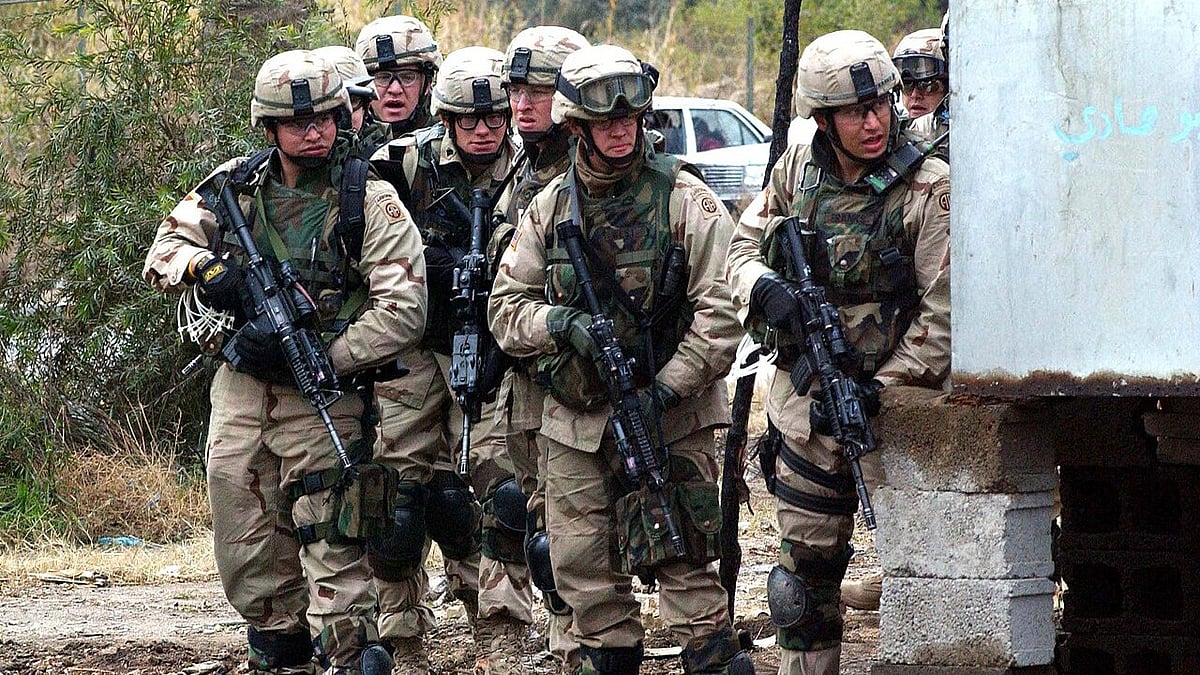
The Pentagon has formally issued written orders for approximately 2,000 to 3,000 paratroopers from the US Army’s elite 82nd Airborne Division to deploy to the Middle East, marking a critital escalation in the ongoing conflict between the US, Israel and Iran.
As Operation Epic Fury enters its second month, this move signifies a shift from a purely standoff air and sea campaign toward potential ground-based joint forcible entry operations. While the administration has conducted a high-intensity bombing campaign—striking over 9,000 targets including IRGC headquarters, ballistic missile sites, drone factories and 140 naval vessels—President Donald Trump is now weighing the possibility of putting American boots on Iranian soil to seize and hold contested territory.
According to The Washington Post, a significant military buildup is underway in the Middle East as three warships from the Tripoli Amphibious Ready Group arrive with approximately 4,500 troops. This force centres on the Okinawa-based 31st Marine Expeditionary Unit, a specialised group of 2,200 personnel that includes an 800-man infantry battalion.
To sustain this presence, the 11th Marine Expeditionary Unit has also launched early from San Diego aboard the USS Boxer and its strike group. Although the 11th MEU is still several weeks away from the region, it is positioned to eventually supplement or rotate out the 31st MEU as operations continue.
Strategic objectives: Kharg Island and the Strait of Hormuz
A central component of US strategic planning involves the potential seizure of Kharg Island, a vital territory 15 miles off the Iranian mainland that handles approximately 90 per cent of Iran’s oil exports. While previous strikes targeted military installations on the island, the oil infrastructure was intentionally left intact to serve as economic leverage.
Securing this high-value hub would provide Washington with significant weight in negotiations, though officials acknowledge that paratroopers would likely have to weather persistent barrages of Iranian drones and missiles once established. Other potential targets include the Iranian shoreline along the strategic Strait of Hormuz.
Tactical integration
The paratroopers will integrate with a massive naval buildup already in the CENTCOM area, including the USS Gerald R Ford and USS Abraham Lincoln carrier strike groups.
Known as 'America’s Guard of Honourr,' the 82nd Airborne carries a legacy spanning from the night jumps into Normandy on D-Day to being the final unit on the ground during the 2021 Kabul evacuation. Their "AA" patch, representing all 48 states at the time of the unit's 1917 founding, remains a symbol of rapid ground-combat flexibility.
However, the transition to ground operations carries significant risks. To date, 290 US service members have been wounded in the conflict while 255 have returned to duty, the move onto Iranian territory would dramatically increase the potential for casualties. Whether used for limited island seizures or a mainland push, the deployment of the 82nd Airborne signals that the United States is prepared for a prolonged, multi-faceted engagement in the Iranian theatre.
Tip of the spear: Readiness and capabilities
Based at Fort Liberty, North Carolina, the "All-American" division serves as the primary fighting arm of the XVIII Airborne Corps and the core of the nation’s Immediate Response Force (IRF). Led by Major General Brandon Tegtmeier, a veteran of the 75th Ranger Regiment, the division maintains extreme readiness through a rotating "picket duty" schedule.
Under the 18-hour rule, specific units keep gear packed and travel restricted, allowing them to mobilise and begin landing anywhere in the world within 18 hours via C-17 and C-130 transport planes.
Unlike standard infantry, the 82nd specialises in seizing airfields and critical infrastructure from the air without the need for a friendly port. By dropping paratroopers and light equipment—such as the M110A1 Squad Designated Marksman Rifle—directly onto a target, they establish a "lodgment" that allows heavier conventional forces to follow.
The current deployment specifically activates the 1st Brigade Combat Team (the "Devils in Baggy Pants") and its headquarters element, which recently withdrew from exercises at Fort Polk to prepare for active theatre operations.
