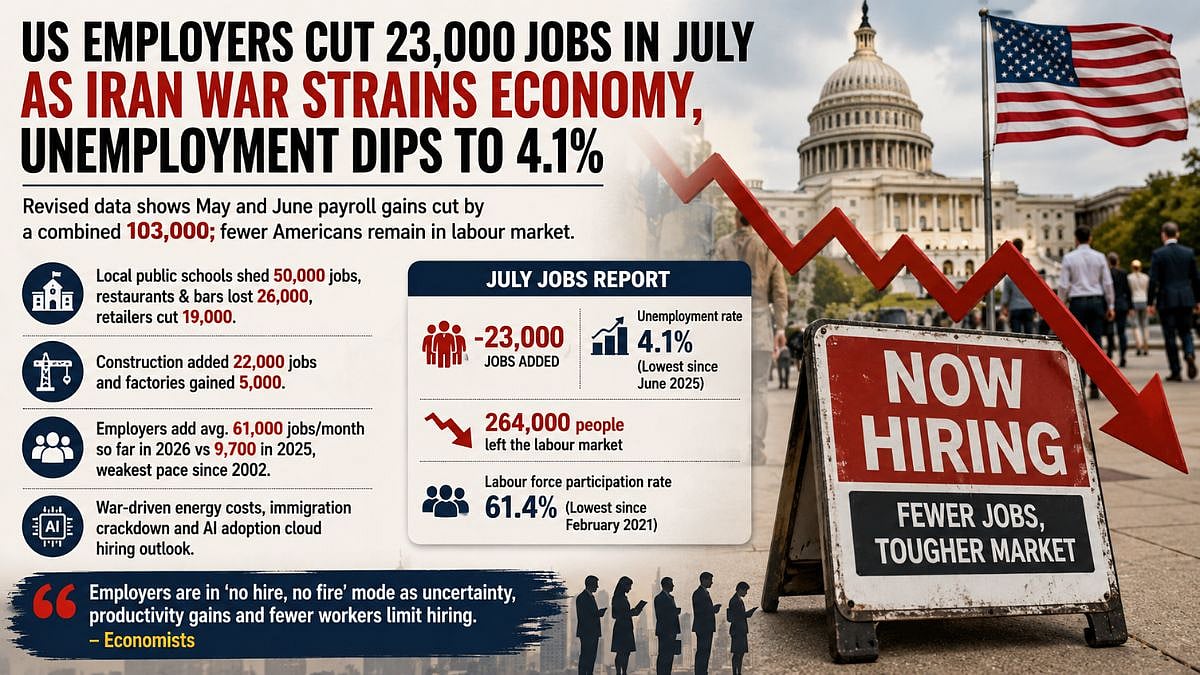
Washington, August 7, 2026: US employers unexpectedly shed 23,000 jobs in July, while revisions by the Labor Department reduced previously reported payroll gains for May and June by a combined 103,000. The unemployment rate fell to 4.1 per cent, largely because fewer Americans remained in the labour market.
July Payrolls Defy Forecasts
The latest Labor Department figures marked a sharp deterioration in the US labour market and dealt a political setback to President Donald Trump, with the Republican Party seeking to retain control of Congress in the midterm elections.
Economists had forecast that employers would add nearly 100,000 jobs in July. Instead, local public schools shed 50,000 jobs, restaurants and bars lost 26,000 positions, and retailers cut 19,000.
The unemployment rate of 4.1 per cent was the lowest since June 2025. However, 264,000 people left the labour market, reducing the proportion of Americans working or seeking employment to 61.4 per cent, its lowest level since February 2021.
The Trump administration highlighted gains in sectors targeted by its economic policies. Construction companies added 22,000 jobs and factories gained 5,000.
“The Trump industrial resurgence is on schedule. Manufacturing and factory construction jobs grew again in July even as government payrolls continued to significantly shrink,” White House spokesman Kush Desai said.
Hiring had recovered this year following a weak 2025, but the conflict in the Persian Gulf has driven up energy prices and put additional pressure on household budgets. Some employers are struggling to fill vacancies, while others are increasingly relying on technology to perform work previously done by employees.
Fewer Americans Remain In Workforce
Workers who already have jobs continue to enjoy relatively strong job security, with layoffs remaining low by historical standards. Companies remain cautious about reducing staff after experiencing labour shortages following the Covid lockdowns.
During one week in July, the number of Americans applying for unemployment benefits fell to its lowest level in more than 50 years. However, those who lose their jobs or are entering the labour market for the first time are finding it increasingly difficult to secure employment.
Economists have described the situation as “no hire, no fire”.
Employers have added an average of 61,000 jobs a month so far this year, compared with 9,700 in 2025, which was the weakest annual pace outside a recession since 2002.
The US economy also needs fewer new jobs than previously to prevent unemployment from rising. Trump’s immigration crackdown and the continuing retirement of baby boomers have reduced the number of people available for work. A Federal Reserve study suggests the monthly “break-even” hiring rate, which stood at 155,000 in 2023–2024, may now be close to zero.
“There are just fewer people available to hire,” BMO Capital Markets senior economist Sal Guatieri said.
Labour shortages have also contributed to stronger wage growth for some employees. Payroll processor ADP reported that workers who changed jobs in July received a 7 per cent year-on-year pay increase, the largest in nearly a year, compared with a 4.4 per cent rise for those who remained with their employers.
Companies are simultaneously becoming more productive by using technology to perform tasks previously handled by workers.
“We are seeing companies produce more with their current staff,” Guatieri said. “So there’s less need to take on new workers.”
Shortages of workers and productivity gains, he added, “will keep the lid on the rate of hiring and monthly job growth.”
War, AI Cloud Hiring Outlook
The outlook remains uncertain as fighting in the Persian Gulf pushes up energy costs and squeezes household budgets. The increasing adoption of artificial intelligence also poses an uncertain impact, potentially improving worker productivity and wages or replacing some jobs.
Researchers Ingrid Chen, Marianna Kudlyak, and Riva Mikhlin of the Federal Reserve Bank of San Francisco found that securing employment has become unexpectedly more difficult over the past two years.
More than six years after the last recession, employers would normally be expected to draw younger and less-educated workers into employment as demand for labour increases. The researchers found that this has not happened.
“Instead of being pulled in, the pipeline into employment is shrinking such that the recovery is no longer reaching workers at the margins,” Chen, Kudlyak, and Mikhlin wrote.
Also Watch:

Even unemployed Americans aged 25 to 54 and those with college degrees, groups that typically return to employment relatively quickly, are struggling to find jobs.
The researchers said the reasons remained unclear, but possible factors included the immigration crackdown, slower hiring by technology companies and government contractors, uncertainty over government policy, or “early signals of broader labour market deterioration.”
To get details on exclusive and budget-friendly property deals in Mumbai & surrounding regions, do visit: https://budgetproperties.in/

