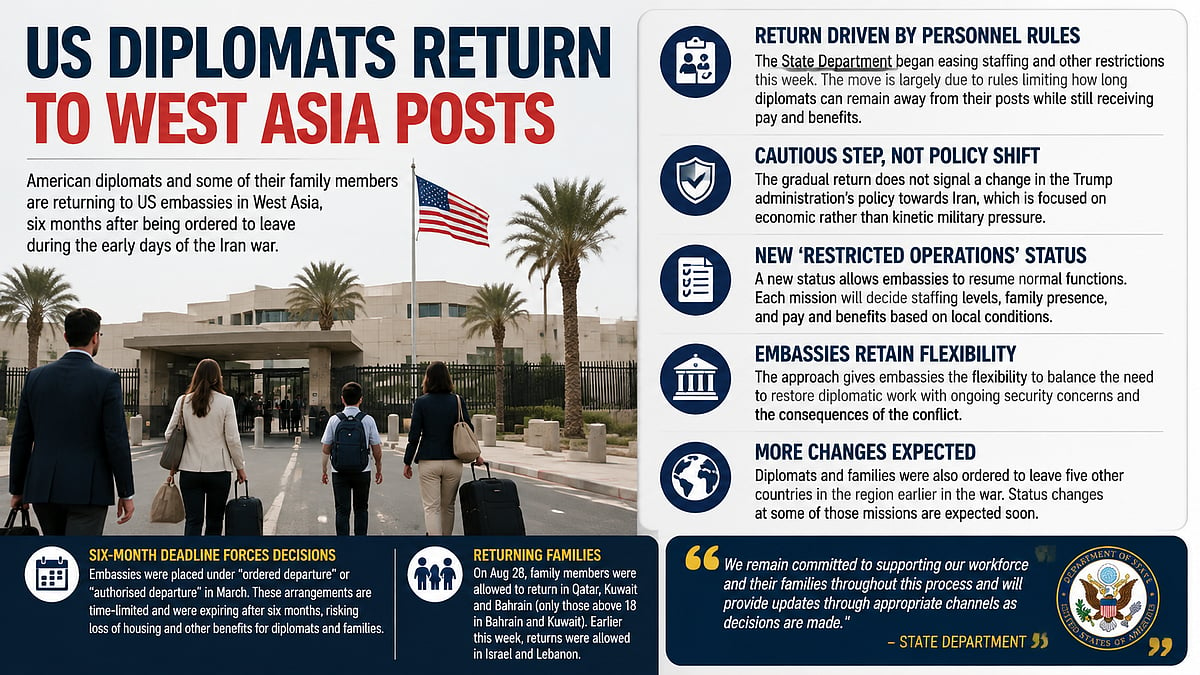
American diplomats and some of their family members have begun returning to US embassies in West Asia, six months after many were ordered to leave their posts during the early days of the war with Iran.
Most embassies are not immediately returning to full strength, but the US State Department began lifting some staffing and other restrictions this week. The gradual return suggests a cautious attempt to restore normal diplomatic operations while security concerns in the region remain.
Return Driven by Personnel Rules
The changes do not necessarily signal a shift in the Trump administration's policy towards Iran, which is now focused on economic rather than kinetic military warfare. Instead, they are largely driven by human resources rules that limit how long diplomats can remain away from their posts while continuing to receive pay and benefits for themselves and their families, AP reports.
On Friday, August 28, when the Iran war completed six months, US embassies in Qatar, Kuwait and Bahrain announced that they would allow diplomats' family members to return. In Bahrain and Kuwait, however, the decision applies only to family members older than 18.
Earlier in the week, all family members of US government employees in Israel were given permission to return. Family members over the age of 21 of employees working in Lebanon were also allowed to return.
Six-Month Deadline Forces Decisions
The embassies had been placed under "ordered departure" or "authorised departure" status in March after Iran began retaliating against US and Israeli attacks by targeting US interests, including embassies and military facilities. The retaliation also created chaotic situations in countries across the region.
Under ordered departure, all non-essential personnel and their families must leave the country. Authorised departure allows employees deemed non-essential and their families to leave.
But these arrangements are time-limited under regulations and were beginning to expire six months after being imposed. Without a change in status, affected diplomats and their families faced the prospect of losing housing and other benefits, potentially creating significant hardship for the workforce.
New Status Offers Embassies Flexibility
To address the situation, the State Department created a new "restricted operations" status designed to allow embassies to resume normal functions. Each affected embassy will decide on a case-by-case basis what staffing levels are appropriate, whether families can be present, and how pay and benefits will be handled.

The approach gives individual embassies room to respond to local conditions rather than imposing a uniform return across the region. It also underlines the difficult balance between restoring diplomatic operations and accounting for the continuing consequences of the conflict.
Diplomats and their families were also ordered to leave US embassies in five other countries in the region early in the war. Changes in status at some of those missions were expected soon.
"We remain committed to supporting our workforce and their families throughout this process and will provide updates through appropriate channels as decisions are made," the State Department said.

