The U.N. food chief warned Tuesday the war in Ukraine has created “a catastrophe on top of a catastrophe” and will have a global impact “beyond anything we’ve seen since World War II” because many of the Ukrainian farmers who produce a significant amount of the world’s wheat are now fighting Russians.
David Beasley, executive director of the U.N. World Food Program, told the U.N. Security Council that already high food prices are skyrocketing.
His agency was feeding 125 million people around the world before Russia’s invasion of Ukraine on Feb. 24, and Beasley said it has had to start cutting their rations because of rising food, fuel and shipping costs. He pointed to war-torn Yemen where 8 million people just had their food allotment cut 50%, “and now we’re looking at going to zero rations.”
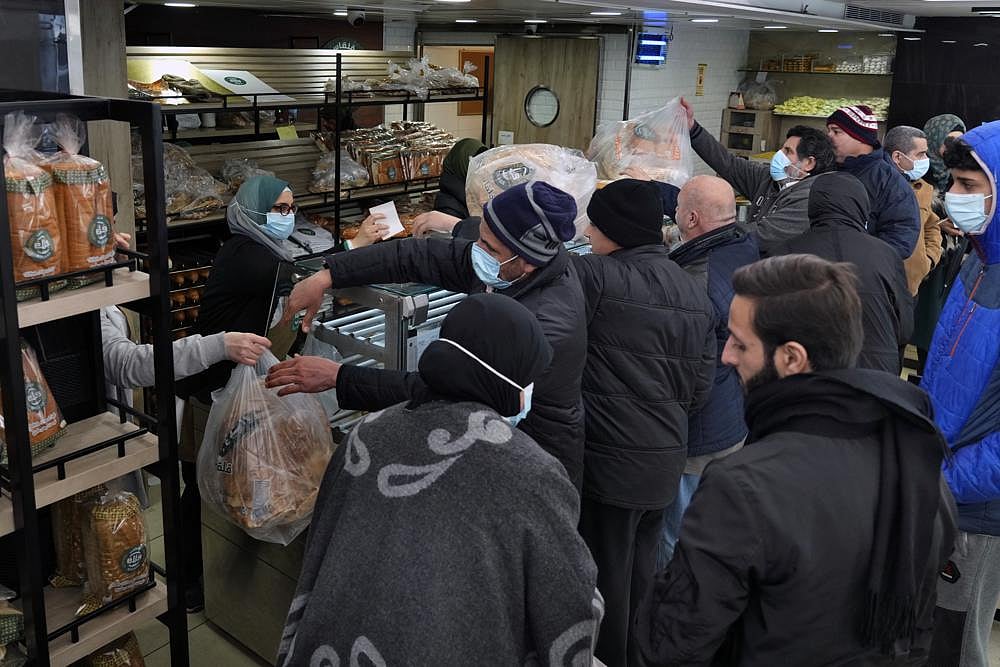
The war in Ukraine is turning “the breadbasket of the world to breadlines” for millions of its people, while devastating countries like Egypt that normally gets 85% of its grain from Ukraine and Lebanon that got 81% in 2020, Beasley said.
As Russia invaded Ukraine, one of the world’s largest breadbaskets, the worst surge in global food prices since the Great Recession looms large over the world. Moscow’s war against Ukraine could spark crisis-level hikes, inflame the scourge of world hunger and spark political turmoil far from the conflict zone.
Food prices across the world were already rising fast amid supply chain disruptions and pandemic-related inflation. However, some prices—especially that of wheat—have shot through the roof because of the Ukraine crisis, upending calculations of the world’s available food supply and leading to the rationing of flour in parts of the Middle East.
Ukraine and Russia together produce nearly 30 percent of the world’s traded wheat and 12 percent of its calories. Without them, soaring food prices and shortages could touch off a wave of instability the world hasn’t seen since the Arab Spring of 2012. The war has all but shut down grain exports from both countries.
And since the two nations (along with Russia’s sanctioned ally Belarus) also supply vast amounts of fertilizer, Vladimir Putin’s invasion of Ukraine could affect every farmer on earth this year, and into the foreseeable future.
A recently published report by the Food and Agriculture Organization (FAO) of the United Nations estimates food and feed prices could surge to up to 22 per cent above the already elevated levels due to the war. Now putting that in terms of real-life inflation, costs are approaching the global food crisis of 2007 and 2008, when droughts, the rise of biofuels and a barrage of trade protectionism merged into the worst food inflation since the Soviet grain crisis of the 1970s.
In the short run, the FAO says, large grower countries—Australia, Argentina, India and the United States—could make up for a portion of the grain shortfalls from Ukraine and Russia. However, the FAO’s preliminary assessment is that, due to the war, 20 per cent to 30 per cent of wheat, corn and sunflower seed crops will either not be planted or go unharvested during Ukraine’s 2022-2023 season.
China, facing its worst wheat crop in decades after severe flooding, is planning to buy much more of the world’s dwindling supply. And India, which ordinarily exports a small amount of wheat, has already seen foreign demand more than triple compared with last year.
While virtually every country will face higher prices, some places could struggle to find enough food at all.
Armenia, Mongolia, Kazakhstan and Eritrea have imported virtually all of their wheat from Russia and Ukraine and must find new sources. But they are competing against much larger buyers, including Turkey, Egypt, Bangladesh and Iran, which have obtained more than 60 percent of their wheat from the two warring countries.
For the global food market, there are few worse countries to be in conflict than Russia and Ukraine. Over the past five years, they have together accounted for nearly 30 percent of the exports of the world’s wheat, 17 percent of corn, 32 percent of barley, a crucial source of animal feed, and 75 percent of sunflower seed oil, an important cooking oil in some parts of the world.
(with inputs from AP)


