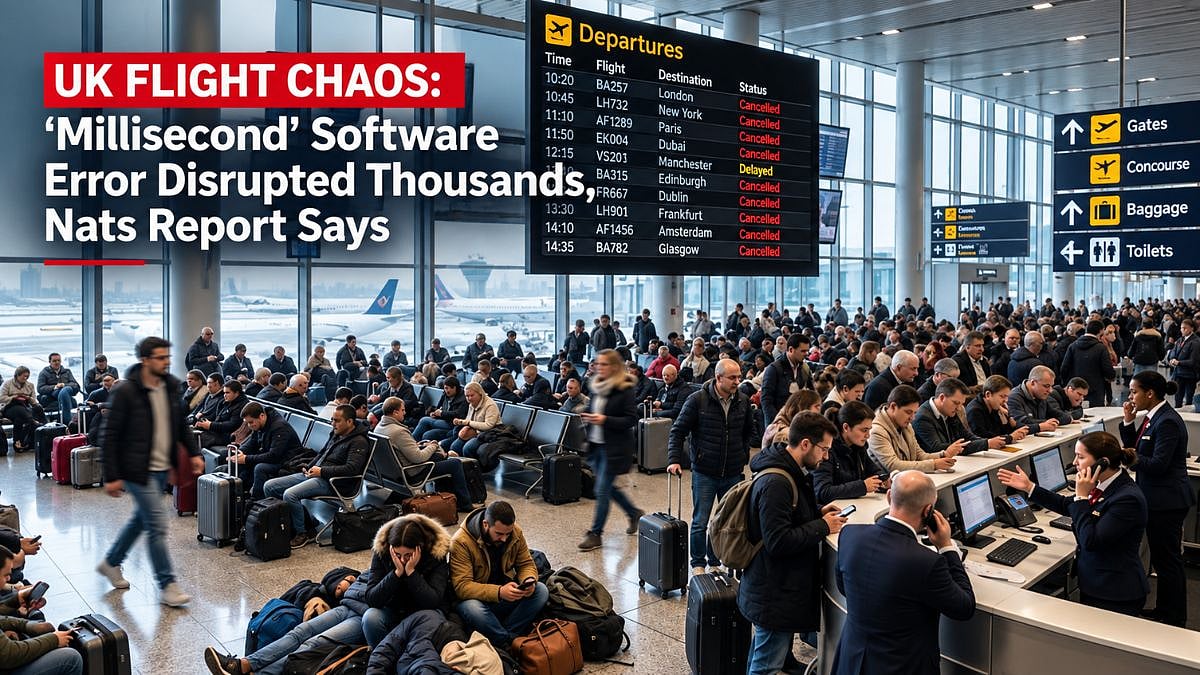
A previously unknown software defect in the UK’s air traffic control system corrupted flight data “in the space of a millisecond”, triggering a six-hour outage that led to widespread cancellations and delays and disrupted hundreds of thousands of passengers, National Air Traffic Services (Nats) has said.
The failure occurred on September 8 and caused disruption across the UK and beyond, with the backlog taking more than two days to clear. More than 2,000 flights were eventually cancelled.
Ministers said the preliminary Nats report left questions unanswered, with UK Transport Secretary Heidi Alexander saying authorities needed “to urgently understand why this issue was not discovered and fixed before it caused chaos”.
Error First Detected At 10am
According to the report, the software error first occurred at 10am. Engineers were notified at 10.02am that the link between the National Airspace System (NAS) and the London area control system had dropped.
By 10.06am, engineers reported that the system appeared to have recovered without any operational impact, although they continued investigating the problem.
The report described the failure as a “legacy and previously unknown software defect and a combination of very specific events occurring simultaneously” in part of the NAS, which allocates codes to individual aircraft to identify flights on radar.
The fault occurred while the system was processing a manual request for an aircraft code. The process was paused for another unspecified, higher-priority activity before resuming incorrectly.
“When processing of the aircraft code request resumed, the software defect meant it did not resume correctly and the resulting output was corrupted, and affected some subsequent flight data updates. This happened in the space of a millisecond.”
System Failed Completely By 1.32pm
At 12.32pm, the link between the national and London airspace management systems dropped again and Nats declared a major incident, forcing controllers to carry out some tasks manually.
Nats began restricting flights by 12.45pm as the system continued to malfunction before it failed completely at 1.32pm. Airlines were informed of restrictions at 1.40pm.
Between 2.50pm and 4.09pm, Nats rebooted the system and eventually restored full operations at 7.30pm. However, the failure left widespread congestion, displaced aircraft and hundreds of thousands of passengers facing delays.
Nats Chief Executive Officer Martin Rolfe said the incident was unrelated to previous failures and added that he could “confirm that it was a software issue and not caused by any incorrect actions by either military or civil operators”.
“The issue has been identified and mitigation is in place while a permanent fix is safety tested and deployed.”
Rolfe also apologised to those affected.
“I would like to apologise again, very sincerely, to everyone who was affected last week. It’s our job to get people where they want to go, quickly and without delay and we are devastated when that goes wrong. However, our primary role is to keep our skies safe, and everyone who flies through them. At no point last week was safety in question.”
Regulator To Conduct Independent Review
Alexander said the disruption was unacceptable and announced that the Civil Aviation Authority (CAA) would independently review the incident and Nats’ wider resilience.
“The disruption we saw last week was completely unacceptable and I know how frustrating it was for passengers, airlines and airports.”
Alexander added: “It’s clear we need to urgently understand why this issue was not discovered and fixed before it caused chaos.
“I have therefore tasked the CAA with conducting an independent review to check Nats’ findings and investigate their investment plans to enhance resilience in the future, along with regulatory accountability.”
The CAA review will be published within six months. A government source said it would provide “a chance to fundamentally investigate” whether Nats was fit for purpose.
Airlines Seek Compensation, Action
Airlines have sought compensation and called for measures to prevent another widespread failure. The incident was the third major UK air traffic control failure since summer 2023.
Airlines UK Chief Executive Tim Alderslade said: “The CAA’s review must mandate real investment in Nats’ resilience so a single fault can never again descend into nationwide disruption.”
He said members of the industry group were writing to Nats to “demand immediate compensation for the costs incurred and a credible plan to improve resilience”.
Also Watch:

EasyJet Chief Executive Kenton Jarvis said: “Passengers deserve more than just another promise that lessons will be learned. Firm actions must be taken … and there must be a fair solution to ensure that airlines are not left to pick up the bill.”
Ryanair Chief Operations Officer Neil McMahon said: “‘The software ate my homework’ is not an acceptable explanation … How many times must the UK ATC system collapse before Martin Rolfe accepts responsibility and resigns.”
Ryanair has demanded Rolfe’s dismissal following the latest disruption.
To get details on exclusive and budget-friendly property deals in Mumbai & surrounding regions, do visit: https://budgetproperties.in/

