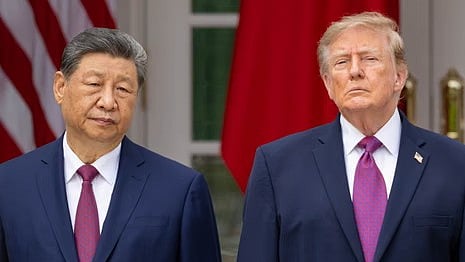
US President Donald Trump hosted Chinese President Xi Jinping at the White House on September 24 for a high-profile summit that combined elaborate diplomatic ceremony with talks on some of the most contentious issues between Washington and Beijing.
Trade, tariffs, artificial intelligence, Taiwan and the broader strategic rivalry between the world's two largest economies dominated the discussions. While both leaders projected a warmer tone and stressed the importance of cooperation, the summit produced limited concrete breakthroughs, with several major disputes left unresolved.
Trade Truce Extended, But No Broad Deal
One of the clearest outcomes was an extension of the existing US-China trade truce. US Treasury Secretary Scott Bessent said the agreement, which was due to expire in November, would be extended by about two months, giving both sides additional time to negotiate outstanding issues.
The extension provides temporary relief from the risk of an immediate escalation in tariffs, but it does not settle the wider trade dispute. Issues including Chinese purchases of US agricultural products, rare-earth and critical-mineral supplies and technology restrictions remain part of the negotiations.
The White House had previously said China would address US concerns over rare-earth supplies and commit to major purchases of American agricultural products, including at least $17 billion annually in 2026, 2027 and 2028.
Taiwan Remains A Major Flashpoint
Taiwan continued to be one of the most sensitive issues in the US-China relationship. Xi urged Washington to handle what Beijing calls the "Taiwan question" with prudence and reiterated China's opposition to Taiwan independence.
The summit did not signal a fundamental change in Washington's longstanding approach to Taiwan. The issue therefore remains a significant source of tension between the two countries, particularly because of its implications for regional security and US-China strategic competition.
AI Emerges As A New Area Of Competition
Artificial intelligence featured prominently in the broader US-China rivalry. Washington and Beijing are competing over AI models, chips, computing capacity and technology supply chains, even as both sides explore ways to manage the risks associated with increasingly powerful systems.
Trump and Xi appeared to approach the issue from different angles. Trump emphasised technological development and existing enforcement mechanisms, while Xi stressed that AI should remain under human control and serve wider societal interests.
The presence of prominent technology and business figures at the White House state dinner, including Elon Musk, Tim Cook, Jensen Huang and Sam Altman, further underlined the growing link between technology, commerce and geopolitics.
Leaders Seek To Manage Strategic Rivalry
Beyond immediate trade and technology disputes, the summit also addressed the larger question of how Washington and Beijing can manage their increasingly competitive relationship.
Xi invoked the idea of the "Thucydides Trap" the risk of conflict between a rising power and an established one and argued that the two countries should avoid allowing competition to become a zero-sum struggle. He also called for regular military communication and stronger mechanisms to prevent crises from escalating.
Trump, meanwhile, highlighted areas where the two countries could cooperate and referred to historical examples of US-China collaboration. The emphasis on maintaining communication reflected an effort by both sides to keep competition from developing into direct confrontation.
Warm Optics, But Core Differences Remain
The summit was marked by elaborate diplomatic pageantry and unusually warm public exchanges. Xi received a formal state welcome, while the White House hosted a state dinner attended by government officials and business leaders. The programme also included cultural and ceremonial events designed to highlight the long history of US-China engagement.
Trump repeatedly emphasised his personal relationship with Xi, while both leaders presented cooperation as important to global stability. However, the cordial atmosphere did not eliminate disagreements over trade implementation, Taiwan, technology controls, critical minerals and the wider strategic balance.

What The Summit Means
The Trump-Xi meeting therefore appears to have delivered a temporary stabilisation of US-China relations rather than a comprehensive settlement. The trade truce extension gives negotiators more time, while continued leader-level engagement keeps diplomatic channels open.
At the same time, the unresolved disputes show that the underlying competition between Washington and Beijing remains intact. Trade, Taiwan, AI, critical minerals and military tensions are likely to remain central issues in future negotiations and leader-level engagements.

