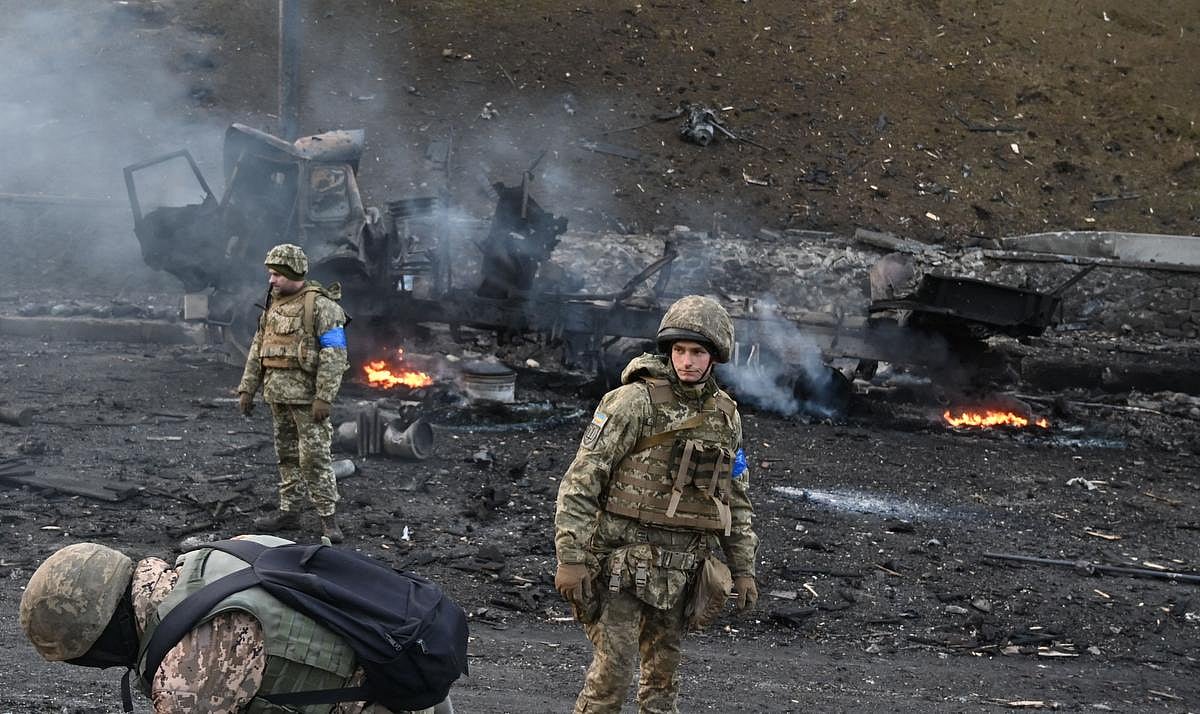
Russian defence officials announced a temporary cease-fire in two Ukrainian cities to allow civilians to evacuate, but a local official reported that shelling continued despite the deal, a sign of the fragility of efforts to stop fighting across the country.
Exasperated at the incessant shelling, Ukraine cancelled a planned evacuation of more than 200,000 civilians from Mariupol and Volnovakha, after it accused Russian forces of derailing the promised ceasefire.
Russia’s defence ministry, in turn, claimed that the firing was against its troops, that no one was using the two humanitarian corridors provided, and that Ukraine’s ‘nationalists’ had prevented civilians from leaving, RIA news agency reported.
Mariupol’s deputy mayor Serhiy Orlov told the BBC: ‘The Russians are continuing to bomb us and use artillery. It is crazy. There is no ceasefire in Mariupol and there is no ceasefire all along the route. Our civilians are ready to escape but they cannot escape under shelling.’ RIA said the Russians had opened humanitarian corridors near the two cities encircled by its troops for five hours between 12 pm and 5 pm Moscow time. The plan was to evacuate around 200,000 people from Mariupol and 15,000 from Volnovakha, and the Red Cross would be the ceasefire’s guarantor.
According to western media sources, the evacuation would have been a prelude to a final assault that, if successful, would see the Russian army push north from occupied Crimea and link up with their forces from the east and take control of Ukraine’s coast on the Sea of Azov.
Mariupol has become a scene of growing misery due to incessant shelling that has knocked out power and most phone service and raised the prospect of food and water shortages for hundreds of thousands of people in freezing weather. Pharmacies are out of medicine.
Diplomatic efforts continued as U.S. Secretary of State Antony Blinken arrived in Poland to meet with the prime minister and foreign minister, a day after attending a NATO meeting in Brussels in which the alliance pledged to step up support for eastern flank members.
As Russian forces batter strategic locations elsewhere, Ukrainian President Volodymyr Zelenskyy lashed out at NATO for refusing to impose a no-fly zone over his country, warning that “all the people who die from this day forward will also die because of you.” NATO has said a no-fly zone could provoke widespread war in Europe with nuclear-armed Russia. But as the United States and other NATO members send weapons for Kyiv and more than 1 million refugees spill through the continent, the conflict is already drawing in countries far beyond Ukraine's borders.
Russia continues to crackdown on independent media reporting on the war, also blocking Facebook and Twitter, and more outlets say they are pausing their work inside the country. And in a warning of a hunger crisis yet to come, the U.N. World Food Program said millions of people inside Ukraine, a major global wheat supplier, will need food aid “immediately.”
The U.N. Security Council has scheduled an open meeting for Monday on the worsening humanitarian situation. The United Nations estimates that 12 million people in Ukraine and 4 million fleeing to neighbouring countries in the coming months will need humanitarian aid.
Kyiv's central train station remained crowded with people desperate to join the more than 1.4 million who have fled Ukraine. “People just want to live,” one woman, Ksenia, said.


