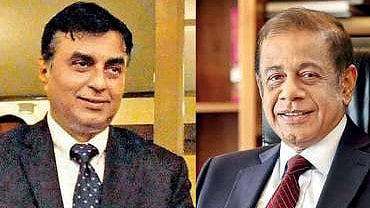
More than seven years after Sri Lanka's devastating Easter Sunday bombings, two of the country's most senior former security officials have been handed the harshest punishment available under the law.
Former Inspector General of Police (IGP) Pujith Jayasundara and former Defence Secretary Hemasiri Fernando were sentenced to death by a special three-judge Permanent Trial-at-Bar on July 31 after being found guilty of criminal negligence and dereliction of duty for failing to act on intelligence warnings that could have prevented the attacks.
The coordinated suicide bombings on April 21, 2019, targeted churches and luxury hotels, killing around 269 people and injuring nearly 500. While both men can appeal before Sri Lanka's Supreme Court, the verdict marks one of the country's most significant accountability measures over the attacks.
Who Is Pujith Jayasundara?
Born on March 15, 1960, in Kurunegala, Pujith Senadhi Bandara Jayasundara spent nearly 35 years in the Sri Lanka Police before becoming the country's 34th Inspector General of Police in April 2016.
A commerce graduate from the University of Sri Jayewardenepura, Jayasundara joined the police service in 1985 as a Probationary Assistant Superintendent of Police. Over the next three decades, he steadily rose through the ranks, serving as Superintendent of Police, Senior Superintendent, Deputy Inspector General and Senior Deputy Inspector General before assuming the nation's top policing role.
He was regarded as an advocate of community policing during his early career, particularly for youth engagement initiatives in Ratnapura, and became the first Inspector General appointed under Sri Lanka's Constitutional Council process introduced after constitutional reforms.
His tenure, however, became overshadowed by the Easter Sunday bombings.
From Police Chief To Convict
Investigators concluded that Jayasundara failed to ensure action despite receiving repeated intelligence alerts, including warnings from Indian agencies identifying radical preacher Zahran Hashim and planned suicide attacks on churches and hotels.
Following the bombings, he was placed on compulsory leave, arrested later in 2019, and eventually retired in 2020.
Although acquitted by a High Court in 2022, the Supreme Court ordered a retrial, culminating in his conviction and death sentence in 2026.
Throughout the proceedings, Jayasundara argued that systemic shortcomings, including limited participation in National Security Council meetings and failures at higher political levels, contributed to the security lapse.
Who Is Hemasiri Fernando?
Unlike Jayasundara, Hemasiri Fernando built his reputation not in uniform but as one of Sri Lanka's most experienced civil servants.
Born on October 12, 1949, Fernando studied at Nalanda College in Colombo before attending the University of Ceylon, where he captained the cricket team. A talented sportsperson, he also represented Sri Lanka in small-bore rifle shooting at the 1982 Asian Games.
His administrative career spanned several decades and multiple governments. He served as Secretary to the Prime Minister, chaired Sri Lanka Telecom, the Airport and Aviation Authority, the Board of Investment, and People's Bank, while also leading the National Olympic Committee of Sri Lanka.
In October 2018, he was appointed Defence Secretary under then-President Maithripala Sirisena.

Resigned Days After The Bombings
Fernando resigned on April 25, 2019, just four days after the Easter attacks, accepting responsibility amid mounting criticism over the government's failure to prevent the tragedy.
Like Jayasundara, he was accused of ignoring multiple intelligence warnings despite receiving information about possible coordinated attacks.
He was arrested in 2019, released on bail, acquitted in 2022, and later retried after the Supreme Court ordered fresh proceedings.
During previous inquiries, Fernando testified that irregular National Security Council meetings, poor intelligence sharing and political decision-making significantly hampered the security establishment's ability to respond effectively.
A Landmark Accountability Verdict
The convictions of Jayasundara and Fernando represent one of the most consequential judicial outcomes arising from the Easter Sunday bombings.
Investigators concluded that the attacks, carried out by members of the National Thowheeth Jama'ath (NTJ), inspired by the Islamic State (ISIS), could potentially have been prevented had repeated intelligence warnings been acted upon.
Although both former officials have been sentenced to death, Sri Lanka has observed a de facto moratorium on executions since 1976, meaning capital punishment is generally commuted to life imprisonment. Both men remain in judicial custody and are expected to appeal the verdict before the Supreme Court.

