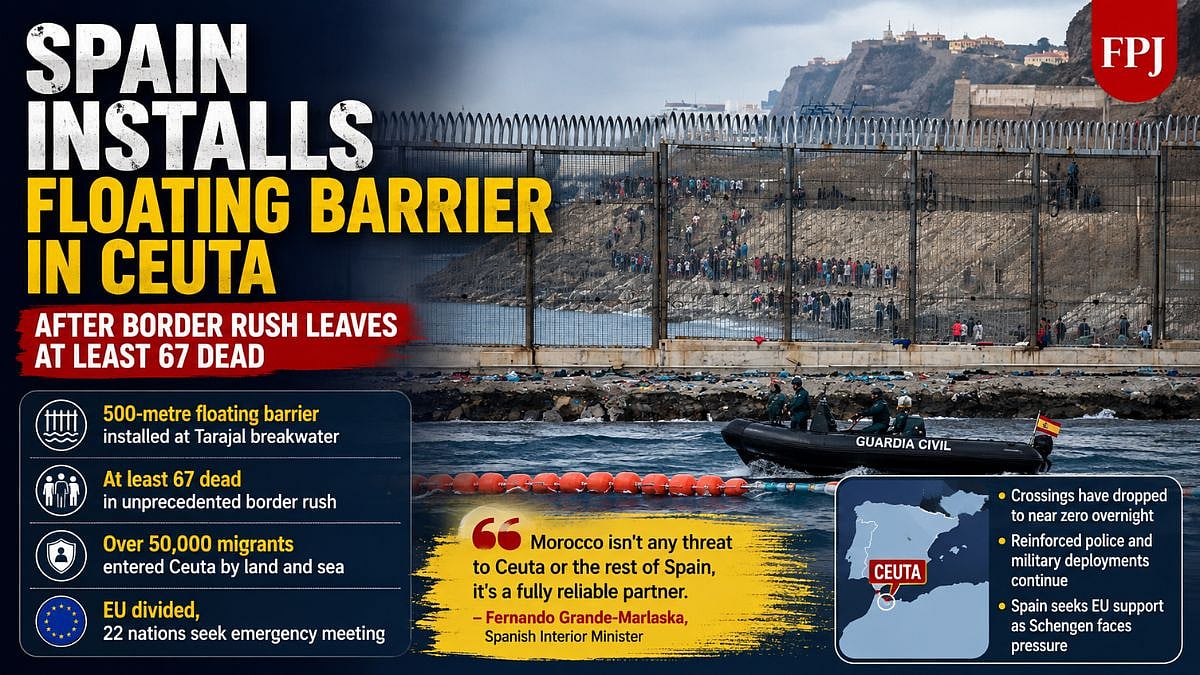
Ceuta, August 1, 2026: Spain has begun installing a 500-metre floating barrier along the coast of its North African enclave of Ceuta after an unprecedented rush across the border with Morocco left at least 67 people dead.
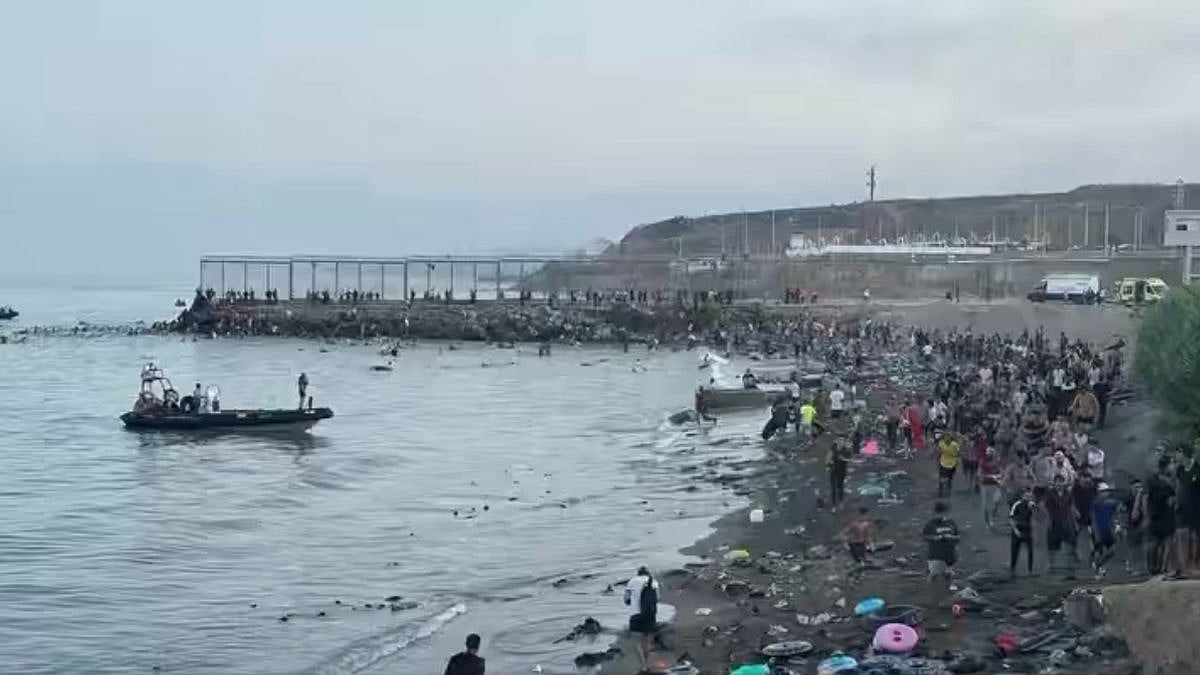
Spanish authorities said migrant crossings had stopped overnight after about 50,000 people entered Ceuta by land and sea from Thursday. More than 48,000 returned to Morocco within 48 hours without any major incident. Spanish soldiers and police continued to patrol Tarajal beach on Saturday.
New Barrier At Tarajal
Civil Guard police began laying the new barrier at 7.50 am on Saturday at the Tarajal breakwater, one of the main points used by people attempting to enter the Spanish territory.
The pneumatic barrier, together with a line of anchored naval buoys, will stand 30 to 70 centimetres above the water and extend up to one metre below the surface. A channel between the barriers will allow Civil Guard vessels to patrol the area, Reuters reports.
The scale of the rush and the deaths underline the dangers migrants face while attempting such crossings, while the speed with which Spain reinforced the frontier shows the political pressure on Madrid to regain control.
At least 67 bodies have been recovered on the Spanish side of the frontier. Officials said some migrants drowned while others were crushed as they tried to climb the breakwater and border fence. Many had been driven to migrate by economic hardship and encouraged by rumours on social media.
Spain Backs Morocco
Spanish Interior Minister Fernando Grande-Marlaska blamed people-smuggling networks for exploiting vulnerable migrants and spreading misleading interpretations of a recent Spanish Supreme Court ruling.
The ruling said migrants intercepted at sea cannot be summarily returned in the absence of a physical barrier.
Speaking in Ceuta, Grande-Marlaska said Spain had largely restored order within 24 hours. However, he warned that the crisis was not formally over and said reinforced police and military deployments would remain for as long as necessary. Overnight crossings had fallen to about zero.
"Morocco isn't any threat to Ceuta or the rest of Spain; it's a fully reliable partner," he said, adding that authorities had received no intelligence indicating that a mass entry was imminent.
Ceuta and Spain's other North African enclave, Melilla, are located on Morocco's Mediterranean coast and periodically face attempted crossings by migrants seeking to reach Europe.
EU Divided Over Crisis
The latest incident has also exposed divisions within the European Union over how to respond to migration at its external borders.
Twenty-two EU governments on Saturday called for an emergency meeting of interior ministers over the Ceuta crisis and urged the bloc to help Madrid regain control of its border with Morocco.
Spanish Prime Minister Pedro Sanchez also asked EU leaders to urgently convene interior ministers. However, he criticised governments that had called for Spain to be excluded from the passport-free Schengen travel area.
Italy's right-wing government said on Friday that it was suspending Schengen arrangements with Spain for one month.
"In the current international context, the EU cannot afford this kind of selfish, polarising and unlawful reaction," Sanchez wrote.
Officials in Rome did not immediately respond to a request for comment on Saturday.
In a letter to Ireland, which holds the EU's rotating presidency, the 22 governments said the crossings posed a challenge to the bloc's external frontier and risked encouraging further illegal migration.
They called for a coordinated response, including possible additional support from EU border agency Frontex and a review of cooperation with Morocco. France, Luxembourg and Portugal did not sign the letter, along with Spain and Ireland.
The disagreement highlights a familiar challenge for the EU: member states agree on the need to manage the bloc's external borders but remain divided over how individual countries should respond when migration pressures suddenly intensify.
Schengen Under Pressure
Madrid said people who entered Ceuta irregularly would not be allowed to travel onwards to mainland Spain or elsewhere in the Schengen zone.
The Spanish Foreign Ministry said travellers leaving Ceuta by sea or air undergo police identity checks, providing a second layer of control after the land border with Morocco.
Spain has taken a more open approach towards migrants than much of Europe, introducing a programme to grant residency to more than half a million undocumented people.
However, Madrid rejected suggestions that the regularisation scheme had encouraged the rush into Ceuta. It said applicants must prove that they were living in Spain before January 1, 2026, as well as five continuous months of residence when applying.
Also Watch:
Sanchez, who visited Ceuta on Friday, described the crossings as a violation of Spain's territorial sovereignty and said returns were being accelerated with Morocco's cooperation.
The immediate rush may have subsided, but the continuing security deployment, the new maritime barrier and demands for an emergency EU meeting indicate that the political fallout from the crisis is far from over.
To get details on exclusive and budget-friendly property deals in Mumbai & surrounding regions, do visit: https://budgetproperties.in/

