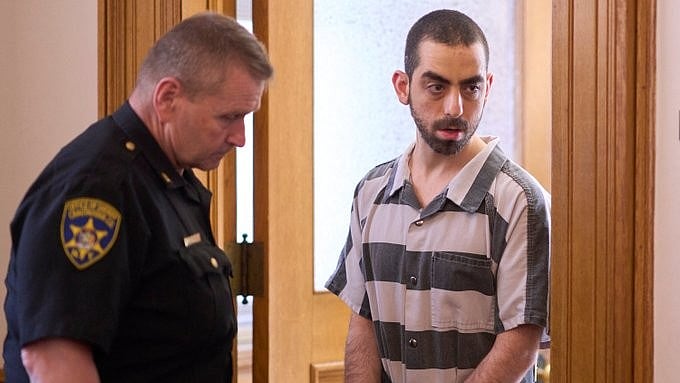
A US federal jury has found Hadi Matar guilty on terrorism charges for the 2022 knife attack on novelist Salman Rushdie, ruling that the assault was motivated by decades-old death threats linked to Rushdie's novel "The Satanic Verses."
Matar, 28, is already serving a 25-year prison sentence after being convicted on New York state charges of attempted murder. He now faces a maximum sentence of life imprisonment when he is sentenced on the federal conviction on November 3.
A US District Court jury in Buffalo, New York, deliberated for about two hours before convicting Matar on all counts, including attempting to provide material support to Lebanon's Iran-backed militant group Hezbollah, a US-designated terrorist organisation, engaging in terrorism transcending national boundaries, and providing material support to terrorists.
Attack linked to fatwa over "The Satanic Verses"
The verdict followed a trial that began last Tuesday and featured testimony from Rushdie, 79, the Booker Prize-winning author of "Midnight's Children." The defence did not call Matar or any other witness to testify.
Rushdie had lived under the threat of death since the publication of "The Satanic Verses" in 1988. In 1989, Iran's then Supreme Leader Ayatollah Ruhollah Khomeini declared the book blasphemous and issued a religious edict, or fatwa, calling on Muslims to kill Rushdie and others involved in its publication.
The fatwa led to a multimillion-dollar bounty and several acts of violence, including the 1991 killing of Rushdie's Japanese translator, Hitoshi Igarashi. Although the Iranian government distanced itself from the fatwa in 1998, it was endorsed by Hezbollah's secretary general in 2006 and reaffirmed in 2017 by Khomeini's successor, Ali Khamenei, according to the US Attorney's Office.
Also Watch:
Rushdie lost vision in one eye after stabbing
Prosecutors said evidence presented during the trial showed Matar spent more than a year researching the fatwa before attacking Rushdie while the author was speaking at the Chautauqua Institution in Mayville, New York, on August 12, 2022.
Rushdie was stabbed more than a dozen times in the head, neck, torso and left hand, leaving him blind in his right eye and causing serious internal injuries. A second person was also injured in the attack before audience members overpowered Matar.
Born in the US and also a Lebanese citizen, Matar lived in Fairview, New Jersey. He was convicted of attempted murder in a New York state court in February 2025 and sentenced to 25 years in prison three months later.
Rushdie, who was born into a Muslim Kashmiri family in India and later became a British and US citizen, spent much of the 1990s in seclusion under British police protection before moving to New York City more than two decades ago. His memoir, "Knife: Meditations After an Attempted Murder," chronicling the attack, recovery and emotional healing, was published in April 2024.

