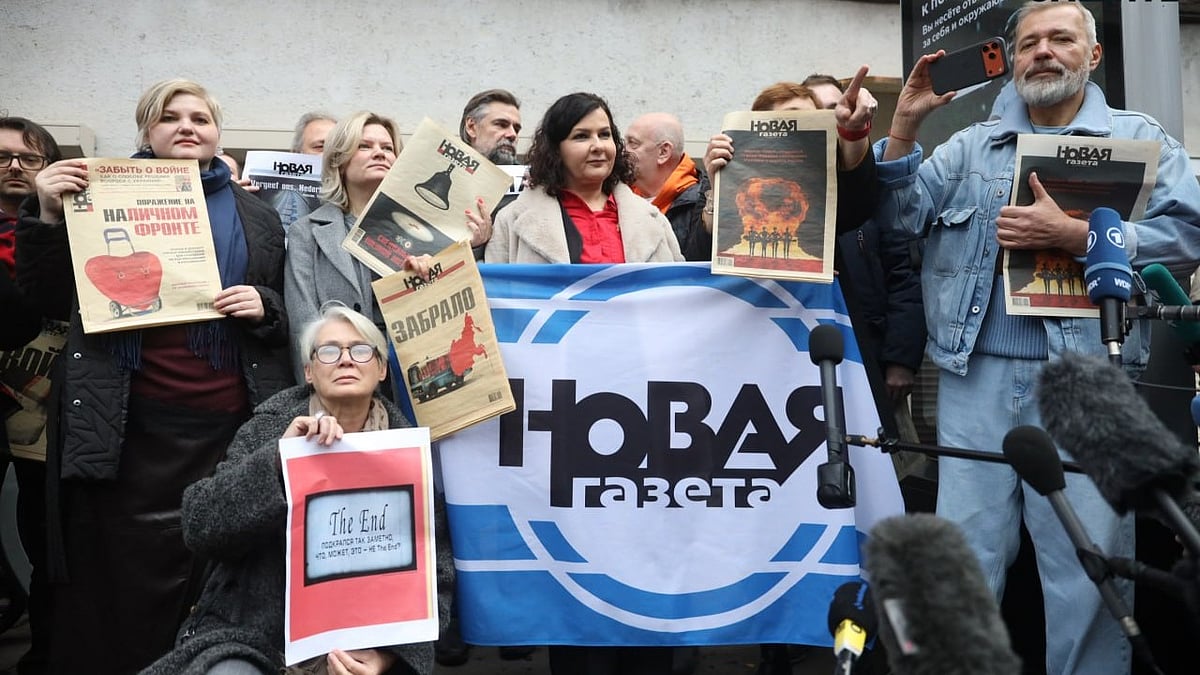
Moscow: Novaya Gazeta, widely regarded as Russia's last major independent newspaper critical of the Kremlin still operating inside the country, shut down its Moscow operations on November 9, 2026, after 33 years. The newspaper's editorial team blamed relentless pressure from Russian authorities and security agencies, saying it had been forced to cease operations.
The closure marks the end of a significant chapter in Russian journalism. Known for its investigative reporting on corruption, human rights violations, police brutality, election fraud and the Chechen wars, the newspaper had continued working despite mounting restrictions, legal action and threats to its journalists.
In a statement published on October 30 titled 'We Have Been Killed', the editorial team said: "We have been killed. On November 9th, we will turn off the lights in the home where we have lived for 30 years, shut down our servers, and leave."
It further alleged that Russian authorities and security services had stripped the newsroom of all its resources and forced its journalists to stop working.
Novaya Gazeta's 33-Year History And Its Founding
Founded in April 1993, shortly after the collapse of the Soviet Union, Novaya Gazeta received early financial support from former Soviet leader Mikhail Gorbachev, who contributed part of the money he received with his 1990 Nobel Peace Prize.
The newspaper was co-founded and long associated with Dmitry Muratov, who received the Nobel Peace Prize in 2021 for his efforts to safeguard freedom of expression.
Over the years, Novaya Gazeta earned a reputation for reporting on corruption, human rights abuses, police misconduct, election irregularities and atrocities during the Chechen wars. Its investigations and coverage of politically sensitive issues made it one of the most prominent independent voices in Russia.
The newspaper operated from its offices at 3 Potapovsky Lane in central Moscow for nearly three decades. Following the pressure that intensified after Russia launched its full-scale invasion of Ukraine in February 2022, a European edition, Novaya Gazeta Europe, was established in Riga, Latvia.
Six People Associated With Newspaper Killed Over Their Work
The newspaper's history is also marked by the killings of six people associated with its reporting and investigations. On its final day, staff removed portraits of the slain colleagues that had hung on the newsroom walls.
They included journalist Igor Domnikov, who was severely beaten near his apartment building in 2000 and died two months later.
Yury Shchekochikhin, a journalist and lawmaker who investigated corruption and organised crime, died in 2003 following what was described as an acute allergic reaction. His colleagues suspected he had been poisoned.
Special correspondent Anna Politkovskaya, known for reporting on human rights abuses during the Second Chechen War, was shot dead in the elevator of her Moscow apartment building in October 2006.
In 2009, journalist Anastasia Baburova and human rights lawyer Stanislav Markelov were shot dead in central Moscow. Natalya Estemirova, a human rights activist and contributor associated with the newspaper, was kidnapped in Chechnya and murdered the same year.
The killings became emblematic of the risks faced by journalists and human rights defenders reporting on sensitive issues in Russia.
Pressure Intensified After Russia's Invasion Of Ukraine
The newspaper faced mounting restrictions after Russia launched its full-scale invasion of Ukraine in February 2022. Russian authorities introduced strict censorship measures targeting independent reporting on the military and the war.
Novaya Gazeta suspended publication in March 2022 after receiving warnings from the media regulator, Roskomnadzor. Its print and online media licences were revoked in September that year, while its website was blocked in Russia, forcing readers to use virtual private networks (VPNs) to access its reporting.
Its printing presses were also seized. The newspaper and several people associated with it, including Muratov, faced 'foreign agent' designations, bringing additional restrictions and scrutiny.
The pressure continued in 2026. In April, the newsroom was raided for around 13 hours, while managing editor and columnist Oleg Roldugin was detained in a case linked to alleged violations involving personal data.
In October, authorities searched the home of editor-in-chief Sergey Sokolov in connection with the same case. The newspaper also faced eviction from its long-time Potapovsky Lane office in central Moscow.
The shutdown of its reader-donation platform further cut off a key source of funding. The editorial team described the developments as a coordinated campaign that left it without the resources needed to continue operating.
Final Editorial Meeting Held As Staff Leave Moscow Office
On November 9, the newspaper's staff held a final editorial meeting before packing up and leaving the newsroom. Muratov and other members of the editorial team were present.
As they prepared to leave, employees removed the portraits of the six people killed in connection with their work. Supporters gathered outside the office, applauding and shouting, "Thank you!"
A sign reading 'Novaya Gazeta lived here' was placed over the newspaper's nameplate, while flowers were left outside the building and at a memorial to Politkovskaya.
The team had planned to publish one final issue before shutting down its servers and leaving the premises. Muratov and Sokolov indicated that the newspaper could continue as an idea, even if its Moscow newsroom had ceased operations.
Meanwhile, Kremlin spokesperson Dmitry Peskov described the closure as a normal process of turnover among media outlets.

Closure Marks Another Blow To Independent Journalism In Russia
Novaya Gazeta's shutdown is a major setback for independent journalism in Russia, where several other critical media organisations have already been blocked, closed or forced to relocate abroad.
The newspaper had continued reporting from inside the country despite restrictions and pressure on its journalists. Its closure leaves fewer spaces for independent reporting and scrutiny of the Russian government within the country.
While its Moscow operations have ended, members of the editorial team have indicated that the newspaper's legacy and commitment to independent journalism may continue in other forms.

