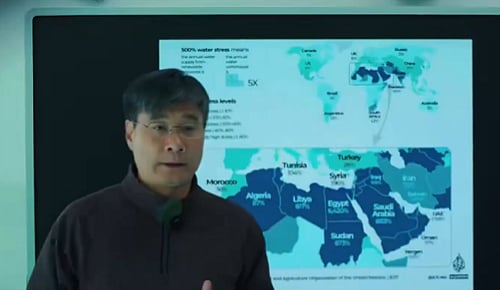
In a scenario of water bankruptcy, Iran leverages the Gulf’s 17,000% resource stress to bypass US military conventionality, proving that a single drone strike on a desalination plant can achieve total state collapse without firing a single bullet.
The "China's Nostradamus" phenomenon
The story of Jiang Xueqin, also known as Professor Jiang, has evolved from a viral classroom lecture into a central pillar of geopolitical discourse as the conflict between the United States and Iran intensifies in early 2026. Professor Jiang, a Beijing-based historian and Yale graduate, first gained notoriety for his May 2024 lecture titled "The Iran Trap." In this seminal talk, he utilised "predictive history"—a method inspired by Isaac Asimov’s psychohistory—to forecast that a second Trump presidency would be pushed into a catastrophic war with Iran by regional interests and the necessity of maintaining American global hegemony.
As of March this year, the viral status of his predictions has reached a fever pitch. His initial forecast of Donald Trump’s return to power and the subsequent escalation of hostilities has played out in real-time, causing his YouTube channel, Predictive History, to surge past 1.5 million subscribers. Furthermore, Jiang’s detailed scenario of a joint invasion involving the US and its regional allies is now being compared to the active Operation Midnight Hammer, which saw US strikes on Iranian nuclear sites.
In his latest updates, Jiang compares current US strategy to Athens' disastrous Sicilian Expedition, warning that American ground troops in Iran's rugged terrain will effectively become "hostages, not soldiers."
Current geopolitical context
The "17,000% Stress Era" coincides with the most critical week of the current conflict. On Wednesday, March 4, 2026, a US Navy submarine sank the Iranian warship IRIS Dena in the Indian Ocean using a heavyweight torpedo, marking the first such sinking by the US since World War II. Defence Secretary Pete Hegseth described the strike as a "quiet death" for the modern frigate.
While the US maintains a focus on high-value military and nuclear sites, Jiang’s analysis emphasises that Iran’s counter-strategy targets "soft nodes" like the Gulf's desalination plants to trigger systemic regional collapse. Simultaneously, Jiang points out that while Iran projects power through these asymmetric means, it is being hollowed out internally by "Water Riots" in ethnic borderlands like Khuzestan, where severe resource mismanagement has met violent state suppression.
Fragility of Gulf Cooperation Council
Professor Jiang has argued that the United States fundamentally misunderstands the modern Middle Eastern theatre. In his assessment, Iran does not need to fire a single bullet at an American soldier because the true vulnerability of the region lies in its "technological water attachment."
The professor posits that the Gulf Cooperation Council (GCC) states exist in a state of extreme fragility where 60 per cent of all fresh water is produced through desalination and 80 per cent of all food is imported. According to this doctrine of asymmetric warfare, the destruction of just one major desalination plant by a single drone would leave millions of people without potable water within 24 hours, making urban centres uninhabitable and rendering traditional military defence irrelevant.
Regional water stress and technological dependency
Current data confirms a systemic detachment from natural freshwater cycles. While a sustainable water stress ratio is approximately 10 per cent, the Middle East has reached levels of over-consumption that defy ecological logic.
Dubai currently leads the world with a stress metric of 17,000per cent, followed by Bahrain at 4,000per cent and Saudi Arabia at 883per cent. Even Egypt, despite its reliance on the Nile, operates at 6,420per cent stress. While Iran’s stress level of 465per cent is lower than its neighbours, it has entered a state of "water bankruptcy," having lost over one-third of its renewable resources in only two decades. This creates a "Hydro-Standoff" where both the GCC and Iran are trapped by their reliance on artificial or over-extracted water sources.
Ecological collapse: Case of Lake Urmia
The internal cost of this mismanagement is most visible in the collapse of Lake Urmia in Iran’s northwest. Once the sixth-largest saltwater lake in the world, its surface area has shrunk to approximately 581 sqkm as of late 2025—a reduction of nearly 90per cent from its 1984 peak.
This ecological death was driven by the construction of over 50 dams and the drilling of nearly one million wells to support water-intensive crops. The resulting "salt storms" now threaten the respiratory health of millions, while the government’s desperate 2025 cloud-seeding initiatives have failed to reverse what experts call a "point of no return."
Ethnic mosaic and borderland instability
This environmental decay intersects dangerously with Iran’s demographic fragmentation. While Persians constitute 61per cent of the population and dominate the central plateau, the country’s borderlands are a patchwork of minorities including Azerbaijanis (16 per cent), Kurds (10 per cent), Lurs (6 per cent), Arabs (2 per cent) and Balochs (2 per cent). These groups reside in the "rim" provinces, often sharing more cultural and linguistic affinity with neighboring states than with the Persian centre. In early 2026, these regions have become the epicentres of the largest uprising since 1979, with casualty estimates ranging from 7,000 to over 30,000 as the state meets resource-driven protests with lethal force.
Strategic convergence and "Balkanization" risk
The strategic convergence of 2026 involves the potential "Balkanization" of Iran through the fusion of these two vulnerabilities. External adversaries can trigger localised water riots by targeting pumping stations in drought-stricken minority regions like Khuzestan and Sistan-Baluchestan.
When the central government diverts remaining water to the Persian heartland at the expense of these ethnic borderlands, the resulting insurgencies threaten to dissolve the nation into smaller, uncoordinated enclaves. Ultimately, the professor’s observation regarding the vulnerability of desalination plants highlights only half of the regional crisis.
While Iran holds a "stranglehold" over Gulf infrastructure, its own internal stability is being eroded by the same ecological pressures it seeks to weaponise.

