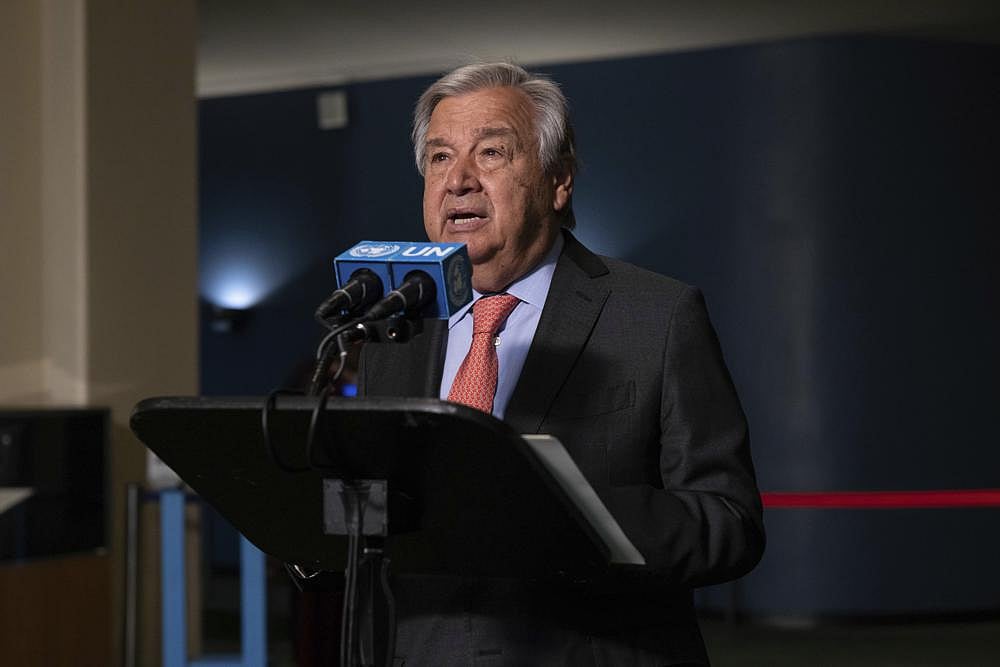
United Nations Secretary-General Antonio Guterres warned that once-unthinkable nuclear conflict is back in the realm of possibility, speaking at the start of a conference in New York.
His warning came as leaders met at the United Nations for the 10th review conference of the Treaty on the Non-Proliferation of Nuclear Weapons (NPT), which came into force in 1970.
"Today, humanity is just one misunderstanding, one miscalculation away from nuclear annihilation," he said.
"The climate crisis, stark inequalities, conflicts and human rights violations, and the personal and economic devastation caused by the COVID-19 pandemic, have put our world under greater stress than it has faced in our lifetimes," Guterres said.
This was occurring "at a time of nuclear danger not seen since the height of the Cold War," he said. "Humanity is in danger of forgetting the lessons forged in the terrifying fires of Hiroshima and Nagasaki," Guterres said.
The war in Ukraine has raised geopolitical tensions to levels not seen since the 1962 Cuban Missile Crisis, Guterres stressed.
What is the Nuclear Non-Proliferation Treay?
The 1968 deal was introduced after the Cuban missile crisis, an event often portrayed as the closest the world ever came to nuclear war. The treaty was designed to stop the spread of nuclear weapons to more countries, and to pursue the ultimate goal of complete nuclear disarmament.
Almost every nation on Earth is signed up to the NPT, including the five biggest nuclear powers. But among the handful of states never to sign are four known or suspected to have nuclear weapons: India, Israel, North Korea and Pakistan.
Secretary General Guterres said the "luck" the world had enjoyed so far in avoiding a nuclear catastrophe may not last - and urged the world to renew a push towards eliminating all such weapons.
"Luck is not a strategy. Nor is it a shield from geopolitical tensions boiling over into nuclear conflict," he said.
World leaders trade barbs
Meanwhile, Russian President Vladimir Putin said there could be no winners in a nuclear war and no such war should ever be started, addressing the participants of the 10th NPT conference in a letter.
Since then, Russia's nuclear forces have been put on high alert.
The United States, France and Britain criticized Putin's threats of nuclear weapon use amid Russia's invasion of Ukraine.
"Following Russia's unprovoked and unlawful war of aggression against Ukraine, we call on Russia to cease its irresponsible and dangerous nuclear rhetoric and behavior, to uphold its international commitments," they said in a statement.
"Nuclear weapons, for as long as they exist, should serve defensive purposes, deter aggression, and prevent war. We condemn those who would use or threaten to use nuclear weapons for military coercion, intimidation, and blackmail," the statement read.
(with inputs from agencies)