
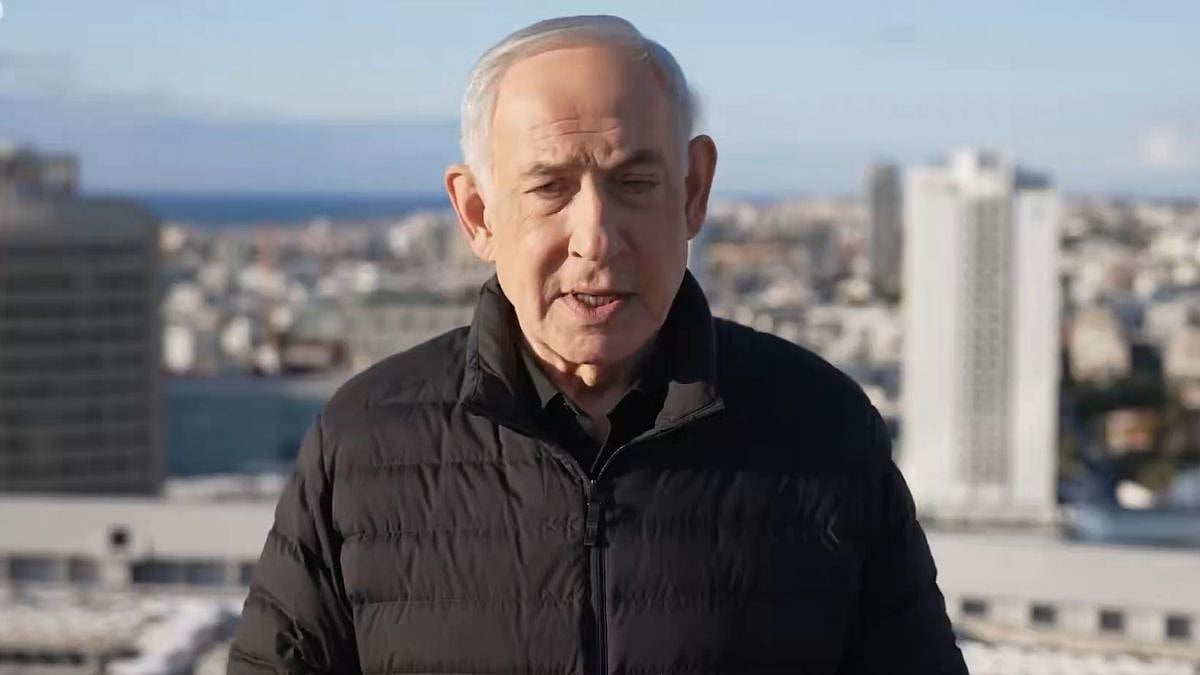
Israeli Prime Minister Benjamin Netanyahu has privately indicated that he is open to considering a rotational arrangement with opposition leader Gadi Eisenkot as part of a possible unity government, according to a November 2 report by Israeli news outlet Ynet. The reported remarks come amid a political deadlock following Israel's October 27 parliamentary elections, in which neither major bloc secured the numbers required to form a government.
In closed-door discussions, Netanyahu reportedly said, "We are examining everything. I am not completely ruling out any option." Sources close to the Prime Minister told Ynet that his response suggested he was keeping the possibility of a unity arrangement open.
However, no formal proposal for a unity government has been made so far, according to the report. Netanyahu's reported openness also contrasts with public statements by several Likud ministers and lawmakers, who have indicated that he would not agree to serve as Prime Minister for only part of a term.
Ofir Katz Issues Ultimatum Over Knesset Speaker Amir Ohana
The possibility of a unity arrangement has also been complicated by differences within the Likud leadership. Coalition Chairman Ofir Katz reportedly issued an ultimatum on Sunday, warning that a unity government would not be possible if the opposition's change bloc moved to remove Knesset Speaker Amir Ohana.
Netanyahu, meanwhile, is reportedly concerned that the opposition could form a government with the support of Arab and ultra-Orthodox parties, either as coalition partners or from outside the government. A senior Likud official told Ynet that the party feared such an arrangement, potentially involving Shas, could remain in power for an entire term.
The Prime Minister has also criticised the opposition over its possible cooperation with Arab parties and its position on ultra-Orthodox military conscription. In a statement, Likud accused Eisenkot and his allies of abandoning their campaign commitments to secure political support.
Israel Election Results Leave Both Blocs Short Of Majority
Israel's October 27 election produced no clear majority in the 120-member Knesset, leaving the country facing difficult coalition negotiations.
According to the final results published by the Central Elections Committee, Netanyahu's right-wing and religious bloc secured 53 seats, while the opposition bloc led by Eisenkot won 48. Arab-led parties, comprising the Joint List and Ra'am, secured 19 seats combined.
A party or bloc needs the support of at least 61 lawmakers to command a majority in the Knesset. The results have therefore left both sides short of the numbers required to form a government independently.
The Likud emerged as the single largest party with 27 seats, while Eisenkot's Yashar party secured 21. The final results are due to be submitted to President Isaac Herzog on November 4, with the newly elected Knesset scheduled to be sworn in on November 10.
Eisenkot Rules Out Serving Under Netanyahu
Despite Netanyahu's reported willingness to consider a rotation arrangement, Eisenkot has repeatedly ruled out joining a government led by the incumbent Prime Minister.
In a late-October radio interview, the Yashar party leader said he would not serve under Netanyahu, even as part of a rotational premiership. He also indicated that he would resign if such an arrangement were reached. Eisenkot has held Netanyahu responsible for the failures surrounding Hamas' October 7, 2023, attack on Israel.
Other opposition leaders, including former Prime Minister Naftali Bennett and Yisrael Beytenu chief Avigdor Liberman, have also publicly ruled out joining a Netanyahu-led government.
Eisenkot is instead exploring the possibility of forming a narrower government and has been seeking support from parties outside his bloc. He has said that potential partners must recognise Israel as a Jewish and democratic state, accept the values of its Declaration of Independence, support compulsory military or civilian national service, and recognise Hamas as a terrorist organisation.
A possible arrangement could involve support from Arab parties and ultra-Orthodox lawmakers, although such cooperation remains politically sensitive. Ynet reported that the change bloc is also working to gain control of key Knesset positions before government formation.
President Isaac Herzog To Begin Consultations
President Isaac Herzog is expected to begin consultations with representatives of the newly elected parties on November 4 to determine which candidate should receive the first mandate to form a government.
Eisenkot's allies are working to secure recommendations for him during the consultations. Bennett's B'Yachad party has already announced that it would recommend Eisenkot for the mandate, while the Democrats are also expected to back his candidature.
Meanwhile, the possibility of cooperation with Eisenkot has prompted differences within the ultra-Orthodox United Torah Judaism party. Some of its leaders are reportedly considering supporting or abstaining in parliamentary moves involving the Knesset Speaker, while others have expressed reservations.
With neither bloc holding a clear majority and key leaders maintaining opposing positions on a unity government, negotiations are expected to remain complicated. If no candidate manages to secure the support needed to form a government, Israel could face a prolonged political deadlock and the possibility of another election.

