A Decades-Old Mystery May Finally Be Resolved
Scientists have found evidence of a vast wind flowing from Sagittarius A* (Sgr A*), the supermassive black hole at the centre of the Milky Way, potentially solving a mystery that has puzzled astronomers for more than 50 years.
Sgr A*, which has a mass roughly four million times that of the Sun, was expected to behave like other black holes by not only consuming matter but also expelling some of it through winds or jets. Yet despite extensive observations, researchers had only found signs of eruptions that occurred more than 20,000 years ago, with no indication of recent activity.
“This is our closest and best-studied black hole,” said Mark Gorski, a research assistant professor at Northwestern University in Evanston, Illinois. “It’s the one we can resolve and see all of the physics around it, and yet it didn’t seem to have a wind. Every black hole in the universe behaves in this one way, but the one that’s closest to us is different. That was a huge problem.”
After analysing five years of observations, Gorski and Lena Murchikova, an assistant professor of physics and astronomy at Northwestern University, identified what they believe is evidence of the missing wind. Their findings were published on June 4 in The Astrophysical Journal Letters, CNN reports.
A Cavity in Space Points to an Unseen Outflow
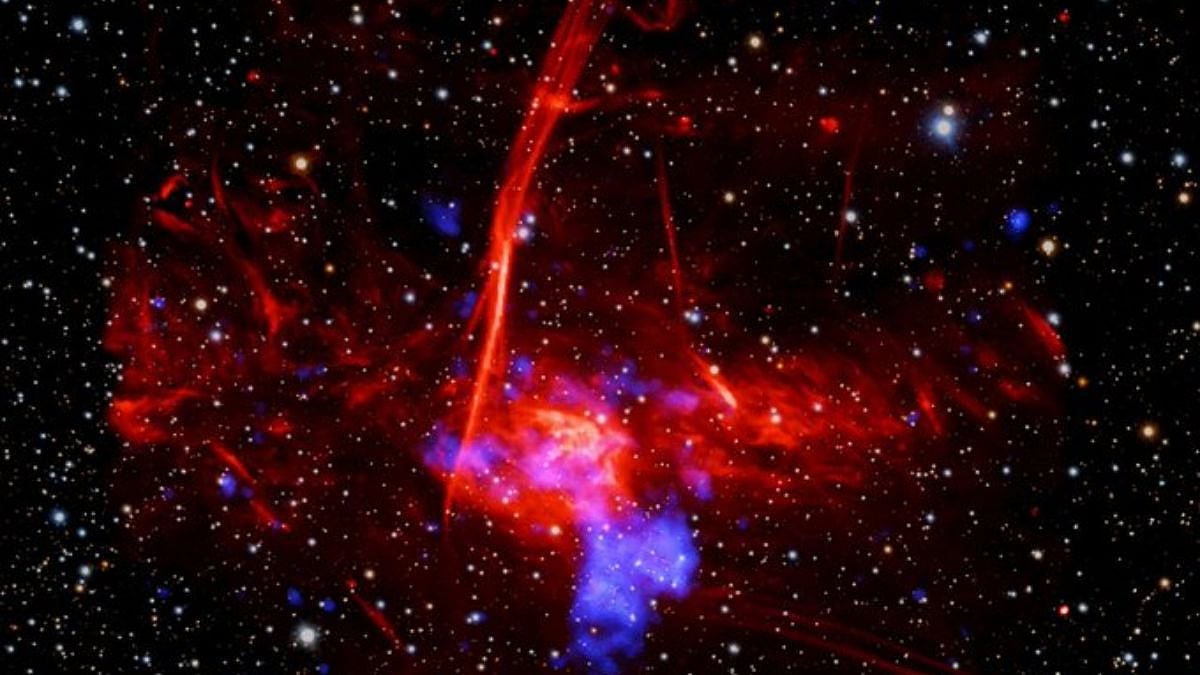
The researchers produced an extremely detailed image of the region surrounding Sgr A* and discovered a large cone-shaped cavity lacking cold gas.
According to the study, the feature could only have been created by a hot gaseous wind emerging from the black hole. The researchers concluded that the wind had pushed away colder material in the surrounding region.
“The black hole wind acts like a hair dryer,” Gorski said. “It blows hot, turbulent air into a colder, denser material, like your wet hair. The wind is warm and strong enough to heat and blow the water out of your wet hair and move the wet hair around a bit — but not strong enough to blow the hair off your head completely.”
Scientists have observed similar outflows from supermassive black holes in other galaxies, where they play an important role in transferring energy and regulating galactic growth.
“These outflows have proved really elusive when looking at our own supermassive black hole — until now,” said Christopher Reynolds, a professor of astronomy at the University of Maryland, College Park, who was not involved in the study. “This study presents a pretty compelling case that a wind from our galaxy’s supermassive black hole has pushed outwards through the surrounding dust and gas. They haven’t actually seen the wind itself, but its presence is quite clear. This required very careful analysis of almost five years of data from the world’s most sensitive radio telescope — a real tour de force.”
Using the Atacama Large Millimeter/submillimeter Array (ALMA) in Chile, the team created the most detailed map yet of cold gas around Sgr A*. After removing radio interference, they found a cavity about three light-years long with a 45-degree opening angle that appeared to originate from the black hole.
Data from NASA’s Chandra X-ray Observatory further indicated that hot plasma from the galactic centre was shaping the cold gas.
“If the cold gas were in front of or behind the hot plasma, there wouldn’t be a strong correlation,” Gorski said. “While we did not directly detect the particles moving in the wind, we were able to deduce the direction and energy of the wind.”
A Weak Wind Offers New Clues About Black Hole Behaviour
Researchers say the discovery took decades because instruments have only recently become powerful enough to peer through the dense dust and gas between Earth and the centre of the galaxy. Another challenge is that Sgr A* is currently in a relatively quiet phase, making any wind far weaker and more difficult to detect.
“Our result essentially says this black hole also has wind, so it’s not weird, and black hole physics in general work as we expected,” Murchikova said. “But the wind was hard to find because it was so weak. Never before have we seen a weak wind from a black hole.”
She noted that although powerful jets from supermassive black holes often attract attention, most black holes spend much of their time in quieter states, producing only faint outflows.
The research team plans to expand its map of cold gas around the galactic centre and create a “movie” showing gas clouds approaching the black hole to better understand how much material it consumes.
Dan Wilkins, a research assistant professor in the Department of Astronomy at Ohio State University, said the findings could help scientists understand how black holes generate winds.
“Seeing evidence for black hole-driven winds in our own galaxy not only gives us a new avenue for understanding how these winds are driven, but shows that supermassive black holes are still able to launch a wind into their host galaxies even when they are not undergoing active phases of rapid growth,” he wrote in an email.
Priyamvada Natarajan, the Joseph S. and Sophia S. Fruton Professor of Astronomy and Physics at Yale University, described the discovery as significant.
Also Watch:

“Sagittarius A* has long been the great frustration of galactic centre astrophysics: close enough to study in exquisite detail, yet stubbornly quiet, apparently windless,” she said. “This paper dismantles that picture. This is what patient, deep observational astronomy looks like when it pays off.”
“There are still many open questions,” Natarajan added, “but that’s as it should be for a discovery paper. The authors have handed the community a new observable, and the follow-up will be rich.”

