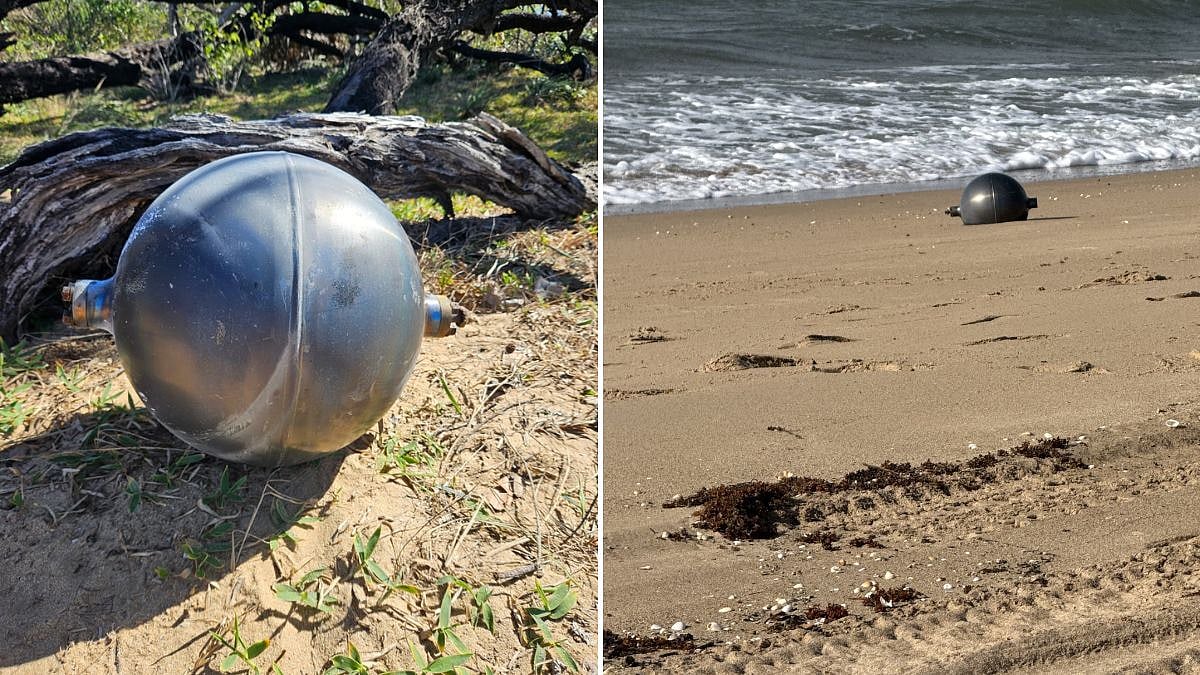
The Australian Space Agency is investigating six pieces of suspected space debris that washed up on beaches in north Queensland, with one expert suggesting they could be "space balls" left over from rocket launches.
Police said the mysterious objects, discovered in the Forrest Beach area near Townsville, were suspected of containing hazardous chemicals. However, authorities said there was "no danger to the local community" and police were not investigating the incident.
The Queensland Fire Department said five of the six objects had been secured in drums, while the sixth was being rendered safe. Officials also warned that more debris could wash ashore in the coming days and advised residents to follow updates from the Australian Space Agency.
A spokesperson for the agency said it was working with police and the National Emergency Management Agency to determine the debris' origin, The Guardian reports.
"The Australian Space Agency is supporting local authorities in relation to suspected space debris located at Forrest Beach in North Queensland. The Agency is working to determine the nature of the debris and its origin."
Expert says objects resemble rocket fuel vessels
Associate Prof Alice Gorman, a space archaeologist and space junk expert at Flinders University, said footage of the objects showed no signs of burning or scorching.
"This suggests they might be from a rocket stage – perhaps a first or second stage – that has fallen back to Earth while the rest of the stage goes on to deliver a payload into space," she said.
"They look to be consistent with what you find as part of a fuel system. They are pressurised fuel vessels made of titanium alloys with a very high melting point.
"They’re actually known as space balls and they can be found years after a launch. It is perhaps not something that anyone would have seen [landing]."
Gorman also said it was possible the objects were not related to the space industry and could instead have a marine origin.
Possible toxic hazard under investigation
If the objects are confirmed to be space balls, Gorman said they could still contain traces of hydrazine, a highly toxic rocket fuel. She speculated they may have originated from a Russian Fregat rocket, which uses similar pressure vessels in its fuel stages.
She added that space balls, unrelated to the 1980s American comedy of the same name, are among the most commonly recovered pieces of space debris and have been found in different parts of the world.
Rising launches increase space junk concerns
More than 30,000 pieces of debris, including operational satellites and discarded rocket parts, are estimated to be orbiting Earth.
"Space junk most commonly flies in over the sea, but Australia is a very big land mass so we do get a reasonable amount of space junk," Gorman said.
She warned that the problem is worsening as the pace of space launches continues to grow. "We’ve had more space launches in the last five years than in the whole of history. That means there are more re-entries happening."

