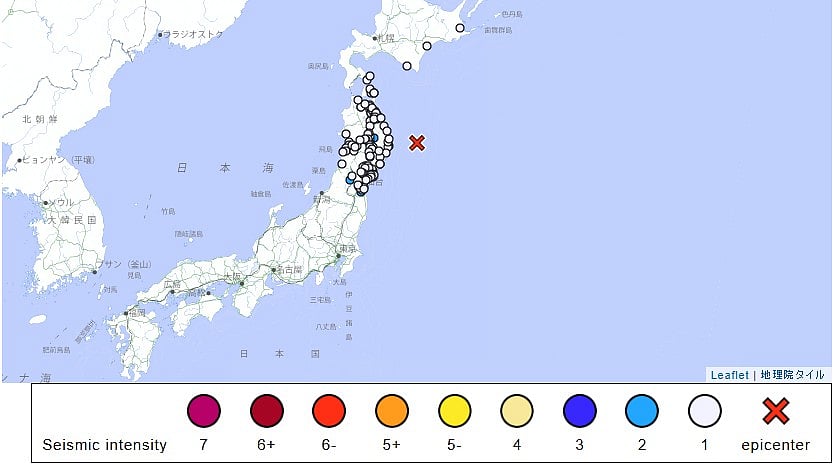
A powerful magnitude 7.5 earthquake struck the Tohoku region of northeastern Japan at approximately 4:53 pm on Monday, April 20, 2026. The Japan Meteorological Agency (JMA) identified the epicentre off the Sanriku Coast, an area historically significant for its high level of seismic activity.
The sudden release of energy from this undersea tremor immediately triggered the nation’s sophisticated early warning systems, as authorities worked to assess the threat to coastal communities.
Regional intensity and shaking distribution
The earthquake produced intense ground motion that was felt across a wide swath of northern Japan. According to the Japanese seismic intensity scale, which ranges from 0 to 7, the town of Hashikami in Aomori Prefecture recorded a level of Upper 5. At this intensity, it becomes difficult for individuals to remain standing and unreinforced concrete-block walls may suffer damage or collapse.
Elsewhere in the region, both Iwate and Miyagi prefectures recorded a seismic intensity of Lower 5, a level that causes hanging objects to swing violently and can result in the breakage of windows and the fall of unstable objects in homes and businesses.
Tsunami warnings and emergency evacuations
In response to the massive undersea displacement, the JMA issued an immediate tsunami warning for the coastal regions of Hokkaido, Iwate and Aomori.
Experts predicted that waves could reach heights of up to three metres, prompting local governments to order residents to seek higher ground or move to the upper floors of designated tsunami evacuation buildings.
These warnings are handled with extreme gravity in the Sanriku region, which has faced devastating tsunamis in the past. Authorities emphasised that the first wave is not always the largest and that sea level fluctuations could continue for several hours.
Critical infrastructure and public safety
The impact on regional infrastructure was immediate as safety protocols went into effect across the transportation and energy sectors. Bullet train services in the affected areas were halted to allow for track inspections, and highways were temporarily closed to check for cracks or subsidence.
Nuclear power facilities in the Tohoku and Hokkaido areas, including those that have been under heightened scrutiny since 2011, reported no immediate irregularities, though engineers continue to monitor cooling systems and structural integrity.
Emergency services remain on high alert for potential fires or landslides, which often follow major tremors in mountainous coastal regions.
Ongoing monitoring and aftershock risks
As the initial emergency response continues, the JMA has warned the public to remain vigilant for significant aftershocks. Experience with magnitude 7.5 earthquakes suggests that tremors of similar or slightly lesser intensity can occur in the days following the main event, potentially causing further damage to already weakened structures.
Residents are encouraged to keep emergency kits ready and stay tuned to official broadcasts for updates on tsunami heights and the eventual lifting of coastal advisories. Government officials are currently coordinating with local municipalities to provide temporary shelter and support for those displaced by the evacuation orders.
