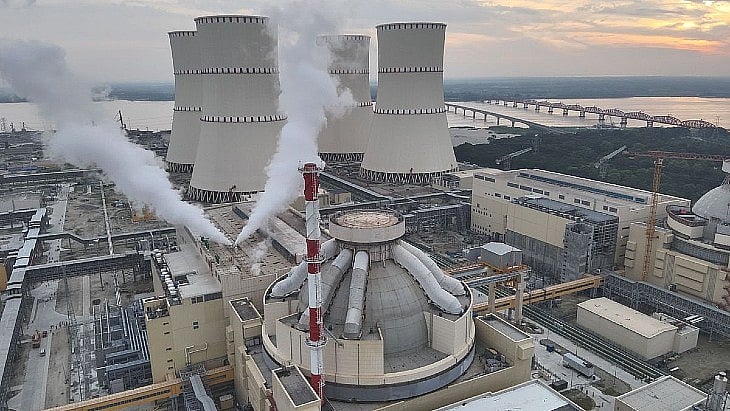
On Tuesday, Bangladesh officially marked its nuclear debut with the commencement of fuel loading at the Rooppur Nuclear Power Plant (RNPP) Unit-1. While the plant is being built on the banks of the Padma River, this milestone is as much a strategic victory for India as it is for Bangladesh. As the 33rd nation to join the global nuclear club, Bangladesh is doing so with a unique support system that places New Delhi at the heart of its atomic journey.
India angle: A neighbourhood partnership
While Russia is the primary financier and builder, the Rooppur project is a landmark in trilateral cooperation. India’s involvement is not just symbolic, it is a critical functional partnership that ensures regional safety and stability.
Under a trilateral agreement signed in 2018, India has played the role of a technical mentor. Because India's Department of Atomic Energy (DAE) has decades of experience operating Russian-designed VVER reactors at the Kudankulam plant in Tamil Nadu, Indian experts from the Global Centre for Nuclear Energy Partnership (GCNEP) have been training Bangladeshi scientists and engineers. This allows Dhaka to build a nuclear culture based on a model already proven in the South Asian climate and regulatory environment.
Furthermore, a nuclear-stable Bangladesh is a massive boon for India’s Neighbourhood First policy. The RNPP is located near the western border, making it a potential hub for the regional high-voltage grid. As Bangladesh achieves base-load energy security, meaning a steady flow of power that doesn't flicker, it reduces the risk of economic instability in a key border state.
The cooperation between the Bangladesh Atomic Energy Regulatory Authority (BAERA) and India’s Atomic Energy Regulatory Board (AERB) ensures that both nations are aligned on safety protocols and emergency response, effectively creating a shared safety net for the region.
What is happening at Rooppur right now?
The physical startup phase began today with the loading of 163 uranium fuel assemblies into the reactor core of Unit-1. This process is being directly supervised by the International Atomic Energy Agency (IAEA) and experts from Russia’s Rosatom.
Over the next several weeks, the reactor will undergo controlled fission. If safety tests remain on track, the plant is expected to feed an initial 300 megawatts into the national grid by August 2026, with the full 1,200 MW capacity of Unit-1 becoming commercially available by the end of the year.
Why is Bangladesh making this move?
Bangladesh is currently facing a severe energy crisis where over 95 per cent of its power generation relies on fossil fuels, with a heavy dependence on imported natural gas. Volatile global prices, exacerbated by international conflicts, have led to fuel shortages and frequent blackouts.
The Rooppur plant—the largest infrastructure project in the country’s history at $12.65 billion—is the solution to this dependency. According to a World Nuclear Association report, once both units are fully operational by 2027-2028, they will provide 2,400 MW, meeting roughly 10 per cent to 12 per cent of the nation's total electricity demand. This clean energy source will also significantly lower carbon emissions, helping the country meet its climate goals.
Safety and technology
The plant utilises the Generation-III+ VVER-1200 reactor, which is equipped with some of the most advanced safety features in the world. A critical component is the core catcher, a massive steel vessel located beneath the reactor designed to contain and cool molten fuel in the highly unlikely event of a meltdown, preventing it from reaching the environment.
The plant also features passive cooling systems that can keep the reactor safe for 72 hours without human intervention or an external power supply. In a significant move for regional safety, Russia has agreed to repatriate all spent nuclear fuel, meaning the radioactive waste will be sent back to Russia for processing rather than being stored long-term in Bangladesh.
Economic impact
While the project has faced delays and cost overruns due to the COVID-19 pandemic and the Russia-Ukraine war—with the total cost rising to approximately 1.40 lakh crore Taka—the long-term economic outlook is transformative. Though initial estimates suggest power may cost between 10-12 Taka per unit, the predictability of nuclear fuel costs offers a shield against the erratic price swings of the global oil and gas markets.
For a nation of 170 million people aiming for "High Income" status by 2041, the Rooppur debut is the engine intended to power that growth.

