
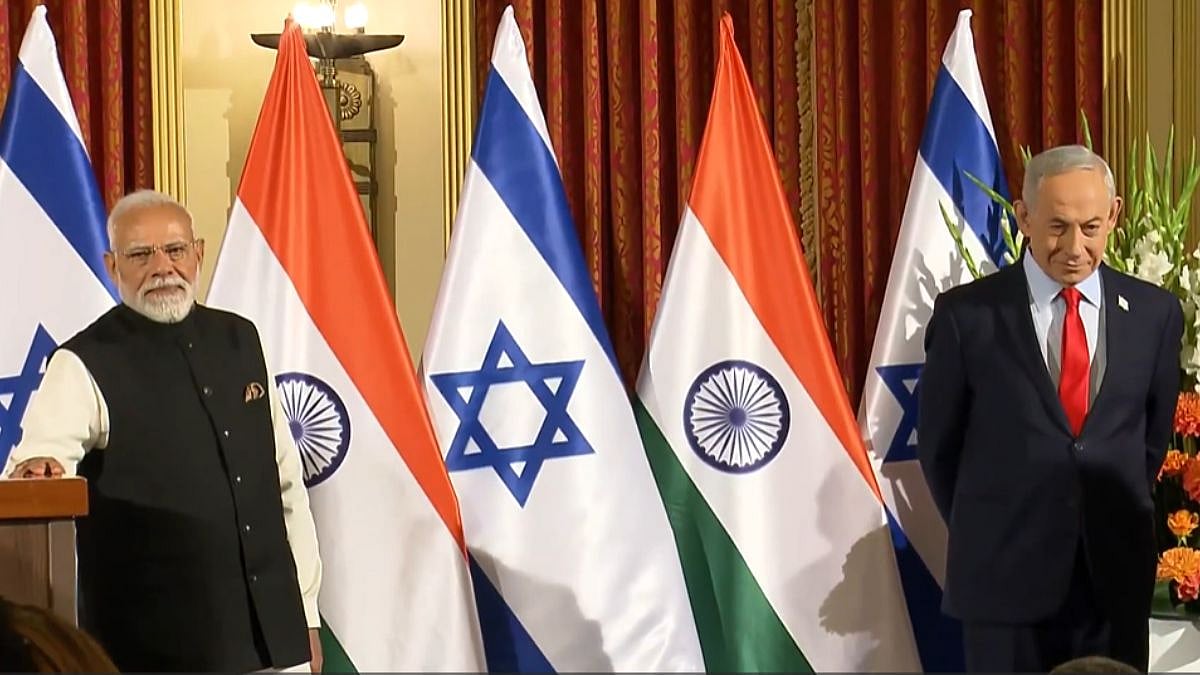
New Delhi: India and Israel elevated their relationship to a Special Strategic Partnership from a Strategic Partnership on Friday. The upgrade took place during Prime Minister Narendra Modi’s two-day visit to Israel on February 25-26, a visit that saw him hold talks with his Israeli counterpart Benjamin Netanyahu, and President Isaac Herzog.
Modi, the first Indian PM to address the Knesset, on Wednesday had spoken about how India and Israel could work together in different formats.
“We will also work closely in different formats such as the India-Middle-Europe Economic Corridor and the I2U2 framework between India, Israel, UAE and the US,” the PM had said in his address.
“Defence and security is another pillar of the partnership. In November last year, we signed an MoU on Defence Cooperation. In today’s uncertain world, a strong defence partnership between trusted partners like India and Israel is of vital importance."
On Thursday, India and Israel signed a total of 17 documents during the visit. AI, agriculture, science, and trade were some of the items of interest with an MoU in cooperation in AI and a Letter of Intent on the establishment of IndoIsrael Cyber Centre of Excellence in India. An MoU on cooperation in the fields of Fisheries and Agriculture, and an MoU on cooperation in geophysical exploration showed that both sides were interested in broadening the relationship beyond the traditional defence field to other sectors. An MoU to allow cross border payments between the two countries through UPI was also signed.
After the signing, Foreign Secretary Vikram Misri said that India did see a role for itself in the Gaza Peace Plan. Responding to a question, at an MEA special briefing in Tel Aviv, he said. “What that role will be will depend on us getting a little more clarity as to how the situation will develop on the ground in Gaza.” He added, “I will not speculate on which exactly is the area on which we may come in, but I can tell you with some conviction that India has very specific capabilities and very specific capacities which would be of considerable relevance in the kind of situation that we see on the ground in Gaza.”
The Indian foreign secretary also confirmed that IMEC was discussed at length between the leaders of the two countries and said that Israel remained a “key actor” in the success of this corridor. “IMEC was discussed between the two leaders at some length. Obviously the regional situation does weigh on the progress of the initiative, and relationships between different countries that potentially lie on the IMEC corridor need to be in a certain state in order for the initiative to make progress.”
With regard to India’s stance on Palestine, Misri said that India’s view on the Palestine issue had been made amply clear by the prime minister in his address to the Knesset. The foreign secretary said that “there have been initiatives taken in the past in this region to try and find a solution to the Palestinian question.” Elaborating on this, he added. “Of course there are developments that have intervened since then, and the situation is not the same. In some ways it is even more difficult, and the path to peace has become even more challenging. But as the prime minister said this is not the time to lose hope; it is the time to sustain hope.”
Reacting to the Trump Peace Plan Misri said that the Peace Plan “holds the promise of a just, durable, and lasting peace for all the peoples of the region while also addressing the Palestinian question.”

