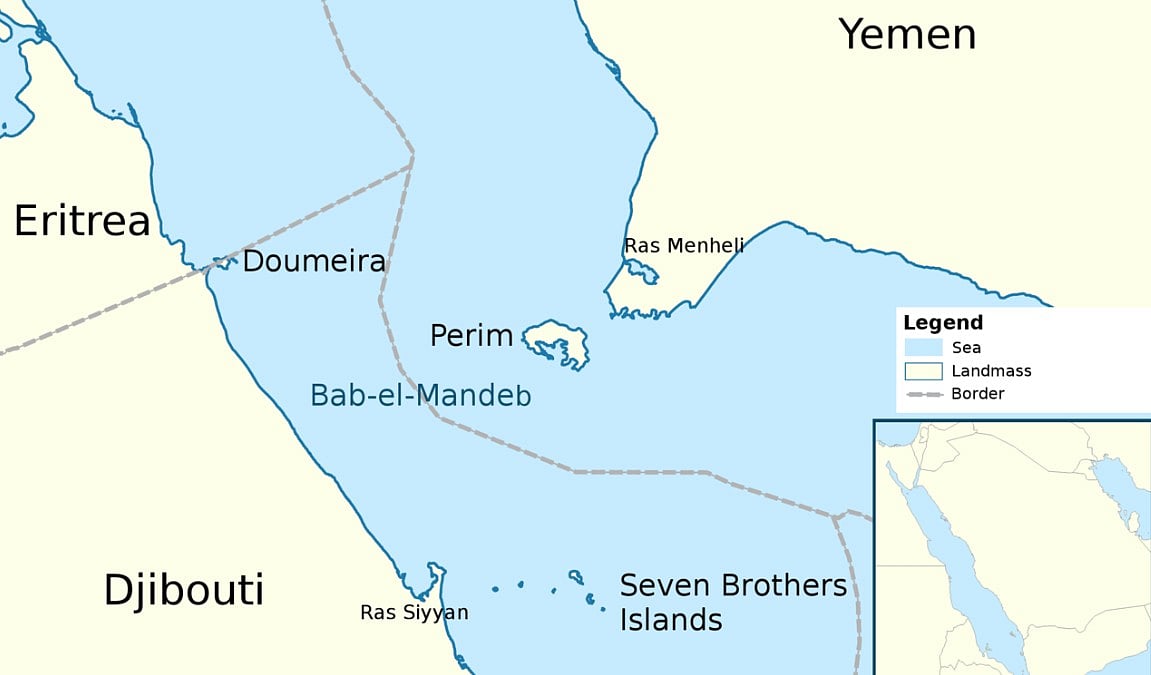
Amid the escalating conflict between the US, Israel and Iran, the world’s attention has shifted toward a narrow, jagged maritime passage off the coast of Yemen apart from the already strained Strait of Hormuz. Known as the Bab al-Mandeb, this waterway has become a central lever of power for the Houthi movement.
With the Strait of Hormuz already facing severe restrictions, any further disruption at the Bab al-Mandeb threatens to paralyse global energy markets and send shipping costs to unprecedented highs, potentially triggering a worldwide economic crisis.
What exactly is the Bab al-Mandeb and where is it located?
The Bab al-Mandeb is a strategic maritime "chokepoint" that connects the Red Sea to the Gulf of Aden and the Indian Ocean. Geographically, it sits at a critical crossroads between continents, separating the Arabian Peninsula (Yemen) from the Horn of Africa (Djibouti and Eritrea). It is roughly 100 kilometres long and narrows to just 30 kilometres at its tightest point.
This narrowness is what makes it so critical and so vulnerable. The strait is divided into two channels by Perim Island. The western channel is the primary route for international shipping, offering a deep-water lane about 16 miles wide. Because it is the southern gateway to the Suez Canal, it serves as the indispensable maritime link between Europe and Asia. Its Arabic name, "Gate of Tears," traditionally refers to the dangers of navigating its narrow currents, but today it reflects the geopolitical sorrow that a blockade would inflict on the global economy.
Why this waterway matter so much to the global economy
The strait is a vital artery for the world’s energy and trade. According to the US Energy Information Administration (EIA), nearly 12% of all seaborne-traded oil worldwide passes through this passage. In 2023, this amounted to approximately 9.3 million barrels of crude oil and petroleum products per day. By 2024, Houthi attacks had already caused this flow to drop to 4.1 million barrels per day, demonstrating how even limited instability can halve the volume of trade.
Beyond oil, the strait is a transit point for liquefied natural gas (LNG) and millions of tonnes of containerised goods ranging from electronics to grain moving between East and West. It is particularly crucial for Saudi Arabia as the kingdom uses a massive pipeline to move oil from its eastern fields to the western port of Yanbu, allowing it to bypass the Iranian-controlled Strait of Hormuz.
However, once that oil leaves Yanbu to head toward Asia or Europe, it must still pass through the Bab al-Mandeb. If both the Hormuz and Mandeb straits are compromised, Saudi oil flows could effectively grind to a halt within weeks.
Who are the Houthis and why are they involved?
The Houthis are an Iran-aligned political and armed group that controls a significant portion of Yemen, including the capital, Sanaa. Over the last several years, they have positioned themselves as a key regional actor opposing Israeli and Western influence. The group has a history of using the strait as a geopolitical tool to support regional allies.
Between 2023 and 2025, the Houthis launched drone and missile attacks on over 100 merchant ships in response to the conflict in Gaza. In the current 2026 escalation, Houthi officials, such as Deputy Information Minister Mohammed Mansour, have signalled that the Gate of Tears is a calculated option to exert pressure on the US and Israel. Mansour recently told Al-Araby Television that closing the strait is one of their trump cards to multiply pressure on their adversaries. By threatening a blockade, the Houthis are holding a lever that could turn a regional military conflict into a global catastrophe.
What would a full blockade mean for shipping routes
If the Houthis were to enforce a total blockade, the immediate result would be the effective closure of the Suez Canal route for most international tankers.
A blockade would force ships to take the long way around the Cape of Good Hope at the southern tip of Africa. This is not a simple detour as it adds thousands of miles to the journey.
For example, according to Bloomberg tanker-tracking data, a journey from Saudi Arabia to Rotterdam in the Netherlands would jump from 22 days to roughly 39 days—a 78 per cent increase in distance. A trip to Augusta in Italy would nearly triple in length. These longer routes exponentially increase fuel costs, labour costs and insurance premiums, while creating massive 'black holes' in global supply chains.
How would this impact the price of gas and goods at home?
The economic ripple effects would be felt by consumers worldwide almost immediately. Since the start of the current US-Israel-Iran conflict, oil prices have already surged over 50 per cent, with Brent crude surpassing $116 a barrel. If the Bab al-Mandeb is fully blocked, prices would quickly escalate to $150 per barrel, putting the world on track for its biggest monthly gain on record.
High energy prices act as a tax on the entire global economy, driving up the cost of manufacturing, electricity and transportation. Furthermore, the region is a major corridor for fertiliser shipments and a blockade could trigger food price hikes and shortages in distant markets.
Beyond the pump, the conflict puts global natural gas supplies and even air travel at risk. For many nations still reeling from the volatility of the early 2020s, the closure of this 18-mile-wide passage could be the tipping point into a deep, synchronised global recession.

