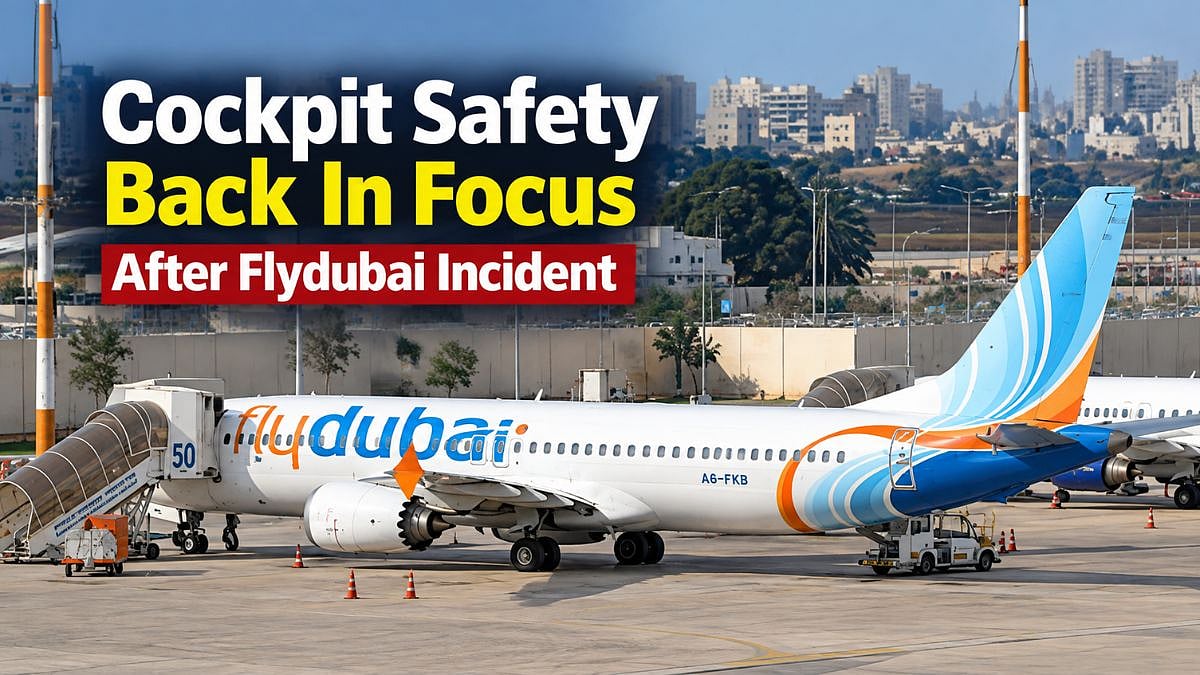
New Delhi, October 1, 2026: EgyptAir Flight 990 in 1999 and Germanwings Flight 9525 in 2015 raised that question in very different circumstances. The disasters eventually shaped aviation procedures designed to ensure that one person does not have unrestricted control of a secured cockpit.
The issue has resurfaced after a reported confrontation aboard Flydubai Flight FZ1073, in which a co-pilot allegedly attacked the captain during the flight. The circumstances of the incident remain under investigation.
EgyptAir 990 Raised An Early Alarm
EgyptAir Flight 990 departed New York’s John F Kennedy International Airport for Cairo on October 31, 1999, with 217 people aboard the Boeing 767.
The aircraft was cruising at about 33,000 feet when Captain Ahmed El-Habashi left the cockpit, leaving relief first officer Gameel Al-Batouti at the controls.
According to the US National Transportation Safety Board (NTSB), Al-Batouti repeatedly uttered an Arabic phrase translated as “I rely on God”. Soon afterwards, the autopilot was disconnected and the aircraft entered a steep descent.
El-Habashi returned to the cockpit and asked, “What’s happening?” Flight-recorder data showed the two pilots making opposing control inputs. The captain was attempting to command the aircraft upwards while Al-Batouti continued commanding it downwards.
The cockpit recorder captured the captain saying, “Pull with me.” At another point, he asked, “What is this? What is this? Did you shut the engine(s)?”
The Boeing 767 eventually crashed into the Atlantic Ocean, killing all 217 people aboard.
Investigators Disagreed Over The Cause
The NTSB concluded that the crash resulted from the relief first officer’s flight-control inputs. However, it said, “The reason for the relief first officer’s actions was not determined.”
Egyptian investigators disputed the conclusion. They rejected the suggestion that Al-Batouti had deliberately caused the crash and pointed instead to possible mechanical problems involving the aircraft’s elevator control system, Money Control reports.
The disagreement meant there was no universally accepted explanation for the EgyptAir 990 crash. Yet the disaster exposed an uncomfortable weakness in cockpit procedures: when one pilot is alone at the controls, there may be little time for the other pilot to intervene if something goes seriously wrong.
9/11 Changed Cockpit Security
The September 11 attacks transformed cockpit security. Commercial aircraft began operating with heavily reinforced cockpit doors intended to prevent unauthorised people from entering the flight deck.
The logic was straightforward. A stronger cockpit door made it more difficult for potential hijackers to seize control of an aircraft. But the same security measure created another vulnerability: if one pilot remained inside and refused to open the reinforced door, the other pilot could be locked out.
That concern became central after the Germanwings Flight 9525 disaster in 2015.
Germanwings 9525 Exposed The Danger
Germanwings Flight 9525 was flying from Barcelona to Düsseldorf on March 24, 2015, with 150 people aboard.
Captain Patrick Sondenheimer left the cockpit after the Airbus A320 reached cruising altitude, leaving co-pilot Andreas Lubitz inside.
Investigators found that Lubitz subsequently changed the aircraft’s autopilot settings and initiated a descent towards the French Alps. When Sondenheimer attempted to return to the cockpit, the door remained locked.
Air traffic controllers repeatedly tried to contact the aircraft but received no response.
French prosecutor Brice Robin said investigators could hear “violent blows” on the cockpit voice recorder, consistent with attempts to force open the door.
“The most plausible and probable interpretation for us is that the co-pilot… refused to open the door of the cockpit to the flight captain and activated the button to start descent,” Robin said.
The Airbus A320 crashed into the French Alps, killing all 150 people aboard.
Investigators later determined that Lubitz had deliberately flown the aircraft into the mountains. They also found evidence of serious mental-health problems and medical recommendations that had not been fully communicated to his employer.
A Disaster That Prompted Swift Change
The Germanwings crash forced aviation regulators to reconsider whether a pilot should ever be left alone behind a reinforced cockpit door.
Three days after the disaster, the European Aviation Safety Agency (EASA) recommended that airlines ensure “at least two crew, including at least one qualified pilot, are in the flight crew compartment at all times of the flight”.
Under the procedure, if one pilot needed to leave the cockpit, another authorised crew member, usually a flight attendant, would enter before the pilot exited.
The intention was not to keep two pilots in the cockpit at every moment. Instead, the measure sought to prevent one individual from having exclusive control of the aircraft while the second pilot was locked outside.
Several airlines quickly introduced the procedure.
Why The Two-Person Rule Changed Again
The two-person cockpit requirement did not remain universal.
In 2016, EASA moved towards a risk-based approach that allowed airlines to decide whether continuous two-person cockpit occupancy was necessary. One concern was that repeatedly opening a secure cockpit door could itself create an additional security risk.
As a result, airlines adopted differing procedures.
In May 2026, however, EASA revised its guidance again, restoring the continuous presence of two authorised people in the cockpit as its preferred approach for commercial operators of large aircraft fitted with secure cockpit doors.
The updated guidance also considered another potential danger: a pilot becoming incapacitated while alone in the flight deck.
Cockpit Safety Is About Who Is Inside Too
The history of EgyptAir 990 and Germanwings 9525 shows how aviation safety measures can solve one problem while creating another. Reinforced doors were introduced to keep dangerous intruders away from the controls, but Germanwings demonstrated the danger of making the cockpit almost impossible to enter when the threat is already inside.
The two-person approach is therefore more than a procedural formality. It adds another layer of protection against deliberate actions as well as medical incapacitation. The reported Flydubai incident has once again brought attention to the question, even though its circumstances remain under investigation.
Also Watch:
The larger lesson from these disasters is difficult to ignore: cockpit security cannot focus only on keeping outsiders away. Aviation authorities must also account for the rare but potentially catastrophic situations that can develop when one person is left alone with unrestricted control of an aircraft.
To get details on exclusive and budget-friendly property deals in Mumbai & surrounding regions, do visit: https://budgetproperties.in/

