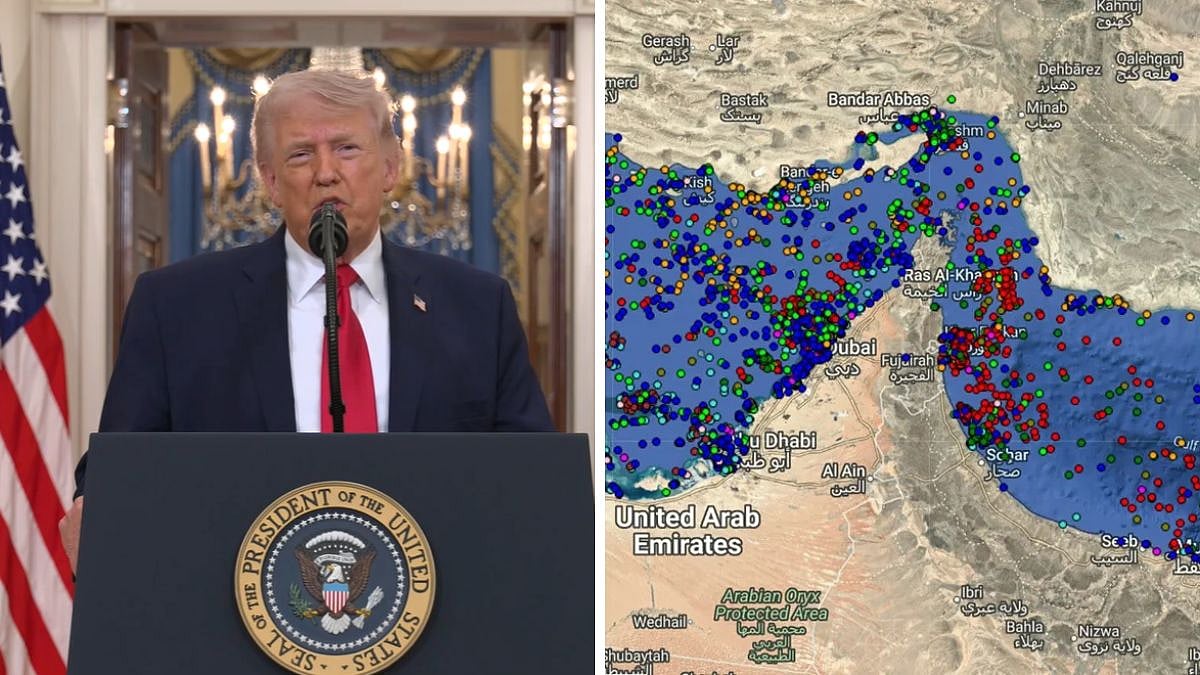
US President Donald Trump said the United States does not rely on oil flowing through the Strait of Hormuz, even as he renewed pressure on Iran to reopen the critical maritime route.
In his latest address to the nation, Trump stated that the US imports 'almost no oil' through the Strait and would not depend on it in the future. “We don’t need it. We haven’t needed it, and we don’t need it,” he said, while urging countries that rely heavily on the passage to take responsibility for securing it.
Calling the waterway vital for global energy supplies, Trump said nations dependent on Hormuz must 'take care of that passage' and 'cherish it,' adding that they should take the lead in ensuring the safe flow of oil. He indicated that while the US would extend support, the primary responsibility should lie with those directly affected.
Trump also suggested that his administration’s strong stance against Iran, including threats to target its nuclear facilities, was partly driven by the reluctance of some countries to get involved in what he described as efforts to weaken Tehran’s leadership. “They should take the lead in protecting the oil that they so desperately depend on. We will be helpful,” he said, adding that the US had acted independently in confronting Iran.
The remarks come amid escalating tensions in the region, with Iran effectively restricting shipping through the Strait of Hormuz, a key route connecting the Persian Gulf to the Gulf of Oman and the Arabian Sea. The disruption has severely impacted global maritime trade, with the movement of hundreds of vessels, including oil tankers and cargo ships, majorly reduced.

The Strait is one of the world’s most critical energy corridors, handling nearly 25 per cent of global oil trade. For countries like India, the dependence is even higher, with around 80 per cent of energy imports passing through this route.
Iran’s move to block or restrict access, particularly for the US and its allies, raised concerns over global energy security, pushing up crude prices and increasing volatility in international markets.

