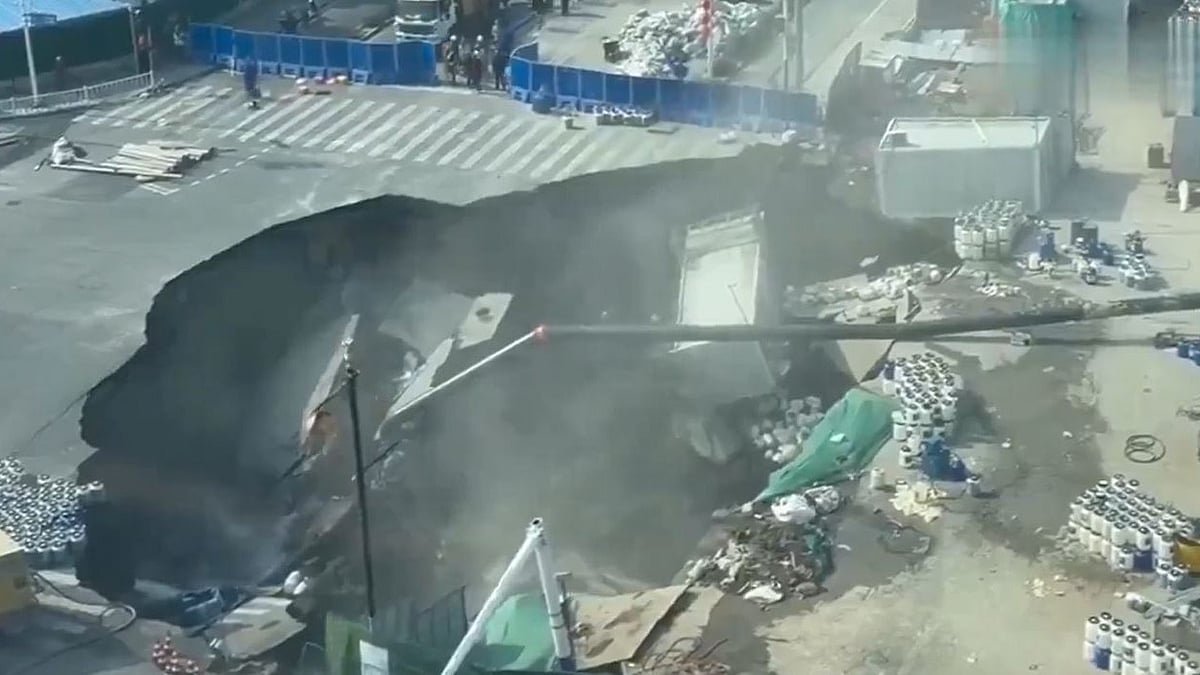
A dramatic incident was caught on security cameras as a large sinkhole abruptly opened on a busy road in Shanghai, consuming a substantial portion of the carriageway and causing damage to nearby structures. The footage shows the asphalt collapsing within moments, leaving behind a deep crater and disrupting movement in the area.
The city has historically been vulnerable to land subsidence due to its soft alluvial soil, which can shift under pressure. Specialists say such collapses are often triggered by multiple factors, including overuse of groundwater, fragile sand layers beneath the surface, underground cavities formed during construction, and ageing civic infrastructure.
Together, these conditions can result in anything from minor road depressions to major sinkholes like the latest one, renewing concerns about public safety in heavily populated metropolitan zones.
Similar incidents have been reported in the past. In January 2024, a road in Shanghai’s Minhang District reportedly sank nearly 10 metres after a sewage pipeline malfunctioned. Authorities confirmed that no injuries were recorded in that case.
Studies covering the period from 2017 to 2023 suggest that roughly 72% of sinkholes across China were connected to human activities, particularly infrastructure defects and construction disturbances.
The recent collapse once again highlights the challenges faced by fast-growing cities built on geologically sensitive terrain, underscoring the need for rigorous urban planning, monitoring, and maintenance to prevent potentially dangerous ground failures.
