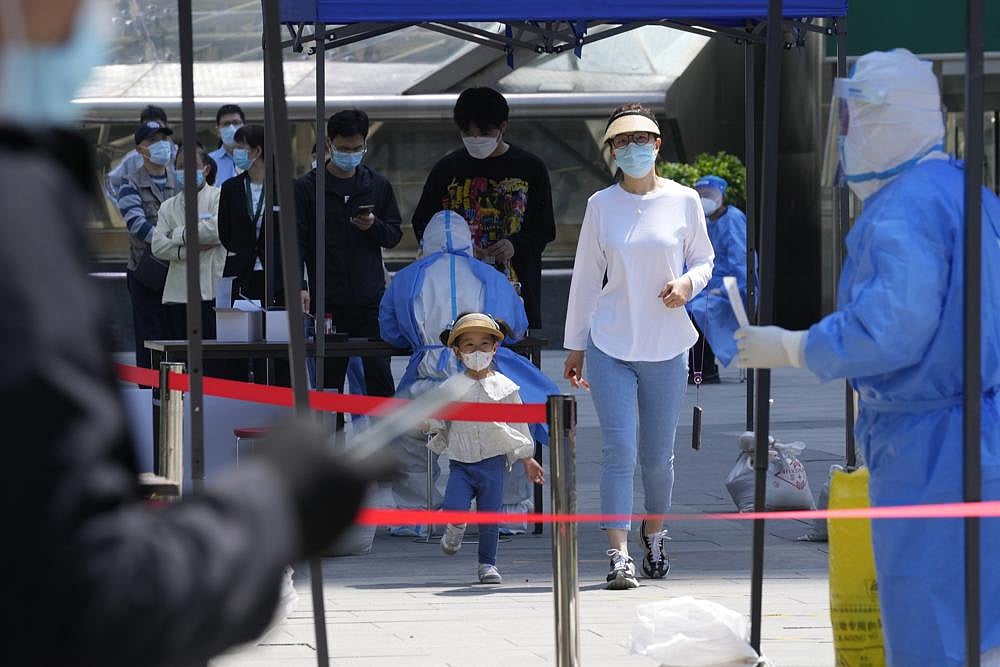
The Chinese capital Beijing shut dozens of metro stations and bus routes on Wednesday in its campaign to stop the spread of COVID-19 and avoid the fate of Shanghai where millions of residents have been under strict lockdown for more than a month.
New evidence has emerged that China's uncompromising battle against the coronavirus, believed to have emerged in a market in the city of Wuhan in late 2019, is undermining its growth and hurting the international companies invested there.
The capital shut more than 40 subway stations, about a tenth of the network, and 158 bus routes, service providers said. Most of the suspended stations and routes are in the Chaoyang district, the epicentre of Beijing's outbreak.
Beijing has been on high alert for the spread of COVID-19, with restaurants and bars limited to takeout only, gyms closed and classes suspended indefinitely. Major tourist sites in the city, including the Forbidden City and the Beijing Zoo, have closed their indoor exhibition halls and are operating at only partial capacity.
A few communities where cases were discovered have been isolated. People residing in “controlled” areas have been told to stay within city limits, including 12 areas deemed high-risk and another 35 considered medium-risk.
City residents are required to undergo three tests throughout the week as authorities seek to detect and isolate cases without imposing the sort of sweeping lockdowns seen in Shanghai and elsewhere. A negative test result obtained within the previous 48 hours is required to gain entry to most public spaces.
Beijing on Wednesday recorded just 51 new cases, five of them asymptomatic.
The subway closings should have relatively little impact on city life, with China observing the Labor Day holiday this week and many commuters in the city of 21 million already working from home.
In one downtown neighborhood categorized as high-risk on Wednesday, the streets were practically deserted apart from a few delivery drivers on scooters and the occasional pedestrian and car.
All businesses were shut except for supermarkets and fruit and vegetable stores. Outsiders generally avoid high-risk areas to avoid the possibility of their presence registering on the tracing apps installed on virtually all mobile phones, creating potential problems for future access to public areas.
While taking a lighter touch in Beijing, China has overall stuck to its strict “zero-COVID” approach that restricts travel, tests entire cities and sets up sprawling facilities to try to isolate every infected person. Lockdowns start with buildings and neighborhoods but become citywide if the virus spreads widely.
On Wednesday, China reported 5,489 cases, including 353 symptomatic. Most (4,982) were in Shanghai, which has been under a weeks-long lockdown sparking widespread complaints and protests over food shortages and overzealous enforcement. Beijing reported 46 symptomatic cases and five asymptomatic on Wednesday, bringing the city’s total since the start of its Omicron outbreak to about 400.
As Shanghai’s case numbers soared into the thousands, authorities raced to identify and isolate every case, regardless of severity. Hundreds of thousands were transferred to temporary hospitals, requisitioned office buildings and residential blocks, and repurposed convention centres. Conditions in some facilities prompted complaints, with bright lights 24/7, limited water and unsanitary conditions.
In a statement the Beijing Municipal Health Commission said it had reopened the Xiaotangshan hospital as a precaution, describing the battle against the Omicron spread as a chess game. It said one isolation unit was already operating, with 40 medical personnel treating 12 people with asymptomatic or mild cases.
The surprisingly low death toll amid an outbreak of more than 400,000 cases in the city that is home to China’s main stock market and biggest port has sparked questions about how such deaths are tallied.
The rigid and widely derided restrictions have led to shortages of food and medical aid along with a wider — though likely temporary — impact on the national economy. Desperate, outraged citizens have confronted authorities at barricades and online, screamed out of their windows and banged pots and pans in a sign of their frustration and anger.
Communist authorities who tolerate no dissent have sought to scrub such protests from the internet and blamed the protests, including the banging of cooking implements, on agitation by unidentified “foreign anti-China forces.”
(with inputs from AP)

