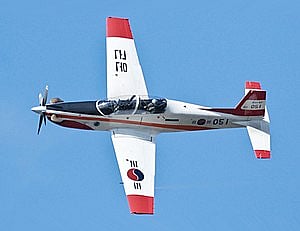
Two South Korean air force planes collided in mid-air during training on Friday, killing three people and injuring one, officials said.
The two KT-1 trainer aircraft crashed into a mountain in the south-eastern city of Sacheon after colliding, emergency officials said.
Three people were found dead and one was injured, the officials said.
They said three helicopters, 20 vehicles and dozens of emergency workers were sent to the scene.
The air force confirmed the collision, but a statement said they were trying to confirm the reported casualties and whether pilots on the aircraft tried to eject to safety.
The KAI KT-1 Woongbi is a Korean single-engined turboprop, basic training aircraft. It was jointly developed by Korean Aerospace Industries (KAI) and the Agency for Defence Development (ADD). The KT-1 is the first completely indigenous Korean aircraft ever developed.
Friday’s incident came months after a South Korean air force pilot died in January after his F-5E fighter jet crashed into a mountain in the city of Hwaseong, south of the capital, Seoul.
Unresolved tension with North Korea has prompted South Korea to allocate 2.6% of its GDP and 15% of all government spending to its military, while maintaining compulsory conscription for men.
Consequently, South Korea has the world's seventh largest number of active troops (560,000), the world's highest number of reserve troops (3,100,000 in 2018) and the tenth largest defense budget. As of 2019 South Korea has a defense budget of $43.1 billion.
The United States has stationed a substantial contingent of troops to defend South Korea. There are approximately 28,500 U.S. military personnel stationed in South Korea, most of them serving one year unaccompanied tours.
The news comes as joint South Korean and US military drills are set to kick off next month, and could for the first time in years include more weaponry and troops, and more aggressive messaging as tensions with North Korea rise.
Neither the South Korean or U.S. militaries have confirmed what this year’s annual drills may entail, but a recent series of unusual displays of military might in and around the Korean peninsula suggest a more muscular show could be in the works, analysts said.
North Korea conducted a full intercontinental ballistic missile (ICBM) test for the first time since 2017 last week, and South Korean officials have reported new construction at the North’s only known nuclear test site, which was shuttered in 2018.


