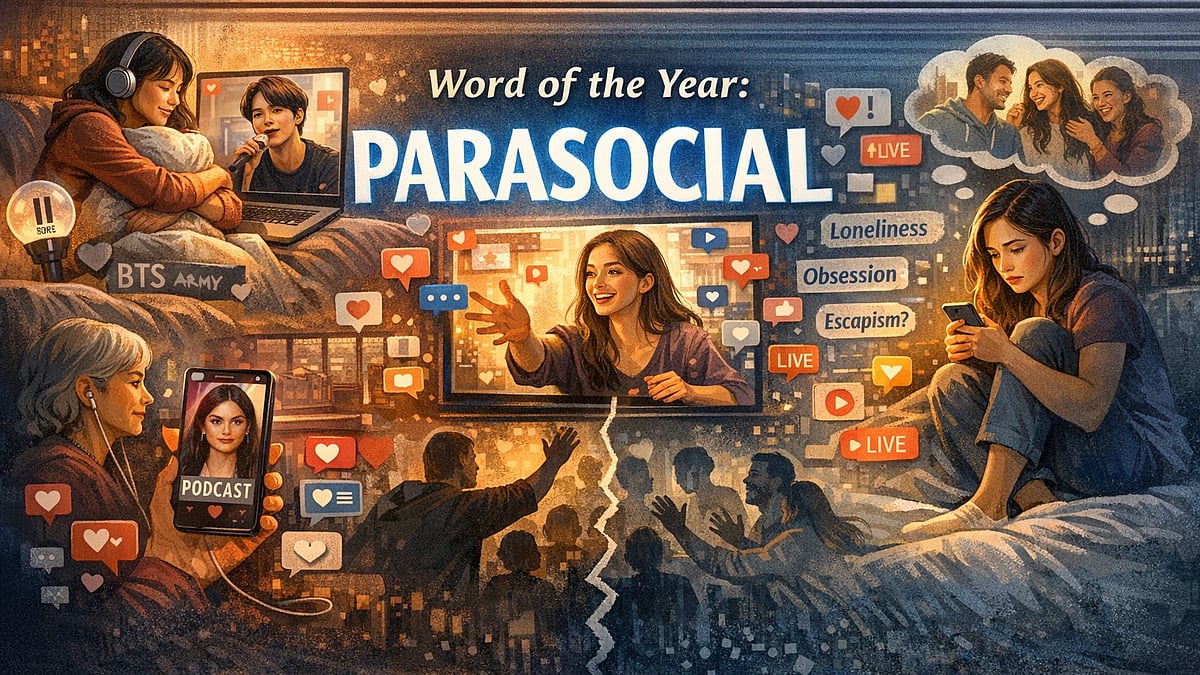
As the year winds down, year-end lists try to distil what truly shaped our collective lives — not just the events that made headlines, but the emotions, habits, and shifts that quietly redefined how we live and relate. This year, one word rose above trend cycles and social media buzz to capture a deeper, more intimate change: parasocial.
When Cambridge Dictionary chose “parasocial” as its Word of the Year, it wasn’t merely acknowledging a linguistic trend. It was naming a lived reality — one that finally gave language to how millions now experience connection, intimacy, and belonging in an always-online world.
Coined decades ago to describe one-sided bonds between television personalities and their fans, parasocial relationships have evolved dramatically in the age of social media. What was once distant admiration has morphed into something far more immersive, blurring the lines between fandom, attachment, and emotional dependence.
What is a parasocial relationship?
A parasocial relationship is a one-way emotional connection in which an individual feels closeness, familiarity, or loyalty toward a public figure who does not know them personally.
“Unlike real-life relationships, where there is mutual communication, shared responsibility, and emotional give-and-take, parasocial bonds offer a sense of closeness without vulnerability, negotiation, or unpredictability. They provide the feeling of intimacy, but not the actual relational dynamics that shape genuine human connection,” explains Mehezabin Dordi, Clinical Psychologist at Sir HN Reliance Foundation Hospital, Mumbai.
Why parasocial bonds feel so real
Parasocial relationships thrive on repetition, consistency, and perceived vulnerability. When a creator shows up daily on your screen, shares struggles, celebrates milestones, and speaks directly to the camera, the brain registers this as social interaction.
A striking modern example is the relationship between the South Korean boyband BTS — particularly its youngest member, Jung Kook — and ARMY, the group’s global fandom. Before mandatory military enlistment, Jung Kook frequently went live, sharing moments that felt almost disarmingly ordinary. He cooked, cleaned, sang, folded laundry, drank, and even fell asleep on camera, while millions watched.
“Oh boy, was I hooked! Not just because he’s one of my favourite idols, but because it felt like seeing who he was beyond the stage,” says 38-year-old Nita P. “Watching him unwind, being so uninhibited and boyish, was oddly comforting. It made him feel real — just a young man enjoying his time off.”
For 32-year-old media professional Amrita Prasad, the connection took a quieter, more parallel form. “For me, it’s Selena Gomez. It’s not about obsessively checking updates. Her life milestones just became timestamps in my own,” she says. “When I was dealing with my first major anxiety attacks, she was speaking openly about her mental health. When she faced scrutiny after her kidney transplant, I was navigating my own chronic illness. We shared a timeline — even if only one of us knew it.”
That sense of closeness deepened through Gomez’s transparency. “Watching her documentary and her work with Rare Beauty felt like sitting in on her therapy sessions,” Prasad adds. “That level of transparency breaks down the celebrity wall entirely. I might not know her, but I know her struggle, and that’s a knowledge that feels deeply personal and connective.”
Fuel on the fire
Unlike traditional celebrities, today’s creators don’t just broadcast; they appear to interact. Likes, replies, livestreams, voice notes, and ‘close friends’ content collapse distance and hierarchy. Algorithms intensify this by repeatedly serving audiences the people they already feel emotionally invested in.
What once felt like fandom now often resembles friendship, or something even closer. “Traditional celebrities maintained distance and mystery, which limited emotional engagement,” says Dordi. “Influencers, however, build appeal through relatability and perceived accessibility. This illusion of two-way communication — through comments, DMs, and livestreams — creates stronger and more immersive parasocial bonds than older forms of celebrity ever did.”
The healthy side
Not all parasocial relationships are inherently harmful. “In moderation, they can be beneficial,” Dordi notes. “They can reduce loneliness, offer comfort, and provide positive role models, especially for adolescents or people navigating stressful life phases. When real-world support is limited, these connections can act as a temporary emotional anchor.”
For many, these bonds coexist comfortably with offline relationships and remain grounded in self-awareness and boundaries.
“From a coaching lens, parasocial relationships are meeting a very basic emotional need: low-risk consistency,” explains Namrata Jain, psychotherapist and relationship expert. “Modern dating is full of ghosting, breadcrumbing, and mixed signals. A favourite creator feels reliable — they show up, speak in a familiar tone, and never disappear.”
“These connections are like emotional snacking,” she adds. “You get a dopamine hit of connection without vulnerability, compromise, or conflict. It’s a simulation of companionship — you feel seen, while remaining safely invisible. In many ways, it replaces the old ‘community village’ we once had.”
For millennials, these relationships often evolved from TV hosts, radio jockeys, and bloggers to podcast voices and long-form creators — familiar presences during commutes, chores, and quiet evenings. Gen Z experiences it differently.
“The relationship I share with my favourite celebs is harmless and fun,” says 23-year-old Summer D’Sa. “If wishing them happiness and success means I feel deeply, then that’s okay. It can feel isolating when romantic partners don’t understand why it matters, but fandoms also bring people together. I’ve made real friends through K-pop, K-dramas, and shared celebrity interests.”
For Prasad, the impact runs deeper. “When I was feeling lost and inadequate, seeing someone globally famous, successful, and beautiful still admit, ‘I'm struggling. I have bipolar disorder. I get anxious. My medication makes me gain weight,’ was revolutionary. It's the ultimate validation that your personal struggles are not a sign of failure; they are just part of the human experience.”
When attachment turns unhealthy
The problem begins when parasocial relationships replace real-world connections or start shaping self-worth and decision-making.
“Warning signs include spending disproportionate time consuming a public figure’s content, feeling intense emotional reactions to their lives, or developing a sense of entitlement to their attention,” Dordi cautions. “In severe cases, these bonds can fuel social withdrawal, reinforce anxiety or depression, or distort expectations of real relationships.”
In extreme scenarios, imagined intimacy can spiral into dependency or obsession.
“One major red flag is using a creator as your primary emotional regulator,” Jain explains. “If your only comfort after a bad day is a YouTuber’s video instead of calling a friend, you’re slowly isolating yourself. When fantasy becomes the standard rather than the escape, your ability to tolerate discomfort in real relationships weakens. You stop building the social muscles required for conflict, because you’ve trained yourself to swipe away anything that feels hard.”

Comfort or substitution?
As the year closes, the conversation around parasocial relationships has shifted from fascination to introspection. The question is no longer ‘what are they’, but ‘what are they replacing’.
For some, these bonds remain a harmless supplement to a real connection. For others, they quietly fill emotional gaps — sometimes at the expense of offline intimacy.
“For me, it’s evolved beyond harmless fun,” Prasad reflects. “It’s an aspirational relationship rooted in resilience and purpose. Her ability to turn pain into her Rare Impact Fund is a roadmap for how to create meaning from suffering. She makes me feel less lonely because her transparency has opened up a shared language for mental health. The community she has fostered around honesty and self-acceptance has created a collective space where vulnerability is normal.”
The final word
That parasocial became the word that defined the year says as much about us as it does about the internet. It speaks to a collective longing — to feel seen, heard, and understood in an increasingly fragmented world. As we step into a new year, the word lingers — not as a trend, but as a reminder: connection matters. But context, boundaries, and balance matter even more.
How to draw healthy boundaries
Parasocial relationships don’t need to be eliminated — just contextualised. Healthy engagement includes:
Acknowledging the one-sided nature of the bond
Prioritising offline relationships
Avoiding emotional dependence on creators
Consuming content intentionally, not compulsively
When balanced well, parasocial connections can remain enriching rather than consuming.

