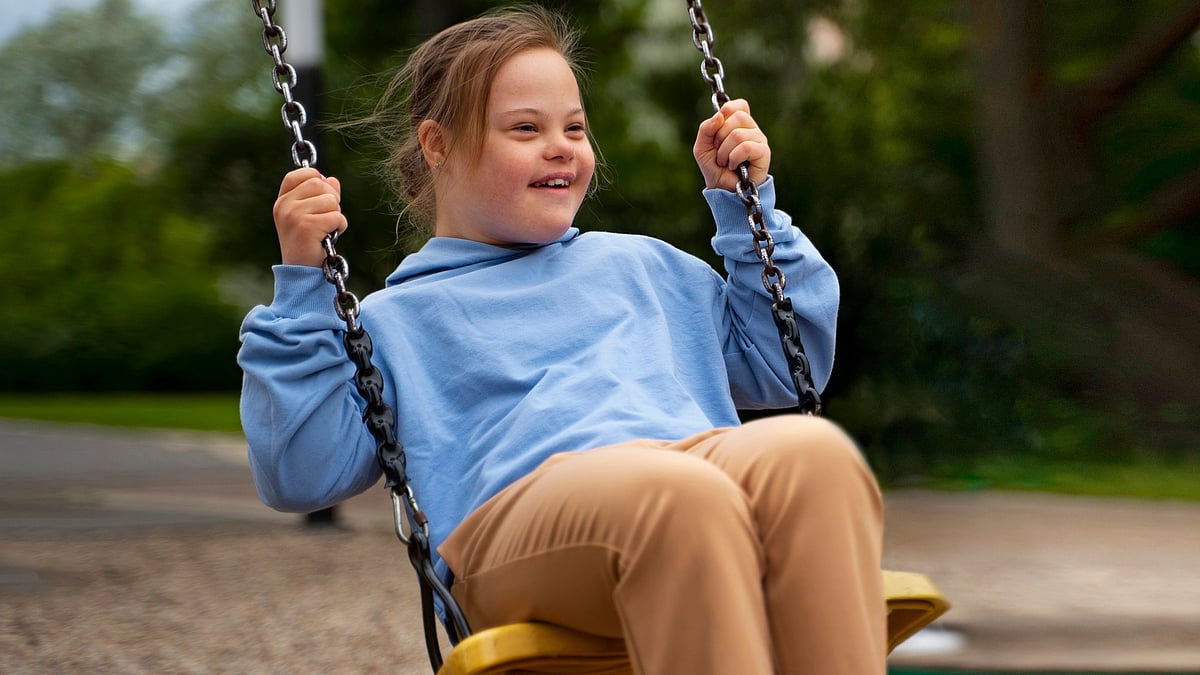
Nearly twenty-three years have passed, yet Bengaluru-based Mudita Khimji remembers that moment with piercing clarity. “When the doctors told us our daughter had Down syndrome, everything went still. My initial feelings were fear and uncertainty—I didn’t know what her future would look like, or if the world would be kind to her,” she recalls. “There was grief, not because of her, but because of all the assumptions I’d unknowingly held about parenthood. That moment shattered them—and opened me up to something deeper,” Khimji recounts.
Down syndrome is a genetic condition where a child is born with an extra copy of chromosome 21, altering physical and cognitive development. People with Down syndrome are neurodivergent, meaning they may think, learn, and interact differently from neurotypical individuals. “Down syndrome is the most common chromosomal condition in the world, occurring in about one in every 800 live births. It is not a disease; it’s a genetic condition, a difference, not a defect,” reiterates Dr Surekha Ramachandran, President, Down Syndrome Federation of India, a parent support organisation that serves innumerable children, parents and their families in India and the Middle East.
Early screening
When Khimji gave birth in the early 2000s, she and her husband were based in Hubli, a small town in Karnataka. It was their second child. Since their firstborn had shown no risk factors, no one suggested advanced screening tests that could have detected chromosomal anomalies.
“While maternal age is a factor, nearly 80% of children with Down syndrome are born to mothers under 35 simply because that’s the age group where most babies are born,” adds Dr Ramachandran.
Dr. Tina Goel, a Delhi-based paediatrician, concurs with her and explains that while diagnostic technology has evolved, the process still begins with risk estimation, not confirmation. “The First-Trimester Combined Screening, done between 11–13 weeks, includes an ultrasound for nuchal translucency and maternal blood tests for β-hCG and PAPP-A,” she says. “Together, these detect 80–85% of Down syndrome cases,” she adds.
The Second-Trimester Screening (the Triple or Quadruple Test) is performed between 15–20 weeks, and is combined with an anomaly scan around 18-20 weeks. The most advanced option—Non-Invasive Prenatal Testing (NIPT)—can be done anytime after 10 weeks, analysing cell-free fetal DNA in maternal blood with over 99% accuracy. If results indicate high risk, Chorionic Villus Sampling (10–13 weeks) or Amniocentesis (after 15 weeks) may be recommended for a definitive diagnosis. “These two are Diagnostic (Confirmatory) Tests and involve sampling fetal cells to study chromosomes and provide a definitive diagnosis,” she adds.
Dealing with diagnosis
But the real test, says Dr Goel, begins once the diagnosis is confirmed. “The decision to continue or terminate a pregnancy is deeply personal and shaped by educational, cultural, and ethical factors—and most importantly, by when the diagnosis is made,” she explains. “Earlier diagnoses allow more time for decision-making, while later ones often see lower termination rates. Access to genetic counselling, financial support, and awareness also play critical roles,” she elucidates. Although India lacks specific data, international studies suggest termination rates for confirmed Down syndrome pregnancies range from 50% to 85%.
Down syndrome is an aneuploidy disorder, often linked to advanced maternal age. According to Dr. Monica Shukla, founder-director of Global Pravi IVF, “The incidence in IVF pregnancies is comparable to natural conception. However, Preimplantation Genetic Testing for Aneuploidy (PGT-A) allows only euploid embryos to be transferred, reducing the risk significantly in older mothers.”
The soon-to-be parents are counselled and told about the various pros and cons of having children with special needs. Dr Ramachandran says, “At DSFI, we work with families from the moment of diagnosis, offering counselling, therapy, and community support.”
Living it up
For parents who choose to continue the pregnancy, the focus shifts to comprehensive care and support for the baby after birth. Prenatal monitoring includes regular ultrasounds, growth tracking, and coordination with paediatric cardiologists and neurologists.
Equally important is genetic counselling, which helps families understand the condition, navigate emotional stress, and prepare for life after birth. “Our message is one of preparedness and positivity. With early medical care, stimulation therapy, and family support, most children with Down syndrome can lead happy, healthy, and meaningful lives,” says Dr. Goel.
For Khimji, that moment of fear transformed the instant she looked into her daughter’s face. “I knew she was exactly who she was meant to be. From then on, I promised to raise her with the same dreams and love as any child, but with extra armour to protect her from the world’s ignorance,” she says. Her daughter, Sania, has since grown into a model, influencer, and artist, which allows her to break barriers and challenge stereotypes every day. “When people see her walking the runway, painting, or speaking up on social media, they know what's truly possible with self-belief and a chance,” says Khimji.

The road ahead
Dr Ramachandran couldn’t emphasise more on the significance of early intervention. The earlier a child begins therapy, the better their growth and development will be. “At the DSFI centre, experienced therapists and professionals implement early intervention techniques to help children strengthen their muscles and develop mental skills that will benefit them in the future. Early intervention is crucial for persons with Down syndrome to lead nearly normal lives. As they age, they tend to become more rigid and harder to manage,” she adds. DSFI also organises health camps to address issues related to behaviour, therapies, language, learning, and other social aspects, helping parents across the country.
Children with Down syndrome often face health challenges such as congenital heart defects, gastrointestinal issues, thyroid disorders, and respiratory or vision problems, which require a multidisciplinary approach. Regular checkups and early interventions in speech, physical, and occupational therapy make a profound difference. “In the first few months, treatment focuses on stabilising medical issues. Later on, the emphasis shifts to early stimulation therapy, including occupational therapy (which teaches skills for daily living), physical therapy (focusing on improving muscle strength and movement), speech, language and behaviour therapy. Even virtual therapy and interactive play have proven effective in strengthening engagement and learning,” explains Dr Goel.
Besides the health camp, DSFI, in collaboration with a local parent support group, also organises medical camps across the country. “Our health and medical camps bring together therapists, educators, and specialists so that parents can access holistic care in one place,” says Dr Ramachandran.
For children with Down syndrome, the psychosocial interaction with parents and caregivers is extremely crucial. The constant nurturing shows in how the child shapes up, despite and in spite of all the medical odds. “People with Down syndrome can lead full, independent lives with the right support, early intervention, quality education, and positive social attitudes because every child with Down syndrome has unique abilities and a distinct personality. They deserve to be seen for who they are, not for their diagnosis.”
Ultimately, raising a child with Down syndrome is a journey of love, learning, and advocacy. As Khimji puts it: “She’s the extra chromosome that gave us extra purpose. The extra factor that makes our family complete. She’s a lesson in love, resilience, and inclusion, for us and others.”

