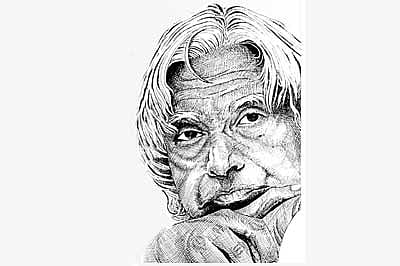
Behind the genial personality, the late Dr A P J Kalam had a pretty tough as nails brain. In early 90’s when India was going through a tough time sourcing Cryogenic engine technology from Russia, Dr Kalam advocated the need of in-house development of technology to make India self-reliant in space technology.
We reproduce one of those rare interviews he gave on the subject to any Indian reporter. This interview was originally published in SUNDAY magazine.
One person is confident that irrespective of whether India gets the Cryogenic Technology or not, it will have to stand up for itself because “strength respects strength”.
The man is Dr Avil Pakir Jainulabdeen Abdul Kalam, better known as Abdul Kalam, the brain behind the Indian Space Research Organisation’s (ISRO) space development programme. He is the chairman of the Integrated Guided Missile Development Programme and the director of the Defence Research and Development Organisation (DRDO).
However, no longer with ISRO, Abdul Kalam’s heart still lies with the organization. A father figure to ISRO scientists, Kalam is not exactly upset over Russia’s reneging on the deal. Confident of himself and “his” scientists at ISRO, Kalam says that it’s time Indians started respecting themselves and became “self-dependent”.
Talking to SUNDAY in his South Block office, Dr ABDUL KALAM refused to discuss in detail India’s missile development programme. He, however, agreed to talk at length on the cryogenic engine deal. Excerpts from the interview:
SUNDAY: Is the Cryogenic engine deal on or off? There are conflicting signals coming from various quarters.
Abdul Kalam: According to all the information reaching me, it is still on. There is no official information that the deal is off. Irrespective of whether we get the technology or not, as far as I can see, India, especially the ISRO, should become self-sufficient.
Q: Why in the first place, did India choose to depend on Soviet technology in a crucial area like the country’s space programme?
A: Good question. There are two reasons. Cryogenic engine technology would have coasted us Rs 400-500 crore. Secondly, it (that money) would have cost us at least a five-year setback. So, ISRO decided to go faster, schedule-wise, and have a cost advantage. Anybody would do it. If there is available technology which given me cost and schedule advantages, then I would go for it. There is nothing wrong in it. But today, technology is used as a tool for commercial purposes and we have to break such strangle-holds. We have to be self-sufficient.
If you take any country or any space system, the fact remains that even in developed countries; 30-40 percent of the space technology comes from other countries. You cannot make everything indigenously. For example, India is one of the leading countries in the solid propulsion system. ISRO is developing the third-largest booster fir its Polar Satellite Launch Vehicle (PSLV) system. You have to be selective about what you want.
Q: Why is cryogenic technology important to India?
A: cryogenic engine has the highest energy level. It uses liquid oxygen and liquid hydrogen. Cryogenic engines help in increasing the satellite payload. Each kilogram of satellite payload has an advantage of a lakh of rupees. Normally you do not have to use a booster when you use cryogenic engine. Since cryogenic engines facilitate a high payload, it is useful at the upper stages. This, in turn, means cutting down costs. Missile boosters are normally solid boosters. Therefore, you do not use cryogenic engines for missile launches.
Q: Isn’t our dependence on foreign technology at variance with our aim of become self-sufficient?
A: Let me explain what has actually happened in rocketry, there is solid propulsion and liquid propulsion. Initially, ISRO started concentrative on the Polar Satellite Launch Vehicle (PSLV). Naturally, it should be the highest priority. The decision was taken to go in for a XXX synchronous launch. At that time, a decision taken to go in for the cryogenic technology. The cryogenic technology was available not only in Russia but also in France and USA, The Russians were offering the technology at the lower cost and therefore we opted for the Russian technology.
Q: In spite of India’s intensions of using cryogenic technology for peaceful purpo USA? is not convinced?
A: World politics is a strange thing. When politics and commercial interest combine, logic fails.
Q: As a compromise, Russia has offered India as many cryogenic engines as it wants without transfer of the actual technology….
A: I do not think ISRO will accept such a solution. It may not help ISRO. We cannot and should not make compromises. Technology has to be our mission. That is the only way India can be great.
Q: Do you really think that the ISRO scientists can overcome these difficulties in two years?
A: Developing cryogenic technology has become a national commitment, a National programme. ISRO will gear up because it will become the single most important programme. If you ask me, I think it will take four years. But I have seen in the past that any programme or project, if given the highest priority, can be done faster and the time period for developing the technology can be reduced. So, one need not get tremendously worried. We will take it as a challenge. How to meet that challenge rather than this problem should be our concern now.

