
Indian newspapers survive as online media takes over the U.S. where print journalism is facing crisis. Holly Brucken in USA and Deepshikha Hooda in India report
Anya Mollenhauer reaches for the newspaper as she heads out of her home on a sunny morning in the U.S. state of Kentucky. Eight thousand miles away in New Delhi, India, Akshita Sood skims through the paper as she’s about to call it a night. Both barely realize the sweeping trends emerging in their respective newspaper industries.
In two giant democracies worlds apart, the future of news is being written today as these industries are transforming themselves. In India, with its rising literacy rate and a growing middle class hungry for news, circulation is holding stable, while it’s dropping in the United States as people look to smartphones and social media for news.

In both places, online news has established a steady base, but is more definitive and aggressive in the United States, where it seems to be stealing away a large portion of print consumers.
The stakes are high. Media experts agree that newspapers play a vital role in the success of a democracy. American playwright Arthur Miller says a good newspaper is a nation talking to itself.
“To be a person in society, you need to know what’s going on,” Mollenhauer said. A subscriber to The Wall Street Journal online, she reads about ten articles a day. She prefers news on her laptop or cell phone, but believes it is important to be aware of international and national news.
Sood believes in reading the newspaper to gain insight into society. “Everyone reads the paper, be it in the urban or rural areas. It’s the nation’s voice to the masses, and as a person in the largest democracy in the world, it’s a means to unify a society and I also want in”.
Experts say news will remain relevant even as the news business transforms.
“It’s just how you look at the world,” Judy Clabes, the owner of Kentucky Forward, an online only newspaper, said. “Things change…”
Ultimately, experts say, the desire to know will override changes in the way people consume information.
“We need to read news if we want to make sense of the world around us,” said Nainy Sahani, BBC writer based in Mumbai. “It’s just as simple as that. If you want to live your life isolated, away from all that is exciting, new, hopeful or even dangerous – maybe news is not for you. But if you want to gain perspective, indulge, co-create and interact with the world and its citizens – news is the first foundation stone for such a life.”
Print circulation drops in the US
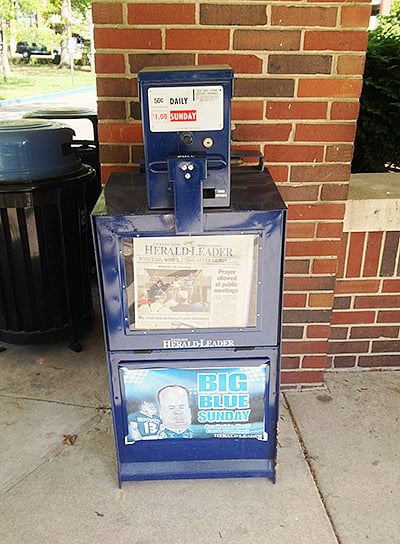
The United States led the way in laying the foundations of journalism. To the nation’s founding fathers, one of the most significant issues was freedom of speech.
U.S. newspaper readership exploded during the 1940s and 50s and continued to grow throughout the 1900s. Between 1940 and 1973, total daily newspaper circulation rose consistently from a yearly total of 41 million to 63 million, according to the Newspaper Association of America.
But U.S. circulation began declining in1987, and in 2012 stood at 44.4 million – its lowest point since 1945, when population was below 151 million barely a third of what it is today, according to the U.S. Census Bureau. In 2010, the U.S. population was nearing 308 million. When economic crisis hit the United States in 2008, it hit the newspaper industry hard.
David Thompson, director of the Kentucky Press Association, said the newspaper industry in Kentucky is stabilizing. “It may not have recovered fully to what print was,” he said. “But it’s still an encouragement.”
Still, he noted, other states have not seen the same upswing. One reason for the decline of print is the shift toward online media.
“I subscribe to the Wall Street Journal online,” said Mollenhauer, adding that she rarely reads a print newspaper.
India’s print industry remains strong
As India’s middle class has grown in the past few decades, the newspaper industry has grown along with it.
Unlike in the United States, Indian newspapers remain attractive for advertisers. The Indian Media and Entertainment Industry Report 2011 says India is one of the world’s largest newspaper markets, with more than 107 million copies circulated daily, accounting for more than one in five dailies across the world. The Times of India is the largest English-language paper in the world, despite the fact that English is not India’s mother tongue.
India’s rising economy also fuels its newspaper industry. In urban India, news websites are fast becoming sources of information, while in smaller cities, newspapers are the dominant player, said Tarun Upadhyay, a Hindustan Times journalist based in Jammu. But as the penetration of online media grows, many experts believe the newspaper industry should tread carefully. According to the Indian Media and Entertainment Industry Report 2013, the recorded growth of print media was 7.3 percent, while digital advertising grew at 40.9 percent. India has to wake up to the importance of this fifth estate — the electronic dissemination of the news, said Suresh Mishra, a former journalist with the Indian Express.
[alert type=”e.g. warning, danger, success, info” title=””]
I get the notifications, like, on my phone, so I read those whenever important stuff is happening –Carlee Schwartz, a student at the University of Kentucky who also reads the Wall Street Journal.
To be a person in society, you need to know what’s going on –Mollenhauer
We need to read news if we want to make sense of the world around us –Nainy Sahani, BBC writer based in Mumbai.
How they consume news will determine which news platforms thrive –Devadas Rajaraman, new media professor at the Asian College of Journalism.
[/alert]
Paolo Hooke, researcher at the University of Sydney, wrote a paper examining how India has moved its content heavily towards entertainment, sports, light news and celebrity journalism. This is a way to attract the younger people who might otherwise move away from traditional media. India will have the world’s youngest population in 2020 – with 55 percent of residents younger than 25, with shorter attention spans and the habit of consuming news on digital devices on the go. “How they consume news will determine which news platforms thrive,” said Devadas Rajaraman, new media professor at the Asian College of Journalism.
Some changes are already visible in the popular national dailies. The Times of India started Alive, augmented reality news applications where readers can scan over a news photo with a mobile phone and see the whole video story. Rajaraman said these efforts are good for the future of print.
Online media brings change
Online news is a growing part of consumers’ media diets in both India and America. Most newspapers have online counterparts, which are becoming not only an asset but a necessity. These sites use social media, video and other multimedia technology to boost readership and tell stories in new ways.


