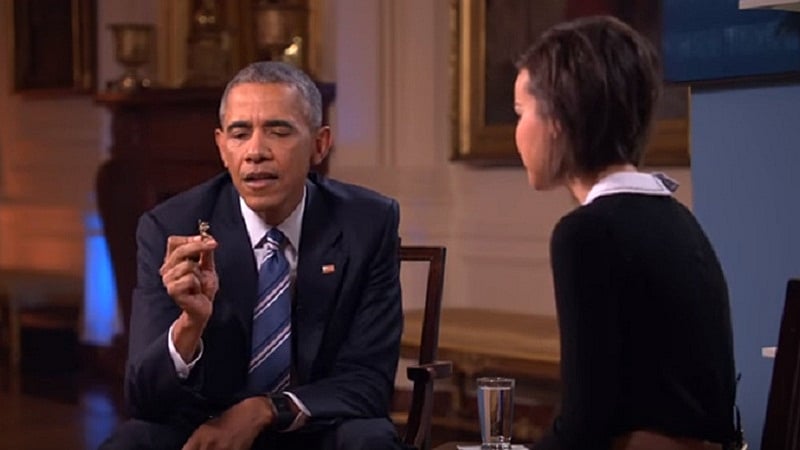
Lord Hanuman is one of the most celebrated gods in the Hindu mythology. We all have grown up watching Hanuman on television. People worship him to gain courage and strength in life. Well, it is not just us who look at Lord Hanuman for help. Even the former President Barack Obama carries a statuette of Lord Hanuman in his pocket and seeks inspiration whenever he feels tired and discouraged. Recently we stumbled upon a video of ‘The YouTube interview with President Obama’. In the video top YouTube creators Destin Sandlin, Ingrid Nilsen and Adande Thorne interview the then President of America Barrack Obama from the East Room of the White House. The interview was streamed live on the official YouTube account of The White House on January 15, 2016.
When Nilsen asked Obama to show off an item of personal significance, Obama pulled a series of small totems from his pocket and said that these things remind him of all the different people he has met along the way. It included rosary beads given to him by Pope Francis, a tiny Buddha statue, a silver poker chip, a Coptic cross and a figurine of Lord Hanuman. The former President also cleared that he is not superstitious. “I carry these around all the time. I’m not that superstitious, so it’s not like I think I necessarily have to have them on me at all times,” Mr. Obama said. He further added, “If I feel tired, or I feel discouraged sometimes, I can kind of reach into my pocket and say yeah, that’s something I can overcome because somebody gave me the privilege to work on these issues that are going to affect them.”
You can watch the video here. (FYI the hanuman part of the video starts at 46:15) :
FYI: Obama lived in Indonesia as a child. Hinduism is one of the six official religions of Indonesia and is practiced by 1.7 percent of the total population.
