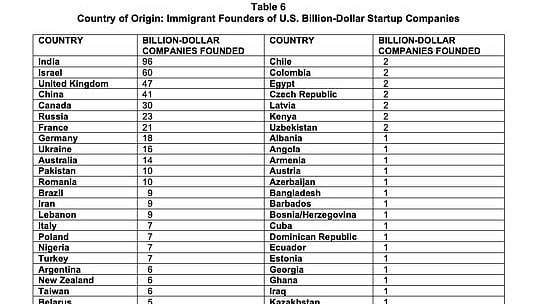
Political commentator and author Richard Hanania has sparked a viral conversation by highlighting a staggering demographic statistic: India has sent 96 immigrants to America who went on to found billion-dollar "unicorn" startups. Pointing out that no other immigrant group comes close to this metric, Hanania used the data to mount a fierce defense of Indian immigration, labeling the diaspora a "holy, special, beautiful people" whom he will "always fight for."
Breaking down the math of high achievement
To contextualise the scale of this achievement, Hanania focused heavily on the proportions. There are approximately 5 million people of Indian descent currently living in the United States. When 96 individuals from that population manage to build companies valued at over $1 billion, it translates to an astonishing ratio: roughly one in every 50,000 Indian immigrants in America is a unicorn founder.
By framing the data this way, Hanania seeks to shift the immigration debate from abstract policy to concrete economic output. He argues that this specific pipeline of talent is a primary engine driving American technological dominance.
Pushing back against right-wing populism
Hanania, who serves as the president of the Center for Study of Partisanship and Ideology (CSPI), is using these figures to wage an internal battle within modern conservative and populist circles. As anti-immigration rhetoric has expanded to target skilled workers and H-1B visa holders, Hanania has used the "96 founders" metric as a shield.
He has bluntly dismissed growing hostility toward Indian immigrants as "the dumbest form of racism," arguing that restricting the very people responsible for America’s high-tech edge is entirely self-defeating. For Hanania, protecting this unique pipeline of innovation is not just a matter of fairness, but a strategic necessity for the future of American progress.

