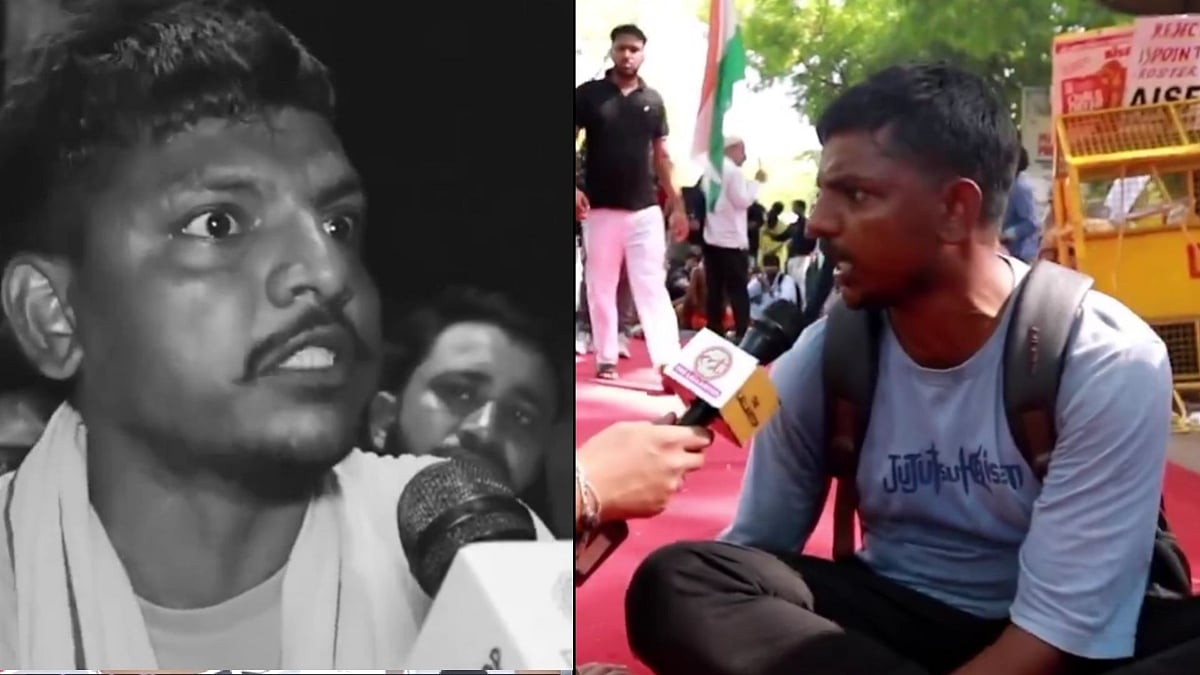
Amid the CJP protests at Jantar Mantar in Delhi, one voice has stood out on social media. Mohammad Irfan, a handcart worker from a Delhi slum, has gone viral after his interviews on social media, not because he belongs to a political party or student organisation, but because of his thoughtful views on issues affecting ordinary people.
Irfan says he attended the protest on his own to speak about the struggles of workers and the underprivileged. He insists that he is not associated with any political group and has no political ambitions.
Self-educated through google
In his interview with The Lallantop, he mentioned that despite never attending school and being unable to read or write, Irfan has found his own way of learning. Using Google Voice Search on his smartphone, he listens to information about history, politics, literature and current affairs.
He says he often verifies information by searching multiple times before forming an opinion. Inspired by Bhagat Singh's ideas, he also listens to poems by Dushyant Kumar and Adam Gondvi, which have shaped his understanding of society and inequality.
Speaking up for workers
At the protest, Irfan raised concerns about the condition of labourers in Delhi. According to him, although government records mention a minimum monthly wage of ₹18,000, many workers receive only ₹13,000 to ₹14,000 despite working 10 to 11 hours a day.
He alleged that unemployment leaves workers with little choice but to accept lower wages. Those who question employers, he claimed, risk losing their jobs. Irfan argued that governments should focus on ensuring labourers receive fair wages instead of offering concessions primarily to large businesses.
He also remarked, "GST is paid even on a daily wage of ₹500," while highlighting the financial burden faced by low-income families.
Sharing his personal struggles
Irfan revealed that he has been dealing with mental stress and depression for the past two years due to financial difficulties and uncertainty about the future.
He also questioned the implementation of the Ayushman Bharat scheme. While acknowledging that many poor people possess Ayushman cards, he claimed the process of getting treatment often involves lengthy paperwork and approvals, making it difficult for patients during medical emergencies.
Committed to non-violence
Irfan says he believes in Mahatma Gandhi's principles of non-violence and peaceful protest. He maintains that he has no desire to enter politics or become a public leader. Instead, he hopes those in power will pay greater attention to the everyday struggles of labourers, slum residents and rural communities, whose voices, he believes, are often overlooked.

