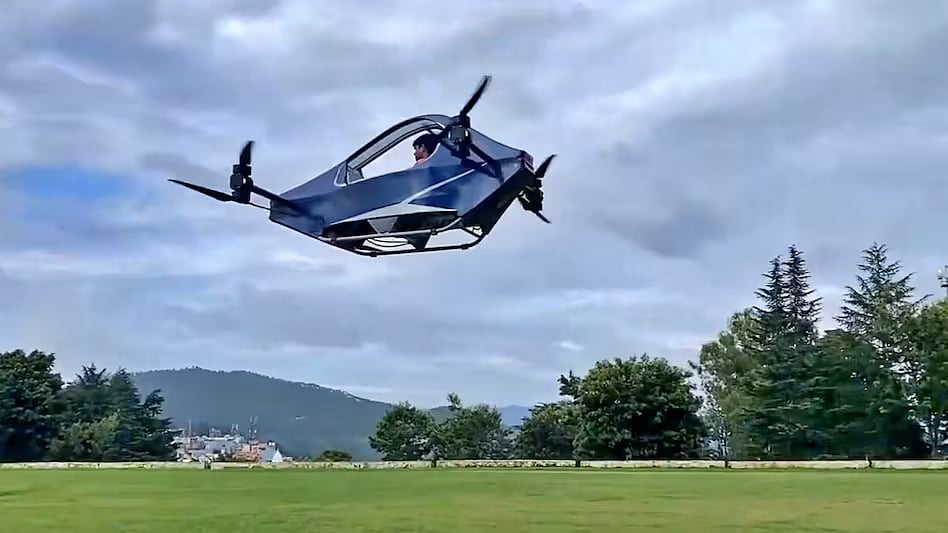
A Bachelor of Arts graduate from Uttarakhand’s Almora district has developed an electric flying car prototype after 13 years of self-learning and experimentation, despite having no formal science or engineering education. Ravi Tamta’s single-seater vehicle, HAPIDA SKYNeX, completed a test flight in August, marking a significant milestone in his journey towards developing personal air mobility.
How Difficult Mountain Journeys Inspired His Dream
Tamta grew up in Kaflikhan, near Jageshwar Dham in Uttarakhand’s Kumaon region. Growing up in the hills, he witnessed the challenges of travelling across winding mountain roads, particularly when reaching essential services such as hospitals required long journeys.
These experiences helped spark his interest in developing a flying vehicle that could potentially make short-distance travel easier in remote areas.
He began pursuing the idea in 2015 through his venture, Hapida Sky Private Limited. Without specialised engineering training, Tamta relied on online resources, repeated experiments and family support to learn about the technology needed to develop his prototype.
What Makes HAPIDA SKYNeX Different?
The single-seater vehicle is designed for vertical take-off and landing, eliminating the need for a conventional runway. It features a lightweight frame, a cockpit and a transparent canopy.
Its propulsion system uses multiple electric motors and propellers, employing technology similar to that found in multirotor drones. The vehicle is battery-powered rather than dependent on conventional aviation fuel.
Although the August test flight represents an important development milestone, further testing would be necessary to establish its range, stability, battery performance and passenger-carrying capabilities.
From Everyday Inventions To Flying Technology
Tamta completed his early schooling in his village before graduating with a Bachelor of Arts degree from the Nainital campus. His father, Harish Ram, works as a mechanic.
HAPIDA SKYNeX is not his first invention. His earlier projects reportedly include mobile phone-charging shoes, a smart walking stick for people with visual impairments, a bamboo-splitting machine and firefighting equipment.

