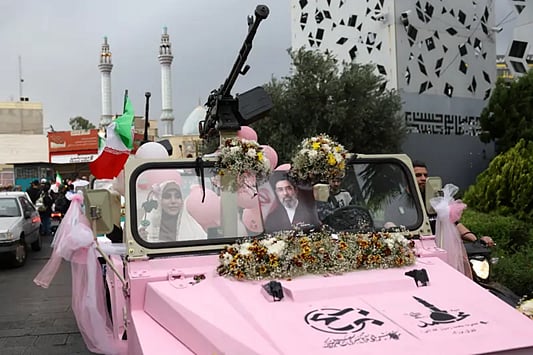
Tehran witnessed an extraordinary public celebration as nearly 1,000 couples tied the knot in a large-scale mass wedding ceremony held across several of the capital’s main squares. Organized under the “Jan-Fada Couples” campaign, the event coincided with the 1st of Dhu al-Hijjah, observed in Iran as National Marriage Day.
The date holds deep religious importance, marking the wedding anniversary of Imam Ali and Fatima, daughter of Prophet Muhammad, a union widely regarded in Islamic tradition as a model of family life and devotion.
City-wide ceremonies mark marriage day
Unlike previous years, authorities implemented a synchronised format that transformed multiple urban hubs into wedding venues simultaneously. Thousands gathered in Tehran’s public squares to witness the ceremonies, which aimed to promote marriage while easing financial burdens faced by young couples.
Rahim Nad-Ali, Cultural Deputy of the Islamic Revolutionary Guard Corps’ Mohammad Rasulullah Corps of Greater Tehran, said the initiative was designed to encourage family formation and reinforce social stability through collective celebrations.
Mass weddings are regularly organized across Iran to help couples avoid the high costs associated with traditional ceremonies, providing logistical support, shared venues, and coordinated celebrations.
Military-themed wedding procession draws attention
One of the most talked-about aspects of the event was its distinctive visual design. Newly married couples were transported in decorated jeep convoys featuring floral arrangements alongside military equipment.
Organizers described the presentation as symbolic, linking everyday social life with national unity and resilience. Officials also referenced the spirit of collective participation seen during the Iran-Iraq War era, emphasizing continuity of life, marriage, and community values.
Main ceremony at Imam Hossein square
The central ceremony began at Imam Hossein Square, where 110 couples recited their marriage vows simultaneously before large crowds. Religious officiants conducted the ceremonies according to Islamic traditions, while parallel wedding rituals were held at Enqelab Square and other designated locations across the city.
Families, residents, and visitors gathered throughout the afternoon to celebrate the couples, turning Tehran’s public spaces into vibrant community venues.
Wedding caravan celebrates across Tehran
Following the formal ceremonies, a festive wedding caravan departed in the evening toward Azadi Square, creating a celebratory procession through the capital. Music, gatherings, and nighttime festivities accompanied the convoy, with crowds lining the streets to congratulate the newlyweds.
The coordinated celebrations continued late into the night, blending religious observance with public festivity.
Encouraging marriage through collective initiatives
The Jan-Fada mass wedding reflects broader efforts in Iran to support marriage amid rising living costs and economic pressures that have led many young people to delay weddings.
Officials described the Tehran event as a successful pilot model, suggesting similar large-scale ceremonies could be expanded to other provinces in the future. The mass wedding ultimately showcased a combination of faith, social policy, and community participation, marking one of the largest coordinated marriage celebrations held in the Iranian capital.

