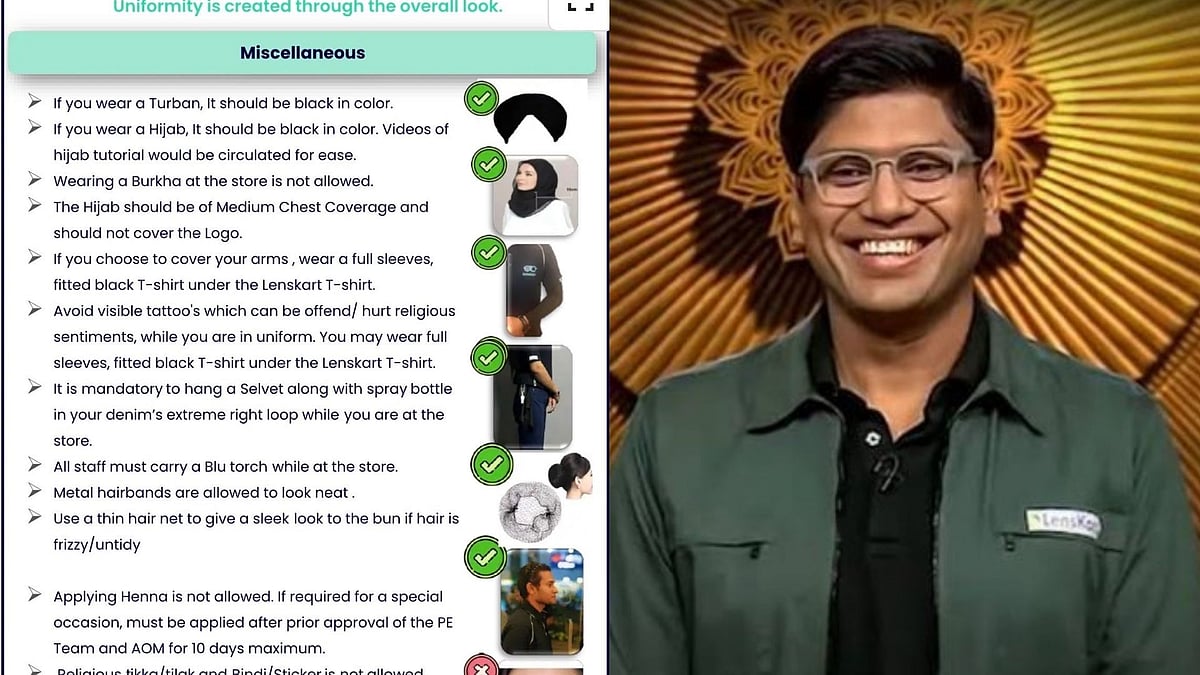
Eyewear brand Lenskart found itself at the centre of an online controversy after a screenshot, allegedly taken from an employee style guide, began circulating widely on social media. The document claimed that certain religious symbols were permitted while others were restricted, prompting questions about workplace equality and religious expression.
The viral image quickly gained traction, with many users debating whether the company’s grooming rules treated different faith practices fairly.
Shefali Vaidya raises concerns
The screenshot was amplified by writer Shefali Vaidya, who shared it online and questioned the alleged policy. In her post, she wrote: “So I confirmed, this is genuine. This is what @peyushbansal tells his employees, hijab is okay, but bindi/tilak/Kalawa is not, for @Lenskart_com, a company that exists in Hindu majority Bharat, where most of the employees and consumers are Hindu! What do you say to this? This is page 11 of the Lenskart style guide for employees.”
Her post drew widespread attention and fuelled heated discussions across platforms.
Social media users react strongly
The controversy triggered a wave of reactions, with several social media users expressing anger and disappointment over the alleged rule.
One user commented: “Hindu employees denied the right to wear kumkum/bindi, while hijab is allowed? Double standards must end."
Another wrote: “Thanks for this information. I will never ever buy any glasses from Lenskart. Recently, family members went to India and had their glasses done there. I’m going to tell them all not to ever spend any money in this anti-Hindu establishment."
A different user said: “Just stupidity. What a shameful company is Lenskart. What’s the harm they see with bindi/ tilak. They want to run business in India and they want to hurt people’s sentiments."
Founder Peyush Bansal issues clarification
Following the backlash, Peyush Bansal addressed the controversy on X (formerly Twitter), stating that the circulating document was outdated and did not reflect current company policies.
He wrote: “I’ve been seeing an inaccurate policy document going viral about Lenskart. I want to speak directly that this document does not reflect our present guidelines. Our policy has no restrictions on any form of religious expression, including bindi and tilak, and we continue to review our guidelines regularly."
Bansal further added: “Our grooming policy has evolved over the years and outdated versions do not represent who we are today. We apologize for the confusion and concern this situation has caused. We as a company, continue to learn and build. Any lapses in our language or policies have and will continue to be addressed."
Emphasising the company’s cultural inclusivity, he also said, “We have thousands of team members across Bharat who wear their faith and culture proudly every day at our stores. They are Lenskart. Lenskart was built in Bharat, by Indians, for Indians. Every symbol and every tradition our people carry is a part of who we are as a company. I will never let that be compromised.”
While the company maintains that its current policies allow all forms of religious expression, the episode reflects growing public scrutiny of brand values, employee inclusivity, and cultural sensitivity in India’s corporate environment.

